Overcoming Perfectionism — When 'Perfect' Blocks 'Start'
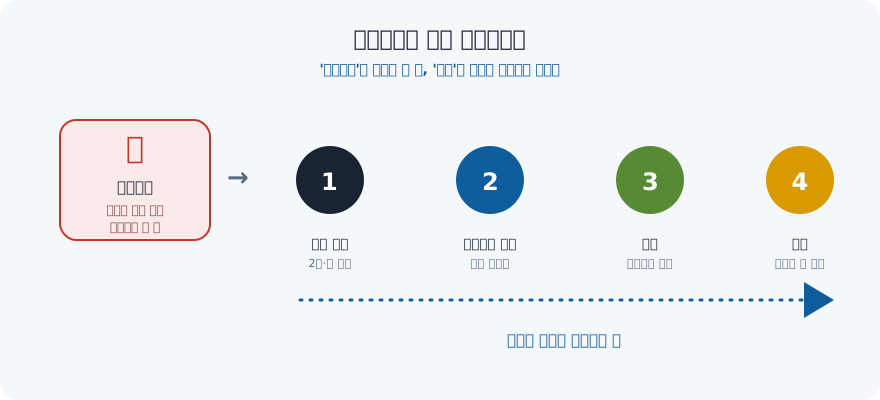
You open the document, the gym app, the blank canvas — and you close it again. Not because you're lazy, but because you can already see how far the result would fall short of the perfect version in your head. So you wait for a better moment, a clearer plan, a stronger mood. That's perfectionism, and it doesn't polish your work. It quietly stops you from ever starting it.
Key takeaways
- Perfectionism isn't high standards — it's fear wearing the costume of high standards
- The higher the imagined bar, the more dangerous the first move feels, so you freeze
- Done beats perfect: a finished rough draft can be improved; a perfect idea in your head can't
- Lower the bar to start, keep the standard for later — action first, polish second
What perfectionism really is
We tell ourselves perfectionism is about caring deeply, about excellence. But look at what it actually produces: unstarted projects, unsent messages, unshipped work. Real excellence ships and improves. Perfectionism protects you from ever being judged by keeping the work invisible. It's fear in disguise — fear of falling short, of criticism, of finding out you're not as good as you hoped. That's why it targets the start most fiercely: as long as you haven't begun, the perfect version is still possible in your mind. It can look identical to laziness from the outside, but the cause differs — you're not out of energy, it's fear wearing the costume of standards, so the fix isn't lowering friction, it's lowering the bar to start.
| Perfectionism | Completion-first |
|---|---|
| "It's not ready yet" | "It's a first draft — of course it's rough" |
| Waits for the perfect moment | Starts in the imperfect one |
| One giant flawless attempt | Many small improvable passes |
| Fear of judgment | Willing to be seen unfinished |
| Nothing ships | Something exists to improve |
Your first draft is supposed to be bad
Here's the reframe that changes everything: the first version of anything is allowed to be terrible. The bad first draft isn't failure — it's the raw material that good work is carved from. You cannot edit a blank page. You cannot improve a run you never went on. Perfectionism skips this stage entirely, demanding the final quality on the first try, which is why it produces nothing at all. Give yourself explicit permission to make something bad, and the start stops being dangerous. (This is self-kindness in practice — see self-compassion.)
Lower the bar to start — not the standard for the end
Completion-first doesn't mean settling for mediocre. It means separating two things perfectionism fuses together: the standard for starting and the standard for finishing. Set the starting bar absurdly low — two minutes, one paragraph, one set. Keep your real standard for the revisions that follow. A finished 60% draft can climb to 90% through editing; a perfect 100% that never leaves your head stays at zero. (Shrinking the first step is exactly how you beat three-day quitting and stack small wins.)
Connect it to your vision, not your fear
Perfectionism pulls your attention onto the flaw right in front of you — this word, this rep, this imperfect detail. The antidote is to lift your eyes to why you're doing it. When a rough draft is a step toward a vision you care about, "not perfect yet" stops feeling like failure and starts feeling like progress. The goal was never a flawless page. It was the finished book, the healthier body, the shipped project — none of which exist without an imperfect first move.
How VisionDream helps you finish
VisionDream is built for completion-first. Instead of one intimidating perfect goal, it breaks your vision into small daily habits you can actually start today, and the Success Tree rewards the streak of showing up — not the flawlessness of each attempt. The Fear Deconstructor helps you name the "what if it's not good enough" thought and take away its power, while the AI Coach nudges you to ship the imperfect draft instead of guarding the perfect idea. Done, repeated, beats perfect, imagined.
So lower the bar, write the bad draft, and let finished be the win. Plant your vision, and the fruit will come. 🌱
Frequently Asked Questions
Why is perfectionism bad?
Because it usually prevents the very excellence it claims to pursue. Perfectionism sets an impossibly high bar for the first attempt, which makes starting feel dangerous, so projects go unstarted and work goes unshipped. It's often fear of judgment disguised as high standards — and unlike real excellence, it never produces anything to improve.
How do I overcome perfectionism?
Separate the bar for starting from the bar for finishing. Give yourself explicit permission to make a bad first draft, then set an absurdly low starting step — two minutes, one paragraph, one set. Keep your real standard for the revisions that follow. A finished rough draft can be improved; a perfect idea stuck in your head can't.
What's the difference between perfectionism and high standards?
High standards push you to improve work that already exists; perfectionism keeps the work from existing at all. Someone with high standards ships a draft and refines it. A perfectionist withholds the draft, waiting for a flawless version that never arrives. The tell is the result: high standards produce and polish, perfectionism produces nothing.
How does VisionDream help?
It's designed for completion-first. VisionDream breaks a big vision into small daily habits you can start today, and its Success Tree rewards the streak of showing up rather than flawless execution. The Fear Deconstructor defuses the 'not good enough' thought, and the AI Coach nudges you to ship the imperfect draft instead of guarding a perfect idea.
Plant a vision, and fruit will surely grow 🌱
Start in the app →Related posts
- 🛡️How to Build Mental Strength — The 4-Week Drill That Starts With Timing Your Recovery
- 🦥How to Overcome Laziness — It's Not a Character Flaw, It's a Signal
- 🪨Grit and Consistency — Why the Person Who Lasts Beats the Talented One
- 🌱Growth Mindset vs Fixed Mindset — The 3 Reactions That Reveal Which One You Have