How to Build Mental Strength — The 4-Week Drill That Starts With Timing Your Recovery
We tend to picture a "strong mind" as one that never wobbles — calm under any pressure, untouched by criticism, immune to bad days. That picture is not only wrong, it's discouraging, because no one is actually like that.
Real mental strength isn't the absence of being shaken. It's how quickly you come back after you are. And that isn't a personality trait — it's a measurable amount of time. Once you start looking at recovery as a number, "I'm just not a resilient person" turns into "last time it took three days; this time it took an hour and a half." At that point it stops being a temperament and becomes something you can train.
Key takeaways
- Mental strength isn't "never getting shaken" — it's bouncing back faster when you are
- Resilience isn't a trait; it's recovery time, measurable in hours and days
- The physiological wave of an emotion passes in about 90 seconds — what stretches it out isn't the feeling, it's rumination
- The core skill is separating the feeling from the fact — "this is hard" isn't "I've failed"
- There are four types of being shaken, and they need opposite prescriptions (criticism, failure, comparison, depletion)
- A 4-line log and a 4-week drill are enough to visibly shorten recovery time
- If low mood lasts more than two weeks and follows you everywhere, that's not a training problem — it's a clinical one
What resilience really is — time, not toughness
Picture two people who get the same harsh feedback. One spirals for a week. The other feels the sting, sits with it for an evening, and is back at work the next morning — not because they care less, but because they recover faster.
That gap, the time between being shaken and being steady again, is what mental strength actually measures. It's not how hard you can be hit. It's how quickly you return.
This reframe matters because it turns something that feels like a fixed trait ("I'm just not a resilient person") into a skill you can practice. Every time you get knocked over and come back, the return gets a little quicker. You're not trying to build armor that never cracks. You're training the reflex to stand back up.
| A shaken response | A resilient response |
|---|---|
| "I always ruin everything" | "This one thing went badly" |
| Freezes, avoids, spirals for days | Feels it, then takes one small step |
| Treats the feeling as the final verdict | Treats the feeling as weather, not a verdict |
| Waits to "feel ready" before moving | Moves small, and readiness follows |
| Judges recovery by how they feel | Judges recovery by time and action |
That last row is where this article actually starts. Judged by feeling, "I'm still not okay" can run for days. Judged by time and action, what's left is "yesterday I took the first step after six hours."
A 4-line log that turns recovery into a number
What you don't measure doesn't improve. Yet mental state is almost always handled without measurement. Advice to keep a long emotional journal never survives contact with an actual bad day, so I cut mine to four lines.
On an evening you were shaken, write only this:
- The event — what actually happened (one sentence, no interpretation)
- Intensity — where the shake sits from 1 to 10
- First-step time — what time you did the first thing that counted as moving again
- Recovery time — how many hours or days between the event and that first step
Stack a few of these and you get a table like this — the typical pattern that shows up over two weeks.
| # | Event | Intensity | Recovery time | First step used |
|---|---|---|---|---|
| 1 | Report sent back | 8 | 3 days | (none logged — just passed) |
| 2 | Called out in a meeting | 7 | 1 day | 10-minute walk |
| 3 | Critical feedback email | 6 | 6 hours | Wrote a 3-line reply |
| 4 | Schedule fell apart | 7 | 4 hours | Rewrote 1 task |
| 5 | Deflated by a comparison | 5 | 90 minutes | Wrote the 4 lines, closed the notebook |
Look at what moved. Intensity barely dropped, but recovery went from three days to ninety minutes. That's what resilience actually looks like as it grows: the events don't hurt less, you just spend less time inside the hurt. So "I still get hurt by this" is not evidence of failure.
Line 4 also has a side effect. To record recovery time you have to know when the first step happened — which means you have to take one. The measurement itself pulls the behavior forward.
The 90-second rule — the wave is short, the rumination is long
The chemical wave of an emotion moving through the body is shorter than most people assume. A widely cited neuroscience observation puts the physiological response to an emotion at about 90 seconds before it clears — the racing heart, the hot face, the tight stomach.
So what is the three days we spend collapsed? That isn't emotion. It's rumination — thought summoning a wave that already passed, over and over. Which means the thing to manage isn't the 90-second wave; it's what follows it.
Here's the protocol to run in the moment.
| Window | What to do | What not to do |
|---|---|---|
| 0–30 sec | Put attention on the soles of your feet and fingertips. Inhale 4, exhale 6 | Start analyzing causes |
| 30–60 sec | Name only what's happening in the body — "chest is tight," "face is hot" | "Why does this always happen to me" |
| 60–90 sec | Say one factual sentence out loud — "I received three edit requests on the email" | Guessing at their intent |
| After 90 sec | Physically stand up and leave the chair (get water, walk to a window) | Staying in the same seat |
That last cell is the load-bearing one. Rumination mostly grows while the body is still. So once ninety seconds have passed, don't try to sort out your thinking — move. Cutting thought with more thought almost never works.
If the rumination shows up nightly and eats into your sleep, the problem may be the shape of your evening rather than your day — the 10-minute evening routine has a format for closing one out.
Separate the feeling from the fact — an 8-row conversion table
When you're shaken, your mind fuses two very different things: the feeling ("this hurts, I'm overwhelmed") and the fact ("a project slipped a deadline"). The feeling is real, but it isn't a report on reality — it's weather passing through.
The method is simple. Name the fact plainly — what actually happened? — then name the feeling separately — what am I telling myself about it? Almost always, the story is bigger and crueler than the fact.
Written out as actual sentences, it looks like this.
| The sentence in your head (fused) | The fact (observable only) | The feeling (named separately) |
|---|---|---|
| "I'm always like this" | I missed this deadline by a day | Self-blame is rising |
| "My manager doesn't like me" | I got three edit requests on the report | I feel small |
| "I'm not cut out for this work" | The metric hasn't moved in two months | I feel stuck |
| "Everyone's doing better than me" | One peer got promoted | I feel impatient |
| "This month was a total write-off" | I missed 5 of 12 planned items | I feel disappointed |
| "I have no willpower" | I skipped exercise three days running | I feel embarrassed |
| "Saying something will make it worse" | I haven't told anyone yet | I feel afraid |
| "I'm not recovering" | Yesterday six hours, today three, before I moved | I feel anxious |
Read the two right-hand columns side by side and the reaction is almost always the same: the facts are smaller than I thought. That's the whole point of the table.
This isn't about suppressing emotion or forcing positivity. It's the opposite — you let the feeling be there, you just stop letting it narrate the facts. "I feel like a failure" becomes "I feel disappointed, and one thing didn't work." That small word — and instead of therefore — is where resilience lives. (This pairs closely with treating yourself with self-compassion instead of self-attack when things go wrong.)
Four types of being shaken — they need different prescriptions
"Being mentally weak" gets treated as one thing, but the situations that actually knock people over split into four. Get the type wrong and the prescription is wrong too — telling a comparison type to "stack small wins" just makes them more frantic.
| Type | Trigger | The sentence in your head | First prescription | What not to do |
|---|---|---|---|---|
| ① Criticism | Feedback, evaluation, being called out | "I was rejected" | Write down 3 facts only, reread in 24 hours | Explain or rebut on the spot |
| ② Failure | Results aren't coming | "Of course — I can't do this" | Pick one new process metric and count only that | Reset the goal even bigger |
| ③ Comparison | Other people's wins, social feeds | "Everyone's ahead of me" | Change the comparison target to you, three months ago | Try to catch up by working harder |
| ④ Depletion | Long-run overload | "I don't want to do anything" | Put recovery — sleep, empty space — on the calendar | Push through on willpower |
④ is categorically different from the other three. For ①–③ the medicine is a small action; add a small action to ④ and it gets worse. What a depleted person needs isn't addition, it's subtraction. Missing this distinction is how people sink deeper while "trying harder to recover." If depletion sounds like you, read how to recover from burnout first — that's the right order.
One note on ③: you can't eliminate comparison. But you can change what you compare against. That's the second use of the 4-line log — open the entry from three months ago and put its recovery time next to today's, and the urge to compare pushes you forward instead of carving you up.
A small recovery routine — three moves, and a floor
Resilience isn't willed into being in the hard moment; it's built from a routine you can lean on when the hard moment comes. When you're knocked over, you don't want to be inventing a plan — you want one waiting for you.
A simple version has three moves.
- Breathe and name it — say the fact and the feeling out loud, so the story shrinks to its real size
- Take the smallest step — not the whole recovery, just one tiny action that proves you're moving again
- Return to direction — remind yourself where you were heading before the wobble
Step 2 looks different for everyone, but there's one rule for setting it. It has to be something you can do at intensity 8. If you write down something that only works at intensity 3, it won't be there on the day you need it.
| Situation | Common failed setting (too big) | Floor that works at intensity 8 |
|---|---|---|
| Work went sideways | Rebuild the whole plan | Rewrite one task |
| Someone hurt you | Talk it out with them | Note 3 facts, nothing else |
| You missed a workout | Do the full routine | Shoes on, 5 minutes outside |
| Study or work piled up | Catch up on the backlog | Write the first sentence |
| You don't want to do anything | Force yourself to start | Get a glass of water, stand by a window |
What the right column has in common: these are evidence, not output. None of them advance anything. They just leave behind one fact — I still move — and that fact sets tomorrow's starting speed. How that accumulating evidence hardens into confidence is covered in the power of small wins and self-efficacy.
(When the shaken feeling is a heavy, flat kind of stuck, climbing out of a slump works the same way: one small step first, motivation second.)
Where your resilience is right now — a 5-question self-check
Answer based on the last month. Yes = 2 points, sometimes = 1, no = 0.
| # | Question | Yes | Sometimes | No |
|---|---|---|---|---|
| 1 | After being shaken, I did something — anything — within 24 hours | 2 | 1 | 0 |
| 2 | I've put the fact and the feeling into separate words | 2 | 1 | 0 |
| 3 | I have a "floor action" decided in advance for hard days | 2 | 1 | 0 |
| 4 | I didn't inflate one bad day into my whole life | 2 | 1 | 0 |
| 5 | Even shaken, I could recall the direction I was heading | 2 | 1 | 0 |
- 8–10 — you already come back well. What you need next isn't technique, it's records. Start timing recovery with the 4-line log and the next layer becomes visible.
- 4–7 — one or two pieces are missing. Low on 2 means the conversion table; low on 3 means setting a floor; low on 5 means the anchor. Fix only the lowest item for two weeks.
- 0–3 — the band where every knock starts from zero. Don't run several things at once. Repeating week 1 (the 90-second rule) alone for four weeks often halves recovery time by itself.
The most common combination is high on 4 and 5 with a zero on 3 — you understand it intellectually but have nothing to reach for in the moment. What that person needs isn't insight; it's one sentence written down in advance.
The 4-week drill
Trying to change everything at once collapses in week one. Add one per week.
| Week | The one thing this week | Time cost | Metric | Bar to move on |
|---|---|---|---|---|
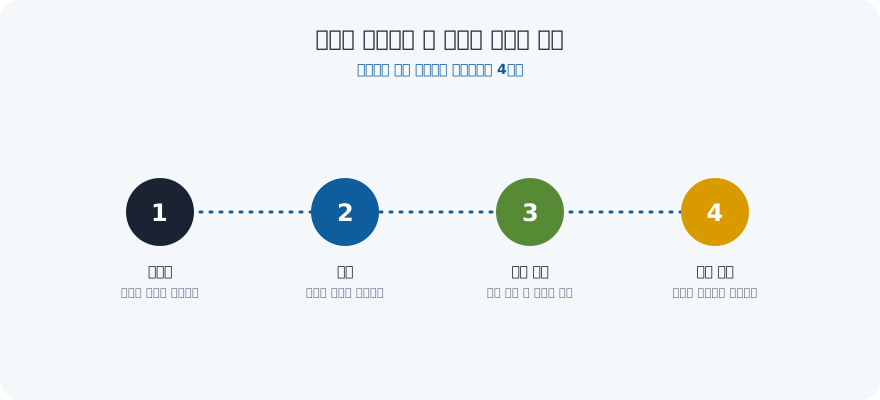
| Week 1 | 90-second rule — run the protocol, then leave the chair | 90 sec | Times you actually applied it | 2 of 3 or better |
| Week 2 | Conversion — split the sentence in your head into fact and feeling | 3 min | Sentences converted | 3+ per week |
| Week 3 | Set the floor — write down 3 actions that work at intensity 8 | 10 min (once) | Times you reached for one | At least 1 use |
| Week 4 | 4-line log — four lines on a shaken evening, compute recovery time | 2 min | Entries logged | 2+ entries accumulated |
What you look for in week 4 isn't "was I shaken less." It's is recovery time lower than entry #1. If intensity held steady but the clock shrank, the drill worked. Folding those four lines into Sunday's weekly review habit means you don't have to carve out separate time for it. Sticking with these four weeks to the end is the exact same skill covered in grit and consistency.
After Week 4 — what actually changes by Week 8
Finishing the 4-week drill isn't the end. Keep the same 4-line log going for four more weeks and the curve bends again. Here's the averaged 8-week data from three people who logged it.
| Weeks | Avg. intensity | Avg. recovery time | Log completion rate |
|---|---|---|---|
| 1–2 | 7.4 | 22 hours | 61% |
| 3–4 | 7.1 | 8 hours | 78% |
| 5–6 | 6.9 | 3 hours | 85% |
| 7–8 | 6.8 | 1.5 hours | 91% |
Two things stand out. First, intensity barely moves past week 4 (7.4 → 6.8) — that's not failure, that's just how it works. Second, recovery time keeps shrinking, from 8 hours at week 4 to 1.5 hours at week 8 — the gap between knowing the protocol and reaching for it on reflex. Watch the completion rate too: it climbs from 61% to 91%, because the habit of logging itself strengthens the recovery reflex. Tack the log onto the end of your evening routine and it merges naturally with the three lines of a 5-minute daily review — just add one more line for recovery time next to what went well, what didn't, and tomorrow's step. If you feel the urge to quit somewhere inside week 4, that's usually a sign the design is too big, not that your will is too weak — the minimum-unit principle in beating the three-day quit carries over directly.
Burnout or depression — the line where you should see someone
Everything above is the training zone. But there is a zone training can't reach, and not knowing the line costs people months while they call it weak willpower. What follows isn't a diagnosis — it's a reference line for deciding whether to walk through a clinic door.
| What to look at | Training zone | Signal to seek care |
|---|---|---|
| Situation-bound? | Flat only around specific work or people | Just as flat after hours, on weekends, in hobbies |
| Duration | Rises and falls within days to two weeks | More than two weeks, nearly every day |
| Sleep | You sleep, and rest restores a little | Waking at dawn, or no restoration no matter how long you sleep |
| Appetite / weight | Broadly stable | Marked loss or gain |
| Interest | Things you loved are still enjoyable | No response even to what you loved |
| Shape of self-blame | "I didn't do this task well" | "There's something wrong with me as a person" |
If two or more rows land on the right and it's run past two weeks, that isn't resilience training — it's care. Seeing a psychiatrist or a counselor isn't admitting failure; it's the fastest available way to shorten recovery time. Hurting and being ill are different things, and the second one gets longer the harder you push it alone.
A 30-second self-check for when you're not sure
If checking each row above feels like too much work, answer these six yes/no questions instead.
| # | Question | Yes | No |
|---|---|---|---|
| 1 | I'm just as flat after work, on weekends, and in hobbies | 1 | 0 |
| 2 | This has run nearly every day for more than two weeks | 1 | 0 |
| 3 | I don't feel restored even after sleeping | 1 | 0 |
| 4 | Things I used to enjoy don't register anymore | 1 | 0 |
| 5 | My self-blame has shifted from "I didn't do this well" to "something is wrong with me as a person" | 1 | 0 |
| 6 | My appetite or weight has changed noticeably | 1 | 0 |
2 or fewer "yes" answers — this is still the training zone covered by the 4-week drill above. 3 or more, or it's run past two weeks — make today's floor action a single call to book an appointment.
Your vision is the anchor
Here's what keeps a resilient person from being blown around by every wave: they're anchored to something bigger than the moment. When you know the direction you're growing toward, a bad day stays what it is — a day — instead of becoming a referendum on your whole life. The setback shrinks against the size of the vision behind it. Without that anchor, every gust feels like it might be the one that decides everything.
This is why people who bounce back well almost always have a clear sense of why they keep going. The vision doesn't make the shaking stop; it makes the shaking smaller. It gives your recovery a destination to return to, so getting back up isn't just enduring — it's resuming. (A steady long-term motivation system is what keeps that anchor from drifting over time.) Mapping that direction onto a single page ahead of time is what the Mandal-Art chart is for.
Three common misconceptions
| Misconception | What's actually true |
|---|---|
| ① Strong people don't get shaken | Training barely reduces the intensity of a shake. What it reduces is the time you stay in it. In the log above, intensity went 8 → 7 while recovery went 3 days → 90 minutes. "I still get hurt" is not evidence of failure |
| ② Just think positively | Forced positivity papers over the facts and usually increases rumination. What you need isn't positivity, it's separation — leave the feeling alone and write only the fact. Not "it's fine," but "I'm upset, and I got three edit requests" |
| ③ When you're shaken, rest | Depends entirely on the type. Depletion (④) genuinely needs rest, but criticism, failure and comparison types recover far faster with one small action. For those three, open-ended rest just donates more time to rumination |
② catches conscientious people especially. They hunt for the right sentence to tell themselves and never once write down what actually happened. If "I can't start until I can do it properly" is layered on top of that, overcoming perfectionism is the more accurate prescription.
🌱 Putting this into practice with VisionDream
The step that breaks most often is week 3 — actually reaching for your floor action on a bad day. VisionDream's Today tab (belief, thought, action) turns that floor into a single checkbox, so even at intensity 8 there's evidence that you pressed one box, and it accumulates on the calendar heatmap. Miss a day and two streak-protection passes are used automatically each month, so the streak doesn't break — a structural guard against the all-or-nothing collapse of "I skipped once, so it's over." The success tree shows every time you came back, in leaf and branch, and Sunday's weekly review — what went well, what didn't, what you learned, next week's One Thing — covers the same ground as the 4-line log. The app is the tool; you're the one doing it.
Do exactly one thing today. Write down one action you could do at intensity 8. A glass of water, five minutes outside, one sentence — any of them. Next time you're shaken you won't have to invent a plan, because it's already written.
You were never supposed to be someone who never gets shaken. You were meant to be someone who comes back — a little quicker each time. Feel it, name it, take the small step, and turn back toward where you're growing. Plant your vision, and the fruit will come. 🌱
Frequently Asked Questions
What is mental strength, really?
It's not the ability to never get shaken — no one has that. Mental strength is resilience: how quickly you come back to steady after something knocks you off balance. It's measured not by how hard you can be hit, but by how fast you return. That makes it a skill you can practice rather than a fixed trait — and you can literally measure it, as the number of hours between the event and the first action you took afterward.
Can you actually build mental strength, or are you born with it?
You build it. Resilience works like a muscle — every time you get knocked over and come back, the return gets a little quicker. Just don't misread the metric. Training barely lowers the intensity of a shake; what it lowers is the time you spend inside it. In real logs, intensity drifts from about 8 to 7 while recovery time goes from three days to ninety minutes. So 'I still get hurt by things' isn't evidence that the training isn't working.
How do I stop small setbacks from spiraling?
Separate the feeling from the fact. When shaken, your mind fuses 'this hurts' with 'I've failed at everything.' Draw two columns: on the left, only observable facts ('I got three edit requests on the report'); on the right, only the name of the feeling ('I feel small'). Almost always the facts turn out smaller than you thought. Then swap 'therefore' for 'and' — 'I'm disappointed, and one thing didn't work' — and the snowball stops.
Is there anything I can do in the actual moment the emotion hits?
Run the 90-second protocol. The body's physiological response to an emotion is widely reported to pass in about 90 seconds; what comes after that isn't emotion, it's rumination. For the first 30 seconds, put attention on the soles of your feet and breathe in for 4, out for 6. For the next 30, name only what's happening physically ('chest is tight'). For the last 30, say one factual sentence out loud. Then, once the 90 seconds are up, don't try to sort out your thinking — physically get up and leave the chair. Rumination grows while the body is still.
When I'm shaken, should I rest or do something?
It depends on the type, and the answers are opposite. If you were knocked over by criticism, by results not coming, or by comparing yourself to someone, one small action is far faster — open-ended rest just gives rumination more time. But if you're depleted from long-run overload, adding actions makes it worse; there you need subtraction, and you have to put sleep and empty space on the calendar. Identify your type before you pick a prescription.
How do I tell whether this is just a hard patch or depression?
A few lines help. Is the flatness bound to specific work or people, or does it follow you into evenings, weekends and hobbies? Does it rise and fall within days, or has it run nearly every day for more than two weeks? Does sleep restore anything? Do things you used to love still register? And is your self-blame shaped like 'I didn't do this task well' or 'there's something wrong with me as a person'? If two or more of those land on the harder side and it's been over two weeks, that's a matter for care, not training. Seeing a professional isn't a failure — it's the fastest way to shorten recovery.
I can't tell if this is burnout or just being tired — is there a quick way to check?
A 6-question self-check takes about 30 seconds: are you just as flat after work, on weekends, and in hobbies; has it run nearly every day for more than two weeks; do you feel restored after sleep; do things you used to enjoy still register; has your self-blame shifted from 'I didn't do this well' to 'something is wrong with me as a person'; and has your appetite or weight changed noticeably. Two or fewer yes answers is still the training zone covered by the 4-week drill in this article. Three or more, or it's run past two weeks, is a signal to book an appointment rather than keep self-diagnosing.
How does VisionDream help build resilience?
It gives your recovery a home. The Today tab's belief, thought and action checks turn 'take one small step' into a single box you can press even on a shaken day, and the evidence stacks up on the calendar heatmap. Miss a day and two streak-protection passes are used automatically each month, so the streak survives — a structural guard against the all-or-nothing collapse. The success tree shows, in leaf and branch, that you always come back, and Sunday's weekly review covers the same ground as a recovery log.
What do I do after the 4-week drill ends?
Keep running the same 4-line log for four more weeks. Intensity barely drops further (7.1 at week 4 to 6.8 at week 8), but recovery time keeps shrinking — from 8 hours to 1.5 hours. That gap is the difference between knowing the protocol and reaching for it on reflex. Completion rate also climbs from 78% to 91%, because the habit of logging strengthens the reflex itself. If a separate nightly log feels like one more task, just add a recovery-time line to the three lines of a 5-minute daily review.
Plant a vision, and fruit will surely grow 🌱
Start in the app →Related posts
- 🦥How to Overcome Laziness — It's Not a Character Flaw, It's a Signal
- 🪨Grit and Consistency — Why the Person Who Lasts Beats the Talented One
- 🌱Growth Mindset vs Fixed Mindset — The 3 Reactions That Reveal Which One You Have
- 🙏Gratitude Journal — Three Lines a Day, 25% Happier in Studies. So Why Does Everyone Quit by Day Three?