Deep Work — How to Focus Deeply in a Distracted Age
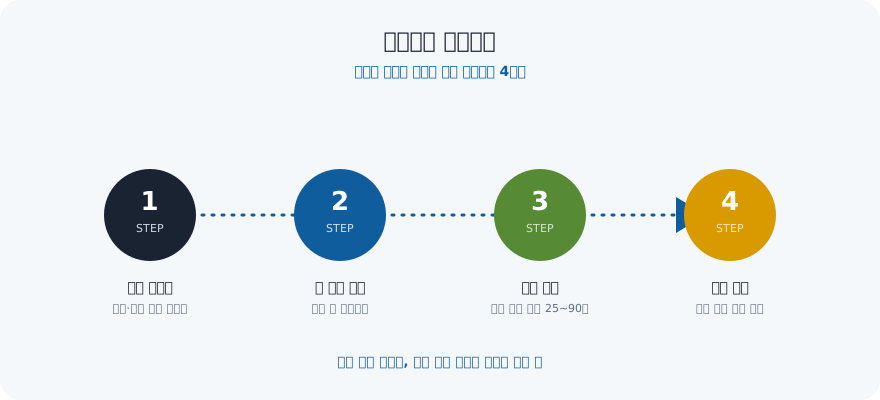
You sit down to do the one thing that matters, and within ninety seconds your hand reaches for your phone. It's not weak willpower — it's a world engineered to interrupt you. Every ping, tab, and notification is a tiny invitation to leave. Deep work is the skill of staying: giving your most important task your full, unbroken attention long enough to actually get somewhere. And unlike talent, it's something you can set up on purpose.
Key takeaways
- Focus is less about willpower and more about removing distractions before you start
- Deep work means one hard task, no switching, for a protected block of time
- Every task-switch costs a "reset tax" — doing one thing at a time is faster, not slower
- A focus block only sticks when it's tied to a vision you actually care about
- One notification doesn't cost you 30 seconds — it costs the 20+ minutes it takes to get back in
- Don't start at 90 minutes. Start at one 25-minute block; three weeks gets you to 90
- Don't count the days you missed — just never miss twice in a row
You've been at your desk for thirty minutes and you're still on the same paragraph. Leaving feels wrong, so the screen stays on and the hour disappears. You call it a focus problem, but most of the time it's an environment and sequence problem. What decides your output isn't how many hours you sat down — it's how many of those minutes went uninterrupted. Follow the order below and you can build one clean 25-minute block today.
Why you can't focus (it's not just you)
The average knowledge worker checks messages every few minutes, and each interruption doesn't just cost the seconds you're away — it costs the several minutes it takes your brain to climb back into the task. Researchers call this "attention residue": part of your mind is still on the last thing. Stack up enough interruptions and you spend the whole day busy but shallow, never dropping into the depth where real work happens. The fix isn't trying harder in a noisy room — it's changing the room.
| Shallow work | Deep work |
|---|---|
| Reacting to whatever pings | Choosing one task on purpose |
| Many things, half-attention | One thing, full attention |
| Feels busy, moves little | Feels calm, moves a lot |
| Interrupted every few minutes | Protected block, no switching |
What losing focus actually costs
"I'll just check it quickly" is why an entire day ends up shallow. A few numbers that keep showing up in the research:
| What you assume | What actually happens |
|---|---|
| "Checking a notification takes ten seconds" | In workplace observation by Gloria Mark's team at UC Irvine, getting fully back to an interrupted task took over twenty minutes on average |
| "I finished that, so I've moved on" | Sophie Leroy named it "attention residue" — part of your mind stays on the previous task and degrades the next one |
| "Two things at once means twice the output" | Task-switching research summarized by the American Psychological Association found a large share of productive time — up to roughly 40% in some studies — simply disappears |
| "My phone is face-down, so it's fine" | Experiments found that merely having a silent phone on the desk reduced available cognitive capacity |
So if you checked notifications six times today, you didn't lose six minutes — you lost the two hours it took to climb back in each time. Flip that around: kill six interruptions and you've found two hours that didn't exist before. That's the real return on deep work.
Step 1 — Clear the distractions first
Willpower is a bad bouncer. Instead of resisting your phone all afternoon, make the distraction physically harder to reach: phone in another room, notifications off, unrelated tabs closed. The goal is a workspace where the easiest thing to do is the thing you meant to do. You're not fighting temptation — you're removing it before it starts. (This pairs naturally with protecting your calendar with time blocks — the block sets when, this clears the space.)
You can't clear "distraction" in the abstract. Each type needs its own fix.
| Distraction | Don't | Do instead (30 seconds) |
|---|---|---|
| Phone | Flip it face-down and "resist" it | Another room, or the bottom of your bag. If you can't reach it, you've won |
| Chat & email | Keep it open to "reply fast" | Close the window; fix check-in times between blocks (e.g. 11:00, 15:00) |
| Browser tabs | Leave things open for later | Three tabs max for this task; everything else goes to read-later |
| People interrupting | Answer every time, instantly | One sentence — "let me finish this, I'll come by in ten" — plus headphones or a different seat |
| Your own stray thoughts | Handle each one as it arrives | Keep paper beside you. Write one line, deal with it after the block |
| Noise | Music with lyrics | Instrumental or white noise. Reuse one familiar track as your "focus starts now" cue |
Pick one row and do it today. For most people it's the first one — moving the phone out of arm's reach — that changes how the hour feels. If the resistance is really about starting at all, read how to stop procrastinating first.
Step 2 — Choose one thing, and protect the block
Multitasking feels productive and is mostly an illusion. Every switch pays a "reset tax" as your brain reloads context. So pick a single task, decide how long you'll stay with it — twenty-five minutes, sixty, ninety — and treat that window as a real appointment. This is exactly what a Pomodoro timer does: it turns "focus for a while" into a concrete, finish-able block. During the block, "done" means the timer, not the task feeling finished.
A 90-minute block, minute by minute
"I should focus more" isn't a plan. Lay the block out in minutes and the resistance to starting nearly vanishes.
| Segment | Minutes | What you do | If you skip it |
|---|---|---|---|
| Setup | 0–5 | Write the output of this block in one sentence ("draft through paragraph 3") · phone away · three tabs | You burn twenty minutes on "where do I start" |
| First push | 5–30 | Start with the hardest chunk. No lookups — leave a "[check later]" marker and keep going | You do the easy admin and the block ends |
| Cruise | 30–75 | The stretch where it flows. Don't look at the clock | One "quick check" leaves residue for the rest |
| Close | 75–85 | Write the first sentence you'll pick up next time | Your next block pays the twenty-minute entry cost again |
| Recovery | 85–100 | Stand up, look out a window, drink water. No screens | The next block is fog, not depth |
The part almost everyone skips is the ten-minute close. Most people just shut the laptop at the end. Leaving one line — "next: start here" — cuts the entry cost of your next block from twenty minutes to about one. That single line is what makes deep work repeatable daily.
Three weeks to a focus muscle — start at 25 minutes
Go straight for 90 minutes and you'll usually quit by day two. Focus behaves like fitness: there's an order to increasing it.
| Week | Daily target | Success means | Common trap |
|---|---|---|---|
| Week 1 | 1 × 25 minutes | You didn't touch your phone once | "That's too easy" — it isn't. The goal right now is unbroken, not long |
| Week 2 | 1 × 50 minutes | You didn't open an unrelated tab | It's going well, so you jump to three blocks a day |
| Week 3 | 1 × 90 minutes (+ one 25) | You leave the next first sentence in the close | Skipping the whole thing on a low-energy day |
After three weeks, stop extending and lock the time slot instead. A fixed hour means you don't have to make the decision to start all over again every day. Those accumulating small wins are what build the sense that you're someone who can focus.
Lock the block with an implementation intention
The "implementation intention" formalized by psychologist Peter Gollwitzer changes follow-through with a single sentence: "I will do [what] at [when] in [where]."
| Vague plan (fails) | Implementation intention (works) |
|---|---|
| Focus on the report tomorrow | I will draft three paragraphs of the report Tuesday at 9:10 in meeting room B |
| Study a bit in the evening | I will do two workbook pages at 8pm at the kitchen table, phone in the bedroom |
| Look at the proposal sometime | I will finish the proposal outline Thursday at 14:00 at the café window seat |
Take the one thing you're avoiding, rewrite it in that form, and stick it on your phone's lock screen note. Thirty seconds.
Step 3 — Rest on purpose, then go again
Depth isn't sustained by grinding without pause — it's sustained by rhythm. After a focus block, take a real break: stand up, look away from screens, let your mind idle for a few minutes. This isn't wasted time; it's what lets the next block be deep instead of foggy. Deep work is a wave, not a wall — focus, recover, repeat. (When even the recovery feels impossible, that's a sign to read beating a slump before pushing harder.)
Step 4 — Aim your focus at something that matters
Here's the part most focus advice skips: technique alone won't hold. You can silence every notification and still drift, because your attention quietly asks why does this matter? Deep work is easiest when the task in front of you is clearly a step toward a vision you care about. When today's focus block is visibly building next year's goal, staying becomes a choice you want to make, not one you have to force. (This is the "why" that keeps a motivation system running when the novelty fades.)
Deep work when you don't have a free hour
Most days you can't find 90 minutes. The rules stay the same; only the length changes.
| Your situation | Block design | What goes in it |
|---|---|---|
| Meetings chop up your day | Book one 50-minute block right after you arrive | The one output that has to survive today |
| Student before exams | 3 × 25 minutes, five-minute gaps | Weakest topic first. Easy subjects live outside the blocks |
| Parenting / working from home | One 30-minute block after bedtime | Only work that needs judgment. Routine tasks fill the scraps |
| A week of late nights | Defend 90 minutes twice a week | Other days, a 15-minute minimum keeps the streak alive |
Spend the time outside your block shallow and guilt-free. The point of deep work isn't to make the whole day deep — it's to secure one deep stretch per day.
Half of deep work is when — a time-of-day placement table
The same ninety minutes produce different work depending on where you put them in the day. Most people sell their best cognitive hours to replies, meetings, and admin, then push the hardest task into whatever is left over.
| Time of day | What your brain is usually doing | Put this here | Never put this here |
|---|---|---|---|
| 1–3 hours after waking | Judgment and focus at their daily peak | The one hard thing that has to survive today (draft, design, problem-solving) | Email triage, chat replies |
| Late morning (around 11) | Still good, but interruptions have started arriving | A second block, or the close-out of block one | Starting an entirely new topic |
| Right after lunch (1–3pm) | The daily low point in alertness | Repetitive work your hands already know — collecting, filing, formatting | Creative judgment, decisions that are hard to undo |
| Late afternoon (3–5pm) | Alertness recovers; deadline pressure helps | Execution work with a defined finish | Open-ended exploratory work |
| After 8pm | Self-control resources are running thin | A 15–30 minute minimum version, review | Attempting 90 minutes — it usually ends on your phone |
Only one habit really has to change here: stop selling your best hours first. The moment you open your inbox on arrival, your sharpest stretch gets filled with other people's priorities. And if it's specifically your evening block that collapses every time, the problem may not be focus at all — see how to break phone addiction with structure, because forty minutes after 11pm quietly shaves the next morning's block too.
The recovery 15 minutes — real rest vs. fake rest
A break between blocks isn't graded on whether you rested. It's graded on whether the next block went deeper. Same fifteen minutes, opposite outcomes.
| What you did on the break | What actually happens in the next block |
|---|---|
| Stand up, walk, look out a window, drink water | Alertness recovers; you're usually back under within a minute or two |
| Three minutes with your eyes closed, light stretching | Eye strain clears — the difference is largest in afternoon blocks |
| A 10–20 minute nap (never past 20) | Rescues the post-lunch trough. Past 30 minutes you come back heavier |
| Scrolling social or short video | Fresh stimulus becomes residue; re-entry costs ten extra minutes or more |
| Checking news or email | Leaves open loops running in your head that eat into the next block |
| Just sitting at the screen | You never rested, so the second block is shallow end to end |
The rule is one line: no screens in the break. One of the most common reasons deep work fails isn't the block — it's what happens between blocks.
Measurement — a four-line block log is enough
Managed by feel, focus is always either over- or under-estimated. Spend thirty seconds when the timer ends.
| What you log | Example | What it tells you |
|---|---|---|
| Start time | 09:10 | What time your block actually opens |
| Output in one sentence | Draft, 3 paragraphs | Separates "I sat there" from "I moved" |
| Number of interruptions | 2 | Whether your distraction blocking is working |
| Next first sentence | "Start with the evidence for item 3" | Your next block's entry cost |
After about four weeks, read it like this.
- If more than half your blocks have zero interruptions, distraction blocking is working — now you may extend the length
- If interruptions stay at two or more, don't extend anything; go back to the distraction-type table above
- If your start time swings by more than thirty minutes a day, fix the hour first with time blocking, not the length
Those four lines become the raw material for your Sunday weekly review. Nothing else needs writing up.
One caveat about the log: if your blocks are deep but your reviews still say "middling," the bottleneck isn't focus — it's that nobody can see the work in flight. That's a different fix, laid out in a top performer isn't the fastest worker.
The three ways deep work collapses
- You book it too long. Ninety minutes is the destination, not the starting line. Begin at 25 and buy "unbroken" first.
- You sit down without an output. Not "study" but "finish through page 3" — an ending your brain can see keeps it from wandering.
- One missed day becomes the end. Habits don't break because you skipped once; they break when you skip twice in a row. One rule: never miss two days back to back. If today is that second day, do the 15-minute minimum right now and the streak survives. If you've already lost a few days, beating laziness and rebuilding focus are the way back.
🌱 Doing this in the VisionDream app
The principles above are built into the app. In the Today tab (B·T·A), setting your weekly One Thing decides in the morning which block you have to protect, and the habit check plus calendar heatmap show you not "how many minutes" but "how many days in a row." When you miss a day, a streak shield (two per month, applied automatically) keeps the run alive — so the "never twice in a row" rule enforces itself inside the app. Sunday's weekly review shows whether your best hours went to your deepest work, and your success tree grows with every day you keep. The app is the tool; you're the one doing it.
How VisionDream helps you go deep
Focus fails when today's task floats free, disconnected from anything larger. VisionDream connects each daily task to the goal above it and the vision above that — so when you sit down for a focus block, you can see exactly which dream it's feeding. Your habit tracker turns "do deep work" into a streak you can protect, and your weekly review shows whether your best hours went to your deepest work or leaked into the shallows.
So clear the noise, pick one thing, and give it your best hour. Half of how deep your day goes was actually decided the night before — if you want the next step, read the 10-minute evening routine.
Here's your one task today. Set a 25-minute timer, put your phone in another room, write your one-sentence output, and start. Protect that single block and day one of the three-week plan is done. Depth is a setup, not a superpower. Plant your vision, and the fruit will come. 🌱
Frequently Asked Questions
What is deep work?
Deep work is focusing on a single cognitively demanding task without switching or interruption, for a protected block of time. It's the opposite of shallow work — reacting to messages and juggling many things at half-attention. Deep work is where meaningful progress actually happens, and it's a skill you set up on purpose by removing distractions.
How can I improve my focus?
Start by removing distractions before you begin, not resisting them mid-task: phone in another room, notifications off, unrelated tabs closed. Then choose one task and protect a set block of time — 25, 60, or 90 minutes. Rest on purpose between blocks, and connect the task to a vision you care about so your attention has a reason to stay.
How does deep work relate to the Pomodoro technique?
Pomodoro is one practical way to do deep work. It turns 'focus for a while' into a concrete block — usually 25 minutes of single-task focus followed by a short break. The Pomodoro timer handles the 'how long,' while deep work adds the 'clear distractions first' and 'do one thing' principles that make the block actually deep.
How does VisionDream help with focus?
VisionDream connects each daily task to the goal and vision above it, so a focus block is visibly building a dream you care about — which is what keeps your attention from drifting. Your habit tracker turns deep work into a streak, and the weekly review shows whether your best hours went to your deepest work. On a day you miss, one of your two monthly streak shields is applied automatically so the run doesn't break.
How many hours of deep work per day is right?
If you're starting out, do one 25-minute block and make 'unbroken' the goal before length. Move to 50 minutes in week two and 90 in week three — that's enough. Even trained practitioners can usually sustain only about three to four genuinely deep hours a day, so instead of aiming higher, lock the same time slot and repeat it daily. Consistency beats volume here.
What do I do on a day I simply can't focus?
Shorten it and keep the thread alive. A 15-minute minimum version that produces one line still preserves the streak. The rule is simple: never miss two days in a row. Habits don't break from one skipped day — they break on the second. And if the fog lasts for weeks, it may not be a focus problem at all but a sleep and recovery problem, so check your evening routine first.
Can I listen to music during deep work?
Music with lyrics competes for the same language resources you need for writing and reading, so it hurts on verbal tasks. Instrumental music or white noise is safer, and reusing the same track every time turns it into a 'focus starts now' cue that lowers the resistance to starting. Spending five minutes picking a song, on the other hand, is itself a distraction.
The timer ended but the work isn't done — should I keep going?
Stop when the timer stops, and use the last ten minutes to write the first sentence you'll pick up next time. The pull to ride the momentum is strong, but a second block bolted on without recovery is usually shallow. And that one line cuts your next block's entry cost from twenty minutes to about one.
I'm not a morning person — do I have to do deep work in the morning?
No. What matters isn't the clock, it's the window 1–3 hours after you wake. If you sleep late, your morning may be 11am, and that's the stretch to spend on hard work. Two rules hold regardless of schedule: don't put creative judgment in the one-to-two-hour trough right after lunch, and don't attempt 90 minutes after 8pm — keep the streak alive with a 15–30 minute minimum instead. Long blocks scheduled when self-control is thin tend to end on your phone.
Is a quick scroll through social or YouTube during a break really that bad?
If the point of the break is that the next block goes deeper, then yes, leave the screen out. Short video and social feeds deliver fresh stimulus, and that stimulus lingers as attention residue that costs you ten extra minutes to re-enter. Screen-free recovery — walking, looking out a window, a glass of water — has you back under in a minute or two. In the post-lunch trough, a nap of no more than twenty minutes is another good option.
Plant a vision, and fruit will surely grow 🌱
Start in the app →Related posts
- 🧭A Top Performer Isn't the Fastest Worker — It's the Most Predictable One
- 🧠How to Improve Focus — Diagnose 3 Root Causes, Then Train for 4 Weeks
- ⏱️Time Blocking — Why Your To-Do List Keeps Failing You (The 60/40 Rule and a 5-Step Day)
- 📲Goal-Tracking Apps — How to Pick One and Actually Finish Your Yearly Goals