Gratitude Journal — Three Lines a Day, 25% Happier in Studies. So Why Does Everyone Quit by Day Three?
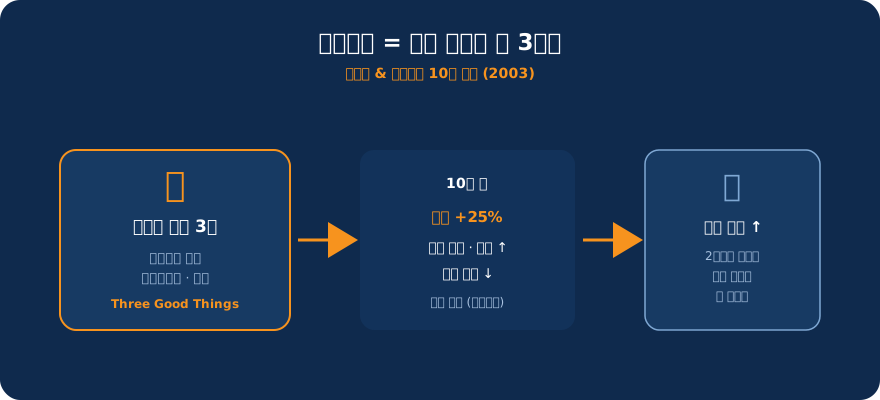
You've probably been told to "count your blessings." It sounds like a fridge magnet — the kind of soft advice you nod at and forget. Except a gratitude journal is one of the most rigorously tested habits in all of psychology, and the results are almost annoyingly good. In Robert Emmons and Michael McCullough's landmark study, people who simply wrote down a few things they were grateful for each week ended up 25% happier after ten weeks — and they also slept better, exercised more, reported fewer physical complaints, and made more progress toward their goals. Three lines. No app required, no cost, no talent. So why does almost everyone start one, feel good for three days, and then quietly stop? Let's fix that.
Key takeaways
- A gratitude journal means regularly writing a few specific things you're thankful for — that's the whole method
- Emmons & McCullough (2003): the weekly-gratitude group was ~25% happier after 10 weeks, slept better, and moved further toward their goals
- Specificity beats quantity — "my friend called to check on me" works; "my family, my health" doesn't
- Most people quit because it turns into a vague, repetitive chore — the fix is a fixed cue and concrete entries
- Written once and forgotten does nothing; gratitude works as a repeated habit, not a one-time inspiration
What is a gratitude journal, exactly?
A gratitude journal is a simple, recurring practice: you write down a handful of things you feel grateful for. That's it — there's no correct format, no required app, no minimum word count. The most-studied version is almost comically plain: "Three Good Things" — each day, jot down three things that went well and why. Some people do it in a notebook, some in a notes app, some out loud. What makes it a journal rather than a passing thought is the two things that give it its power: it's written down, and it's repeated. The writing forces your attention to actually land on the good thing instead of skimming past it; the repetition is what compounds a nice moment into a measurable shift in mood.
Does it actually work, or is it just positive thinking?
This is where gratitude journaling separates itself from ordinary self-help. In 2003, psychologists Robert Emmons and Michael McCullough ran a now-famous experiment (Counting Blessings Versus Burdens): they split people into groups who each week wrote down five things — one group listed things they were grateful for, another listed hassles, another listed neutral events. Ten weeks later, the gratitude group was about 25% happier, exercised more, had fewer physical symptoms, and felt more optimistic about the week ahead. A later meta-analysis of 38 trials found gratitude practices meaningfully reduced depressive symptoms. And — the part that matters most here — participants keeping gratitude lists made more progress toward their important personal goals over the following two months. Gratitude isn't just a nicer mood; it quietly moves you forward. That's not positive thinking. That's a measured effect, repeated across studies.
Why does almost everyone quit by day three?
If it's this good and this easy, why does the average gratitude journal die within a week? Three predictable reasons — and each has a fix.
It gets vague. By day three you're writing "my family, my health, my home" on autopilot. Your brain has stopped searching, and the effect lives entirely in the search. The fix is specificity: not "my friend," but "my friend texted at exactly the moment I felt alone." One concrete, freshly-noticed thing beats five recycled categories.
It has no anchor. You meant to do it "sometime," and sometime never came. Gratitude journaling needs a cue — bolt it onto something you already do without fail, like the last thing before you close your eyes. Making it part of an evening routine is the single highest-leverage move for keeping it alive.
It feels like homework. If it becomes one more box to grind through, resentment wins. Keep it small — three lines, sixty seconds. The goal isn't a beautiful diary; it's the daily rep. This is the same reason small wins beat grand resolutions: consistency at a tiny scale outperforms intensity you can't sustain.
How to keep one that actually lasts
Start absurdly small and specific. Three things, once a day, tied to a fixed moment — most people do best right before sleep. Write why each one mattered, even in four words, because the "why" is what makes your brain re-experience it. On flat, gray days — the ones where you're sure you've got nothing — write the small stuff anyway: warm water, a working streetlight, a message you'd forgotten. Those days are exactly when the practice does the most work, because it's training your attention to find good things when they aren't obvious. And when you inevitably miss a day, skip the guilt spiral; a little self-compassion is what keeps one missed night from ending the whole habit. To go deeper, pair your daily gratitude with a weekly review: the day-to-day catches the small joys, the weekly look-back connects them into a story of a life that's actually moving.
How VisionDream keeps your gratitude from fading
The reason most gratitude journals fail isn't the idea — it's that a blank notebook has no memory and no nudge. VisionDream turns the one-off practice into a habit that holds. Log gratitude as a daily habit and it gets a cue and a check, so "I meant to" becomes "done" — and every check grows a leaf on your Success Tree (S = B·T·A), turning an invisible practice into visible proof you kept showing up. On the empty days, the AI coach asks the one gentle question that unsticks you — "what's one small thing that went right today?" — so you rarely stare at a blank page. And because Emmons found gratitude moves people toward their goals, VisionDream keeps that thread visible: your gratitude sits right beside the goals and habits it's quietly fueling. Notice the good, on purpose, every day — and let it compound. Plant your vision, and the fruit will come. 🌱
Frequently Asked Questions
What is a gratitude journal?
A gratitude journal is a simple, recurring practice of writing down a few things you feel grateful for. There's no required format or app — the most-studied version is 'Three Good Things,' where each day you write three things that went well and why. What gives it its power is that it's written down (which forces your attention onto the good thing) and repeated (which compounds a nice moment into a measurable mood shift).
Does keeping a gratitude journal actually work?
Yes, and it's unusually well-tested. In Emmons and McCullough's 2003 study, people who wrote down things they were grateful for each week were about 25% happier after ten weeks, exercised more, had fewer physical symptoms, and were more optimistic. A meta-analysis of 38 trials found gratitude practices reduced depressive symptoms, and participants keeping gratitude lists also made more progress toward their personal goals over two months.
How do I write a gratitude journal so it lasts?
Keep it small and specific: three things, once a day, tied to a fixed moment like right before sleep. Write why each one mattered, and be concrete — 'my friend texted right when I felt alone' beats 'my friends.' Anchor it to an existing routine so it has a cue, keep entries to about sixty seconds so it never feels like homework, and skip the guilt when you miss a day so one missed night doesn't end the habit.
Why do most people quit their gratitude journal?
Three reasons. It gets vague — by day three you're recycling 'my family, my health' on autopilot, and the effect lives in actively searching for something new. It has no anchor — 'sometime' never comes, so it needs to be bolted onto an existing habit. And it feels like homework when it grows too big. The fixes are specificity, a fixed cue, and keeping it to three quick lines.
Plant a vision, and fruit will surely grow 🌱
Start in the app →Related posts
- 🛡️How to Build Mental Strength — The 4-Week Drill That Starts With Timing Your Recovery
- 🦥How to Overcome Laziness — It's Not a Character Flaw, It's a Signal
- 🪨Grit and Consistency — Why the Person Who Lasts Beats the Talented One
- 🌱Growth Mindset vs Fixed Mindset — The 3 Reactions That Reveal Which One You Have