The Evening Routine — Ten Minutes Tonight Decides Tomorrow Morning (4-Step, 10-Minute Checklist)
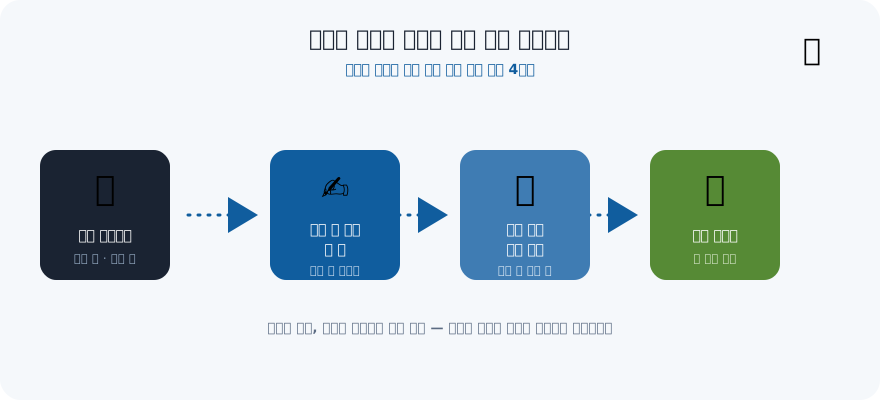
Ten minutes tonight decides tomorrow morning.
If your mornings keep falling apart, the problem usually isn't your willpower at 6am — it's what happened at 11pm the night before. The night you got into bed, said "okay, sleep now," picked up your phone, and put it down forty minutes later. The night you technically slept seven hours and woke up heavier. The weekend you rested and still hit Monday empty. It isn't that rest doesn't work on you — it's that you rested in a way that doesn't restore.
A calm, deliberate evening does the opposite: it decides your morning before you're even awake. This is the routine nobody posts about, and it's the one that actually works. And it isn't an hour-long ritual — ten minutes is enough.
Key takeaways
- A good morning is built in ten minutes the night before, not willed into being at dawn
- The four-step timebox: tomorrow's first action 3 min → screens off 4 min → close today 2 min → vision 10 sec (9 minutes 10 seconds in total)
- The highest-leverage move is writing one concrete first action for tomorrow as a sentence
- The same seven hours land differently after a draining night versus a restoring night — and four countable numbers tell you which one you had
- Three sizes of the same routine — 30 / 15 / 5 minutes — chosen by how tired you are, never by how motivated you feel
- Late shift, parent, night owl — the clock changes, the closing sequence doesn't
- Log five numbers for fourteen nights and you'll see exactly which step you keep skipping
Why the night decides the morning
Willpower is lowest exactly when the morning demands it most — the moment the alarm rings. If you leave every decision for then (What do I wear? What do I start with? Where's my bag?), you're spending scarce morning energy on choices you could have made the night before. The evening routine moves those decisions to a calmer moment, so your morning-self just follows a plan instead of inventing one. (The morning routine still matters — see the miracle morning system — but this is the half that makes it possible.)
| A rushed night | A deliberate evening |
|---|---|
| Scroll until you crash | Screens off, lights down |
| Wake to a blank, anxious morning | Wake to a first action already chosen |
| Today's loose ends spill into tomorrow | Today closed in two minutes |
| Mornings run on willpower | Mornings run on a plan |
A restoring night vs a draining night — same seven hours, different results
"I rest and never feel recovered" is usually accurate. The issue isn't the length of your sleep, it's the kind of night in front of it. What you do in the last hour before bed decides whether those seven hours are recovery or just pause.
| A draining night | A restoring night | |
|---|---|---|
| Last hour | Phone, video, work chat, in bed | Screens off, lights down, one line for tomorrow |
| Mental state | Unfinished tasks still open | Today closed, tomorrow booked |
| Time to fall asleep | 30–40 minutes of turning over | Asleep within 10–15 minutes |
| First 30 min tomorrow | Re-deciding "what do I start with?" | Just doing the action you wrote |
| After a weekend off | Rested, yet empty again by Monday | The rest actually carries into next week |
The fix isn't more hours of rest, it's a procedure for closing the day. If you're already deeply depleted, recovery comes before routine — start with how to recover from burnout.
The four numbers that tell you what kind of night you had
"Restoring" and "draining" sound like feelings. They aren't — you can count them. Tomorrow morning, before you open anything else, write down these four numbers for last night. Thirty seconds, four digits. They'll tell you more than a sleep-tracker graph will, because each number points at one specific step you can fix tonight.
| # | The number | Where you get it | Draining night | Restoring night | The step that fixes it |
|---|---|---|---|---|---|
| 1 | Minutes from lights-out to asleep | Your honest morning estimate | 30–40 | 10–15 | Step 2 (screens off) |
| 2 | Phone pickups after your last "goodnight" | Count them; 3+ means the phone sleeps in your bedroom | 3–6 | 0–1 | Step 2 (move the charger) |
| 3 | Morning minutes spent deciding what to start | Alarm to first real action | 20–30 | Under 2 | Step 1 (first-action line) |
| 4 | Open loops you can still name while lying in bed | Count the unfinished things on your mind | 4+ | 0–1 | Step 3 (close today) |
Two weeks of those four digits is a better diagnosis than any article, including this one. Most people find the same culprit: number 2 is the one dragging all the others down.
The 10-minute evening routine — a four-step timebox
The most common reason evening routines fail isn't laziness, it's volume. A plan with 20 minutes of meditation, 30 of reading and 15 of stretching gets skipped whole on a tired night. So we cap the whole thing at ten minutes.
| Step | Time | What you do | If you skip it |
|---|---|---|---|
| 1. Tomorrow's first action | 3 min | Lock one opening move into a sentence | You spend 30 morning minutes deciding |
| 2. Screens off, prep | 4 min | Phone charges outside the bedroom; clothes and bag by the door | 30–40 minutes turning over in bed |
| 3. Close today | 2 min | Three sentences to end the day | Loose ends leak into your sleep |
| 4. Vision check | 10 sec | One look at where you're headed | The routine becomes another chore |
That's nine minutes and ten seconds. Set a ten-minute timer and stop when it rings. Doing it every day beats doing it thoroughly.
Where the ten minutes actually sit — anchored to bedtime, not the clock
Most people don't fail this routine because they disagree with it. They fail because they never decided when it happens. So place it by countdown from your target bedtime. The example below assumes an 11:30pm bedtime; if yours is 1am, shift every row by the same offset and nothing else changes.
| Clock (11:30pm sleeper) | Countdown | The move | Minutes |
|---|---|---|---|
| 10:30pm | T-60 | Phone charger leaves the bedroom; alarm set on a clock | 1 |
| 11:00pm | T-30 | One lamp on, glass of water, tomorrow's bag by the door | 2 |
| 11:15pm | T-15 | Write tomorrow's first action as one sentence | 3 |
| 11:20pm | T-10 | Set out tomorrow's clothes, reread the line | 1 |
| 11:24pm | T-6 | Close today in three sentences | 2 |
| 11:27pm | T-3 | Ten seconds on your vision, then lights out | 0.2 |
| 11:30pm | T-0 | Sleep | — |
Add it up: 9 minutes 10 seconds, spread across a one-hour window, never more than three minutes in a row. If that countdown column looks familiar, it should — this is time blocking applied to the last hour of your day, except the blocks are two minutes long instead of ninety. A routine without a timestamp is a wish; a routine with a timestamp is a schedule.
Step 1 — Decide tomorrow's first action (3 min)
This is the single highest-leverage minute of your night. Before you wind down, write one concrete first action for tomorrow — not a to-do list, one starting move. "Open the doc and write the first paragraph." "Put on running shoes and walk out the door." The point is to remove the morning's hardest question — where do I even start? — while your calm evening-self answers it for you. Keep it small enough that it beats the three-day quitting trap.
Use this formula for the sentence: Tomorrow at (time), in (place), I will (one action).
| The usual plan (collapses by morning) | The first-action sentence (just happens) |
|---|---|
| Work out tomorrow | 7am, at the front door, shoes on, walk 5 minutes |
| Write the report | 9:10am, at my desk, open the doc, first paragraph only |
| Read more | 10pm, on the couch, 2 pages from the folded corner |
| Study English | 8:30am, on the train, one set in the vocab app |
The difference isn't motivation, it's resolution. Once time, place and action are fixed, your morning-self has nothing left to decide. Two guardrails make the sentence survive contact with a real morning: cap it at five minutes of work (if it takes longer, you wrote a task, not a first action), and make sure it needs zero preparation you haven't already done tonight. When the single line feels easy, widen it to the whole day — time blocking is this sentence stretched across your calendar, and SMART goal setting is the same resolution applied to goals.
Step 2 — Screens off, cue your sleep (4 min)
Your whole next day runs on the energy this night gives you. About an hour before bed, put the screens down and let your body get the signal that the day is over — dim lights, a glass of water, tomorrow's clothes and bag set by the door. You're not trying to build a perfect spa ritual; you're just lowering the volume so sleep can arrive on time. Protecting sleep isn't lazy — it's the most practical productivity move you have.
Three lines are enough:
- 60 minutes before bed — move the phone charger out of the bedroom. Use a clock or watch for your alarm.
- 30 minutes before — one lamp left on, a glass of water, tomorrow's bag packed.
- 10 minutes before — set out tomorrow's clothes and reread your first-action line.
If you only keep one, keep the first. Most evening routines die from a single phone within arm's reach of the pillow. Moving a charger beats resisting temptation ten nights running, and the reason is mechanical: it converts a one-second decision (reach out, grab it) into a ten-step decision (get up, cross the hall, stand in a lit room). Ten-step decisions lose to sleepiness every single time — which is exactly what you want.
Four objections come up every time, and all four have a fix that costs less than a week of willpower:
| "But…" | The fix | Cost |
|---|---|---|
| "My phone is my alarm clock." | A basic bedside alarm clock, or your watch alarm | One purchase, then never again |
| "What if there's an emergency call?" | Ringer on in the next room, or allow calls from favourites only | Two minutes in settings |
| "I read on my phone before bed." | Put the book on the pillow instead — paper doesn't autoplay | Free |
| "I fall asleep to a podcast." | Speaker in the bedroom, phone charging outside it | One cable |
The same principle runs your daytime too — the first move in deep work isn't out-willing distraction, it's removing it. And if your leak isn't the phone but your own head — screens away, lights off, and you still lie there re-running the day — that's the third and innermost layer of distraction, and it's exactly what the two-minute close below is built for. How to improve focus walks through all three layers; almost everyone clears the desk and forgets the layer inside their own skull.
When you're exhausted and still can't sleep — the 90-minute wind-down
If you read all of that and thought "my problem is the opposite," this section is yours. Some nights you're flat on empty all day, and the moment the light goes off your head speeds up. You're drowsy in the afternoon, so you add a coffee; that coffee costs you the night; you sleep twelve hours on Saturday and Monday still arrives heavy. In that state, "keep a 10-minute routine" doesn't land. The problem isn't a missing evening — it's that the arousal your day never discharged has been pushed into the night.
So the order changes. You're not trying to get better at falling asleep. You lower arousal → get your head out onto paper → fix one anchor in the rhythm.
| Step | When | What | Why in this order |
|---|---|---|---|
| ① Dim the inputs | 90 min before bed | Kill one bright lamp · close work chat · no news or feeds | Arousal takes time to come down. Starting it after you lie down is already too late |
| ② Dump the worries | 60 min before bed, 5 min | Get what's looping onto paper — five items maximum | Unwritten, your brain keeps replaying it so it won't be forgotten |
| ③ Fix the wake time | Every morning | Anchor the time you get up, not the time you go to bed | Falling asleep isn't under your control. Getting up is |
The format of ② is the whole trick. Write it like a journal and arousal goes up. Use three columns, one line each.
| The worry, one line | Can I control it? | If yes, tomorrow's first action |
|---|---|---|
| Tomorrow's deck feels thin | Yes | 9am: open last year's folder, copy one table |
| Is she angry at me? | No | (Not controllable — the line ends here) |
| When is the card payment due? | Yes | On the commute, check the due date in the app |
Leave the "no" rows completely empty. That's half of what makes this work. The moment you turn something you can't control into "I'll figure it out tomorrow," that line replays all night. And stop at five items. Ten isn't a wind-down; it's building a worry list.
③ is the dullest and the strongest. Catching up on weekends and anchoring your wake time produce different people two weeks later.
| Sleeping in on weekends | Anchored wake time (±1 hour) | |
|---|---|---|
| Sat/Sun wake | 11am–12pm | At most one hour past the weekday time |
| Sunday night | Wide awake at 2am | Sleepy at the usual hour |
| Monday morning | Jet-lagged | Roughly normal |
| Total sleep hours | More | Fewer |
| Condition after 2 weeks | Unchanged | Noticeably lighter |
The point is that the one with more total sleep feels worse. Pay back a sleep debt with a 20-minute nap before 3pm, and cap weekend drift at one hour.
Two more things finish it. Cut caffeine 8 hours before bed — it takes roughly 5–6 hours for half of it to clear your system, so an 11pm bedtime means the last cup is at 2–3pm. And if you've been lying there more than 20 minutes, get out of bed. Sit somewhere dark for five minutes, then go back. The longer you toss in bed, the more thoroughly your brain learns "bed = the place I'm awake."
If you run all three steps for two weeks and nothing shifts, this isn't an evening problem — it's depletion. Start with the recovery sequence in How to recover from burnout, and for the skill of returning faster after you're shaken, see How to build mental strength. If the phone eats these 90 minutes every single night, How to break phone addiction comes first. And if you tend to beat yourself up on the nights you don't sleep — that itself raises arousal, so self-compassion is the faster road.
Step 3 — Close today in two minutes
Give today a proper ending in two minutes. Ask three quiet questions: What went well? What drained me? What's the one thing to carry forward? This isn't self-judgment — it's closing the loop so today's loose ends don't leak into tomorrow's sleep.
Copy this template as-is:
- One thing that went well today: ______
- What drained me today: ______
- One thing to carry into tomorrow: ______
One sentence each; don't write well. This isn't a journal, it's a close button. Here's a filled-in version from an ordinary Tuesday, so you can see how low the bar is:
- Went well: sent the quote I'd been avoiding for three days.
- Drained me: the 4pm meeting that could have been two lines of text.
- Carry forward: ask for the agenda before saying yes to a meeting.
Thirty-eight words. That's the entire exercise. Seven nights of it become the raw material for a real weekly review, and a few months of it become proof that consistency is return speed, not a perfect record.
Step 4 — Reconnect with your vision (10 sec)
End the day facing the direction you're growing in, not the feed. Ten seconds is enough: glance at your vision, and remember that tomorrow's small first action is a step toward it. Anchoring the day to something bigger is what keeps a routine from becoming another chore — it's the difference between discipline and a motivation system that lasts.
If the board you made last year is still sitting untouched, these ten seconds are what revive it. A vision board works from its daily position, not from the day you made it — placement and monthly refresh are covered in how to make a vision board, and walking backwards from the goal is in backcasting.
Three sizes of the same routine — 30, 15 and 5 minutes
You will not have ten calm minutes every night, and pretending otherwise is how routines die. So keep three sizes of the same sequence, and choose by how tired you are — never by how motivated you feel. The order never changes; only the depth does.
| 30-minute version | 15-minute version | 5-minute version | |
|---|---|---|---|
| Use it when | Sunday night, or resetting after a bad week | An ordinary weekday | You're wrecked, or it's already past 1am |
| Tomorrow's first action | Written, plus the two likeliest obstacles named | Written as one sentence | One sentence, no editing (30 sec) |
| Screens | Charger out at T-60, nothing on a screen after | Charger out at T-30 | Charger out on the way to bed |
| Close today | Three sentences, plus the week's tally so far | Three sentences | One sentence: what to carry forward |
| Vision | 2 min: reread the board, mark this month's target | 10 seconds | Skip it |
| Extra | Next week's One Thing, one glance at the calendar | — | — |
| Non-negotiable | All four steps | First action + charger out | The first-action sentence |
| Nights per week to aim for | 1 | 4 | 2 |
The five-minute version isn't a lesser routine — it's the floor, and the floor is the entire point. It works for the same reason a short deep work block beats a heroic four-hour session you never start: the routine you can run at your worst is the only one that survives your worst weeks.
Three versions for three real lives
"Ten p.m., unhurried" isn't most people's reality. Shrink it by situation.
| Situation | Start | What to cut | What to always keep |
|---|---|---|---|
| Late shift (home at 11pm) | 11:40pm, out of the shower | Reflection: one sentence instead of three | Tomorrow's first action |
| Parent (kids down at 9pm) | 9:20pm, right after lights out | Vision check: 10 seconds on the way out | Phone charging outside the bedroom |
| Night owl (asleep at 2am) | 1:20am, 40 minutes before bed | Dimming lights (it's already dark) | The two-minute close |
| Shared bedroom, partner asleep | Wherever a light is already on — the kitchen table | Nothing; do it standing up | All four steps, quietly, in nine minutes |
An evening routine isn't about going to bed early; it's about closing the day deliberately. The clock changes, the sequence doesn't.
A worked example — Tuesday, 11:48pm
Abstract advice dies at 11:48pm, so here's the sequence at the exact moment it's hardest. You got home at 11:10, ate standing up, and it's now 11:48. Bedtime was supposed to be 11:30. You are eighteen minutes late, and the honest options are "skip it" or "run the five-minute version."
- 11:48 — You take the five-minute version. That's a decision about size, not about character.
- 11:48:30 — Phone goes on the kitchen charger on the way past. This is the one non-negotiable, and it costs eight steps.
- 11:49 — One line on the pad by the bed: Tomorrow at 9:10, at my desk, open the proposal and write the first paragraph only. Time, place, action. Under five minutes of work. No preparation required.
- 11:50 — One closing sentence instead of three: Carry forward — ask for the agenda before agreeing to a meeting.
- 11:51 — Lights out. You skipped the vision check, and that's fine; at this size it's the one step marked skippable.
- Next morning, 9:10 — You sit down and open the proposal. Minutes spent deciding what to start: zero. Number 3 on the scoreboard went from about 25 to 0 because of a sentence that took forty seconds to write the night before.
Notice what did not happen: you didn't do the routine well, and you didn't have to. Eighteen minutes late, five minutes long — and the next morning still worked. That gap, between "did it properly" and "did it at all," is where every long streak actually lives.
Which type are you? Four collapse patterns and their prescriptions
Evening routines don't fail in one generic way. They fail in four recognisable ones, and the prescription differs for each. Find your row and do only that row's fix this week.
| Type | What it looks like | Root cause | Tonight's prescription | You'll know it worked when |
|---|---|---|---|---|
| The 11pm scroller | In bed at 11, asleep at 12:40, no idea where the time went | Phone within arm's reach | Charger to the kitchen; a cheap alarm clock on the nightstand | Pickups after "goodnight" drop to 0–1 |
| The late finisher | Home at 11:30 and refuses to "waste" the only free hour of the day | Evening is your only unowned time | Move the reward earlier: 20 minutes of your own thing at T-90, then the 5-minute version | You're in bed within 20 minutes of target, two nights running |
| The over-planner | Designs a 45-minute ritual, keeps it 4 nights, quits | Volume — not laziness | Hard 10-minute ceiling; only three steps in week one | 5 of 7 nights completed |
| The all-or-nothing | One missed night ends the whole streak | Perfectionism | Pre-declare two skip nights a month, before you need them | You come back the very next night |
That last row quietly kills the most routines, and the reason is arithmetic: keeping 5 nights a week for a year gives you about 260 nights, while demanding 7 and quitting in March gives you about 70. Nobody's record is unbroken — the people who last simply return faster, which is the whole argument in consistency and grit.
Your first two weeks
| Days | What you do | Minutes | Success looks like |
|---|---|---|---|
| 1–3 | Step 1 only — one line for tomorrow | 3 | 2 of 3 nights written |
| 4–7 | Add the phone charging outside the bedroom | 4 | 5 of 7 nights |
| 8–11 | Add the two-minute close | 6 | Number 4 on the scoreboard falls below 2 |
| 12–14 | Add the ten-second vision check — full sequence | 9m10s | Miss a night, return the next |
Don't start all four steps at once. A tracker with twelve boxes usually stalls in week two, because every unfilled box turns into guilt — three boxes are enough for a habit tracker, and this routine only needs one box until day four.
The three reasons evening routines collapse
1) The phone is in the bedroom. Don't out-will it; move the charger to the living room. Turning arm's reach into ten steps is the only fix that works every night.
2) One missed night feels like failure. People who last aren't the ones who never slip — they're the ones who don't turn one missed night into three. Don't count the gaps; just show up again tomorrow night.
3) The routine is too long. Keep the ten-minute ceiling, and on genuinely exhausted nights write the one line and go to sleep. Laziness is a starting-threshold problem, not a character trait — the conclusion of beating laziness is the same one: a system, not more willpower. One minute beats zero.
A one-page scoreboard — five numbers, fourteen nights
If you take only one thing from this article, take this table. Copy the five rows onto a sticky note, keep it where the phone charger used to be, and fill it in for fourteen nights. It costs under a minute a day, and it removes the guesswork about which step you're actually skipping.
| # | What you log each night | Time to log | Where it comes from | Target by night 14 |
|---|---|---|---|---|
| 1 | Did I write tomorrow's line? (Y/N) | 3 sec | Step 1 | 12 of 14 nights |
| 2 | Where did the phone sleep? (bedroom / outside) | 3 sec | Step 2 | Outside on 12 nights |
| 3 | Minutes from lights-out to asleep (estimate) | 5 sec | Your own guess in the morning | Under 20 |
| 4 | Open loops named while lying in bed | 10 sec | Step 3 | 0–1 |
| 5 | Morning minutes spent deciding what to start | 5 sec | Alarm to first real action | Under 5 |
Five entries, about 26 seconds. Rows 1 and 2 are inputs you fully control; rows 3, 4 and 5 are outputs that prove the inputs worked. If rows 1 and 2 are green for a full week and rows 3–5 haven't moved at all, the problem isn't your evening — it's something upstream, like a genuinely overloaded schedule or unaddressed exhaustion. Keep the tracker at five boxes and no more; twelve boxes is how habit trackers quietly turn into another source of guilt.
When the rhythm breaks — weekends, travel, late dinners, sick days
Fourteen good weeknights still tend to come apart on two weekend days. The cause isn't laziness; it's that the anchor disappears. Everything here hangs off T, your bedtime, and on a weekend or a work trip T stops existing. So move T, and decide in advance the one thing you keep.
| Situation | What happens to T | The minimum you keep | What you drop | Return rule |
|---|---|---|---|---|
| Weekend, holidays | 1–2 hours later | Tomorrow's first-action line | The close, the vision check | Return to your weekday T on Sunday night, not Monday |
| Travel, work trips | Both time and place change | Phone charging at the socket furthest from the bed | The whole placement table | First night home: step 1 only. Full sequence from night two |
| Late dinners, evening plans | Pushed 1–3 hours | 30 seconds at the door — one line | Lights, water, clothes laid out | Normal T the next night. Don't try to make up the lost time |
| Sick days | Sleep outranks everything | Nothing at all | All of it | First night of recovery: step 1 only. If it runs past three days, this is a recovery question, not a routine one — see recovering from burnout |
Two lines cover all of it. 1) On a broken night, keep only the one-line step. 2) Come back the very next night. Streaks don't end because the start was weak; they end because nobody wrote the return rule in advance — the same conclusion as beating the three-day quit. Be especially careful with make-up ambition: two nights behind, attempting a 30-minute version the next night just adds a third failed night.
And if you've bought several routine books and stopped at page 25 in all of them, the problem may be the order you picked them in, not your execution — the four-square diagnostic for choosing self-help books sorts that out in ten minutes.
🌱 Putting it into practice with the VisionDream app
An evening routine dies when it lives in your head. The VisionDream app gives all four steps a home: an evening reminder tells you when to close the day, the Today tab turns tomorrow's first action into a single Belief · Thought · Action (B·T·A) box you can tap, and the calendar heatmap shows every night you kept — scoreboard rows 1 and 2, without the sticky note. Miss one? Two streak protectors a month are applied automatically, so a single slip doesn't snowball into quitting; that's the all-or-nothing prescription built into the tool instead of into your willpower. And Sunday's weekly review gathers your nightly three sentences into one week's summary and next week's One Thing. The app is the tool; you're the one doing it.
You don't need a heroic morning. You need ten minutes that hand your morning-self a plan.
Clear ten minutes tonight and write down the very first thing you'll do tomorrow. It's the shortest letter you can send to your morning-self. Close today, protect your sleep, look at your vision once. Plant your vision, and the fruit will come. 🌱
Frequently Asked Questions
Why is an evening routine important?
Because your morning is largely decided the night before. Willpower is lowest right when the alarm rings, so if every choice is left for then, mornings run on scarce energy. An evening routine moves those decisions to a calmer moment — you choose tomorrow's first action, close today, and protect your sleep — so your morning-self just follows a plan instead of inventing one. The difference shows up in one countable number: minutes spent after the alarm deciding what to start, typically 20–30 without a routine and under 2 with one.
What should I put in an evening routine?
Four moves inside a ten-minute ceiling: write one concrete first action for tomorrow (3 min), put screens down and move the phone charger out of the bedroom (4 min), close today in three sentences (2 min), and take ten seconds to reconnect with your vision. That is nine minutes and ten seconds in total. Anchor them to your bedtime rather than the clock — charger out at T-60, lights down at T-30, tomorrow's line at T-15, the close at T-6, vision at T-3.
I'm a night owl — can I still do this?
Yes. An evening routine isn't about going to bed early; it's about closing the day deliberately, whenever your day ends. A 2am sleeper starts at 1:20am, drops the dim-the-lights step because it's already dark, and keeps the two-minute close. Whether your day ends at 10pm or 2am, the same three moves apply — decide tomorrow's first action, lower the screens and lights before sleep, and reconnect with your vision. Consistency of the close matters far more than the clock.
How does VisionDream help with an evening routine?
The VisionDream app turns the routine into something you actually keep. An evening reminder tells you when to close the day, the Today tab turns tomorrow's first action into a single Belief · Thought · Action box to tap, and the calendar heatmap shows the nights you kept. Two streak protectors a month are applied automatically when you miss a day, and Sunday's weekly review gathers your nightly three sentences into a week's summary and next week's One Thing.
What time should an evening routine start?
Anchor it to your bedtime, not the clock. Move the phone charger out of the bedroom 60 minutes before sleep, dim the lights 30 minutes before, write tomorrow's line 15 minutes before, and close today about 6 minutes before. A late-shift worker home at 11pm starts at 11:40 out of the shower, a parent starts at 9:20 right after lights out, and a night owl who sleeps at 2am starts at 1:20 — the same sequence, shifted by the same offset.
What if I'm too exhausted for even ten minutes?
Run the five-minute version. Move the charger out of the bedroom on your way past it, write tomorrow's opening move as 'Tomorrow at (time), in (place), I will (one action)', add one carry-forward sentence, and skip the vision check. That is the designed floor, not a failure — the most common reason evening routines fail isn't laziness, it's volume. A realistic week is roughly four nights of the 15-minute version, two of the 5-minute version, and one 30-minute version on Sunday.
I've missed several nights — can I still restart?
Don't count the gaps; just do it again tonight. People who last aren't the ones who never slip, they're the ones who don't turn one missed night into three. When restarting, don't bring back all four steps at once: days 1–3, write tomorrow's line only; days 4–7, add charging the phone outside the bedroom; days 8–11, add the two-minute close; days 12–14, add the ten-second vision check. Keeping 5 nights a week for a year is about 260 nights; demanding 7 and quitting in March is about 70.
How long until an evening routine actually changes my mornings?
The first step pays off the very next morning — a first-action sentence written tonight removes tomorrow's 20–30 minutes of deciding, immediately. The sleep-side numbers move more slowly: expect the time from lights-out to sleep to shift over one to two weeks, driven mostly by where the phone charges. That's why the fourteen-night scoreboard separates inputs (line written, phone location) from outputs (minutes to sleep, open loops, morning decision time) — inputs should turn green in days, outputs in weeks.
Should I do the evening routine on weekends too?
Keep the close, relax the clock. Weekends are exactly where the 'rested but still empty on Monday' pattern gets created, because the day never gets closed and the phone comes back to the bedside. The practical compromise: on Friday and Saturday allow a later bedtime but still write tomorrow's line and keep the charger out of the bedroom, then use Sunday night for the 30-minute version — three closing sentences plus the week's tally, and next week's One Thing.
What about travel, and nights when I'm ill?
Both are handled by the same two rules: on a broken night keep only step 1, and come back the very next night. On a work trip, the only move worth protecting is charging the phone at the socket furthest from the bed — drop the placement table entirely, then run step 1 on your first night home and the full sequence from night two. When you're ill, sleep outranks the routine completely; do nothing, and restart with step 1 alone on your first night of recovery. And don't try to make up lost nights — attempting a long version to compensate is the most reliable way to produce a third failed night in a row.
I'm drained all day and then can't sleep once I lie down. Does an evening routine even help?
In that state the order has to change: you're not getting better at falling asleep, you're lowering arousal first. Three steps. ① From 90 minutes before bed, dim the inputs — kill one bright lamp, close work chat, no news or feeds. Starting after you lie down is already too late. ② Sixty minutes before bed, spend five minutes dumping the worries onto paper — not as a journal, as three columns: the worry in one line, can I control it yes/no, and if yes tomorrow's first action. Leave the 'no' rows empty and stop at five items. ③ Anchor your wake time rather than your bedtime; falling asleep isn't under your control, getting up is, and the rhythm sets from the morning end. Add a caffeine cutoff eight hours before bed and the 20-minute rule — if you've been lying there more than 20 minutes, get out of bed and sit somewhere dark for five. If two weeks of this changes nothing, the problem is depletion rather than your evening.
Doesn't catching up on sleep at the weekend fix it?
Your total hours go up, but recovery doesn't. Sleeping until 11 or 12 on Saturday and Sunday means no sleepiness arrives Sunday night, so you're up at 2am and Monday starts jet-lagged — which is why the person who slept *more* feels worse. Cap weekend drift at one hour past your weekday wake time and pay back the debt with a 20-minute nap before 3pm instead. Holding your wake time inside that one-hour band, on its own, visibly changes the weight of Monday morning within two weeks.
What about an evening routine on a night I've had a drink?
Change one thing only: put hydration before screens-off. Alcohol can shorten the time it takes to fall asleep, but it's well documented to fragment REM sleep in the second half of the night — which is why 'I fell asleep fast but woke up heavier' is such a common pattern the morning after drinking. On those nights, keep step 1 (tomorrow's first-action line) and step 2 (phone charging outside the bedroom), and skip steps 3 and 4 entirely. A glass of water and the phone out of reach is enough for that night. As covered in [the science of self-control](/en/blog/self-control-science), not scoring that night's choice as a 'failure' is what actually makes it easy to return the next night.
Plant a vision, and fruit will surely grow 🌱
Start in the app →Related posts
- ⏰How to Stop Procrastinating — Break the Habit With Systems, Not Willpower
- 🌙How to Do a 5-Minute Daily Review — Stop Grading 'What You Didn't Do' (3-Line Format + Timebox)
- 📔Before You Buy a Planner — 3 Checks That Decide Whether You Finish the Year
- 📖How to Build a Reading Habit — No Finish-the-Book Guilt, a 3-Step System That Survives a Missed Day