The Mandal-Art Chart — Ohtani's 9×9 Goal Grid and How to Fill Every Box (Template + 5 Steps)
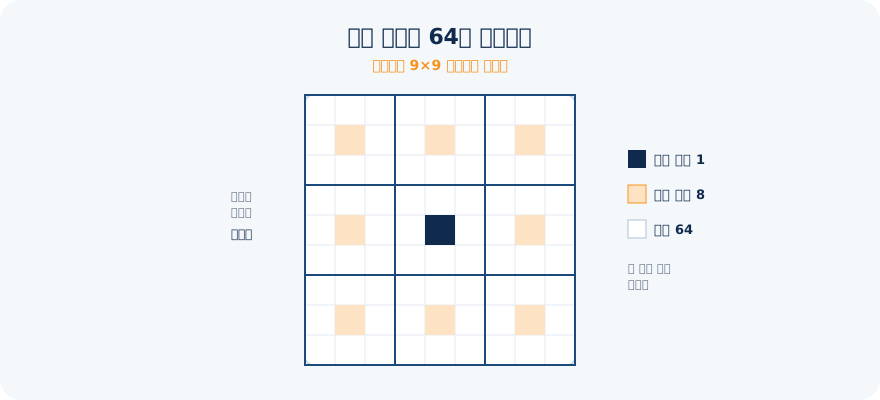
You've seen the grid — a big 9×9 square, a goal written dead center, sixty-four little boxes around it, all filled in tidy handwriting. It went viral as the sheet Shohei Ohtani wrote at sixteen, the one that supposedly turned a high-schooler into a two-way superstar. So you search for a template, print it out, stare at the sixty-four empty boxes... and freeze. The Mandal-Art chart isn't magic, and it isn't a coloring page. It's a thinking tool with one job: take a goal too big to act on and shatter it into actions small enough to do this week. Here's how to actually fill it — and why most people's charts die in a drawer.
Key takeaways
- The Mandal-Art chart is a 9×9 grid: one core goal in the center, 8 sub-goals around it, 8 actions under each — 64 actions total
- It works by forcing you to decompose one vague goal into concrete, doable behaviors
- Fill it in three passes: core goal → eight sub-goals → sixty-four actions (the third pass is the whole point)
- Ohtani's genius was putting character and luck in the boxes, not just skill
- A finished chart is worthless in a drawer — the boxes only matter if they become weekly actions
What is a Mandal-Art chart?
A Mandal-Art chart (also spelled mandalart or mandal-art — from mandala + art) is a goal-setting grid made of nine 3×3 boxes arranged into one big 9×9 square. You write your one core goal in the very center. The eight cells touching it hold eight sub-goals — the pillars that would make the core goal happen. Then each of those eight sub-goals gets copied into the center of its own surrounding 3×3 block, and you fill the eight cells around it with concrete actions. When it's done, one goal has fanned out into 8 sub-goals and 64 actions — a whole map on a single page. The Japanese designer Matsumura Yasuo created the format; Ohtani made it famous.
Why the grid works: decomposition beats motivation
Most goals don't fail because you stopped caring. They fail because "get healthy" or "become a pro" is too big to do — there's no obvious first move, so you do nothing. The Mandal-Art chart attacks exactly this. Its fixed structure forces decomposition: you literally cannot leave a box empty, so your brain is pushed to keep asking "okay, but what would actually make that happen?" until the answer is small enough to act on. Sixty-four boxes sounds like a lot, but that's the feature — by the time the grid is full, "become a pro" has become sixty-four things you could start today. It's backcasting drawn as a picture.
Fill it in three passes
Don't try to fill sixty-four boxes at once — you'll stall. Do it in three passes.
Pass 1 — the center. Write one core goal in the middle box. Just one, and make it real. Not "be successful" but something that would genuinely change your year. This is the anchor for everything else, so if it's vague, make it SMART first.
Pass 2 — the eight pillars. In the eight boxes around the center, write the eight areas that must be strong for the core goal to happen. For a fitness goal that might be: nutrition, strength, sleep, cardio, mindset, recovery, routine, accountability. These are still categories, not actions — that's fine for now.
Pass 3 — the sixty-four actions. This is the whole point of the tool, and where people quit. Copy each of the eight sub-goals into the center of its own 3×3 block, then fill its eight surrounding boxes with concrete actions — things you could literally do this week. Under "sleep": no screens after 11, same wake time daily, room cool and dark. Not "sleep better" (that's a wish) but "lights out by 11:30" (that's an action).
What Ohtani's chart actually teaches
The famous part of Ohtani's chart isn't that he wanted to be drafted first overall — it's what he put in the boxes. Alongside "fastball 160 km/h" and "build the body," he wrote sub-goals like character, mentality, and even luck (運). And under luck, the actions were things like pick up trash, greet people, be kind to teammates. A sixteen-year-old understood that a big goal isn't reached by talent alone — it's reached by the boring, human habits around it. When you build your own chart, resist filling all eight pillars with pure skill. Leave room for how you'll treat people, how you'll recover, how you'll stay steady when it's hard.
Sixty minutes is all it takes — the time budget
Sixty-four boxes feel heavy because nobody tells you how long they take. Timed honestly, it's under an hour.
| Pass | Boxes filled | Time | How you know the pass is done |
|---|---|---|---|
| 1 · Center | 1 | 5 min | It reads as one sentence, and you could answer yes/no about it in December |
| 2 · Eight pillars | 8 | 15 min | At least 2 of the 8 are not skills — they're people, recovery, or attitude |
| 3 · Sixty-four actions | 64 | 40 min (5 per pillar) | Every box answers yes to "could I do this tonight?" |
| Sweep · Review | — | 10 min | Fewer than 8 boxes are still empty |
The trick in pass 3 is a five-minute timer per pillar. If eight boxes won't come in five minutes, that pillar is still too abstract — rename it ("mentality" becomes "pre-game routine") and the boxes appear.
What Ohtani actually wrote in his eight pillars
| Pillar | Type | Examples of the actions under it |
|---|---|---|
| Body building | Physical | Reach 90 kg, seven scoops of rice at dinner, flexibility work |
| Control | Skill | Strengthen the lower body, don't let the axis wobble |
| Sharpness (kire) | Skill | More spin, drive from the legs |
| Speed 160 km/h | Skill | Strengthen the shoulder area, liner catch-ball |
| Breaking balls | Skill | More count pitches, finish the slider |
| Luck | Non-skill | Greet people, pick up trash, clean your room, treat your gear well, how you speak to umpires, positive thinking, become someone people root for, read books |
| Character | Non-skill | Gratitude, consideration, manners, being trusted, persistence, planning |
| Mentality | Non-skill | Don't ride every high and low, don't get swept up by the mood, think of teammates |
One number worth sitting with: three of the eight pillars (luck, character, mentality) are not baseball skills. That's 24 of the 64 boxes — roughly 37% — with no direct connection to how hard he threw a ball.
When the eight pillars won't come — a catalog by goal type
| Core goal type | Eight pillar candidates |
|---|---|
| Fitness / weight | Nutrition, strength, cardio, sleep, recovery, tracking, environment (fridge, gear), a partner |
| Exam / certification | Progress per subject, past papers, error log, study time slot, stamina, information, mock exams, focus environment |
| Career change | Core skill, portfolio, résumé, network, information (postings, companies), interview practice, financial buffer, finishing well at the current job |
| Revenue / business | Product, price and offer, traffic, conversion, repeat purchase, cost control, time allocation, learning channel |
| Reading / learning | Reading slot, how you choose books, a finishing structure, notes, one action, reading with others, environment, rereading |
One rule when you choose: assign at least two of the eight to people, attitude, or recovery. That is precisely what made Ohtani's sheet different from a training plan.
Turning wishes into actions — five worked examples
| Dead box | Live box |
|---|---|
| Be more confident | Read one affirmation out loud every morning |
| Get healthy | Tue/Thu/Sat, 8:30 pm, walk 3 km |
| Study hard | 30 minutes before work, 10 past-paper questions |
| Be better with people | Once a week, one message to someone I'm grateful for |
| Stay consistent | After a missed day, return at half the amount |
The only thing the right column has in common is that it contains a when and a how much.
Three mistakes that kill a Mandal-Art chart
Writing wishes instead of actions. If a box says "be more confident," it's not done — that's a feeling, not a behavior. Keep asking "what would I do?" until the box holds something you could check off.
Making it too pretty and never using it. The chart is a plan, not a poster. A grid that lives on the wall looking beautiful but never turns into this week's to-do list has failed at its only job.
Filling it once and forgetting it. This is the big one. The Mandal-Art chart is a setup — powerful, but one-time. Without a weekly review that pulls a few boxes into actual weekly actions, all sixty-four fade. Setting the goal was the easy part; managing it is where it lives or dies.
The four-week loop that keeps the grid moving
| Week | What you pull from the grid | This week's job | Check |
|---|---|---|---|
| Week 1 | Exactly 3 boxes, from three different pillars | Do only those three | Did 2 of the 3 actually happen? |
| Week 2 | Keep the same three | Add nothing new | Did you use the missed-day rule? |
| Week 3 | Retire the one that stuck, add one new box | Always exactly three running | Is there a box on a three-week streak? |
| Week 4 | Sweep the whole grid (10 min) | Cross out dead boxes, rewrite changed ones | Have you picked next month's three? |
Three boxes at a time is the ceiling. The moment you try to run all sixty-four, none of them run. And you don't rewrite the sheet every month — once a quarter you spend ten minutes replacing only the boxes you crossed out.
The sentence formula that turns a square into this week's action
The most common reason 64 squares die isn't laziness — it's the shape of the sentence. Put a noun or an adjective in a square (fitness, consistency, confidence) and on Monday morning you have no idea what to do. A square only gets executed when it contains four pieces.
[verb] + [quantity] + [frequency] + [time and place]
Then apply two tests. First, can you start within ten minutes of reading it (the ten-minute rule)? Second, does it resolve cleanly into done / not done by bedtime? If either answer is no, it's still a wish, not an action.
| Pillar type | The usual square (a wish) | Rewritten (an action) | How it's judged |
|---|---|---|---|
| Fitness | Exercise more | Walk 30 min around the block after work, 3x/week (Mon/Wed/Fri) | Yes/no at night |
| Mindset | Manage my mental state | Write 3 lines of gratitude before bed, daily | 3 lines exist |
| Character | Be a better person | Greet one person first on the morning commute, daily | Counted or not |
| Study | Get better at my field | Read the technical book 20 min before work, 5x/week | 20-min timer |
| Relationships | Be good to my family | Call my parents 10 min on Sunday evening, weekly | Call log |
| Money | Start investing | Set a 10% auto-transfer on payday, monthly | Transfer record |
| Execution | Stop procrastinating | First 25 minutes at 9 a.m. go to the task I hate most, 5x/week | 25-min timer |
| Recovery | Rest properly | Charge the phone in the living room at 11 p.m., daily | No phone in bedroom |
What the right-hand column has in common is that each item is small: 30 minutes, 20 minutes, three lines, 10 minutes. The moment one square becomes an hour-long project, 64 squares is a physically impossible plan. Cap a single square at 30 minutes and you can run one square a day inside half an hour. Why shrinking the unit does the heavy lifting is covered in the power of small wins.
The 8-2-3-1 rule for running 64 squares — the trick is not looking at all of them
The mistake people make the week after finishing the grid is trying to manage all 64 squares. That burns out in two days. Grids that actually keep moving hold these proportions.
- 8 — keep all eight pillars (don't cut them; the balance is the whole point of Mandal-Art)
- 2 — pick only two focus pillars for this quarter. The other six stay in maintenance mode
- 3 — pull exactly three squares for this week (two from the focus pillars, one from anywhere else)
- 1 — execute one square today. One action a day stacks 5–7 per week
The point of the structure is deliberately not looking at the other 61. The grid is a queue, not a drawer. Swap the two focus pillars each quarter and all eight cycle through in a year.
The weekly check takes five minutes and five questions. Anchor it to Sunday evening.
- How many of last week's three squares did I actually do? (Just the number.)
- For the ones I missed — was it a time problem or an oversized sentence?
- What are this week's three squares? (Two focus + one other.)
- Which of them can I start tonight within ten minutes?
- Did the center goal get any closer than last week?
If question 2 answers "oversized sentence" two weeks running, split the square. You aren't failing to find 30 minutes — the square is a two-hour job. If the time genuinely isn't there, the problem is the shape of the day, not the grid: use time blocking to create the slot the three squares live in.
Signs of a dead grid, and what to do
| Sign | What's actually wrong | Prescription |
|---|---|---|
| You haven't opened it in over a month | It lives somewhere you never look | Move it to your lock screen, fridge, or app home, and fix the weekly check to Sunday evening |
| Every square is a noun or an adjective | You skipped the third pass (actions) | Rewrite three squares with the sentence formula above — not all 64 |
| Six of the eight pillars are work-related | You filled pillars with your job instead of your life | Guarantee at least two pillars for relationships, health, and recovery |
| Checks accumulate but the center never moves | You've been picking only the easy squares | Make one of this week's three a hard square from a focus pillar |
The fourth sign is the most common. People unconsciously pick squares that check off easily. The "one hard square a week" rule is the guard against it — and where you place that hard square in the day should follow the principle in how to improve focus: the first block of your clearest hours.
Paper, spreadsheet, or app — where you keep it decides whether it survives
The same grid has a different lifespan depending on where it lives. Each medium is good at something different, so the default combination is draft on paper, run it digitally.
| Medium | Speed to write | Cost to revise | Reminders | Progress visibility | Risk of losing it | Best for |
|---|---|---|---|---|---|---|
| Printout (A4/A3) | Fastest (60 min a sheet) | High (rewrite by hand) | None | None (check marks only) | Medium (drawer) | First draft, start of the year |
| Spreadsheet | Medium | Low | None (calendar by hand) | Low | Low | Team sharing, quarterly review |
| Notes app / Notion | Medium | Low | Weak | Low | Low | People who revise squares often |
| Habit / goal app | Slow (you must transfer it) | Low | Strong | Strong (streaks, charts) | Very low | Weekly and daily operation |
The recommended sequence: (1) finish the paper draft in 60 minutes — speed of thought is the goal, (2) photograph it, (3) transfer only the 16 squares of this quarter's two focus pillars into digital, (4) run the weekly three and daily one there. Grids often die during a heroic attempt to transfer all 64 squares, because the transfer itself becomes the work. Sixteen squares takes ten minutes.
Why seeing the checks accumulate matters is covered in the power of consistency, and keeping the grid in front of your eyes as an image continues in how to make a digital vision board. If you need a tool for the daily check itself, see how to use a habit tracker.
Mandal-Art vs other goal tools — what to use when
| Tool | What it gives you | Strong when | Weak when |
|---|---|---|---|
| Mandal-Art 9×9 | Full decomposition of one big goal into 64 actions | New year, new quarter, goal still vague | Managing daily execution |
| SMART goals | Makes one sentence judgeable | Sharpening the center box | Spreading wide |
| OKRs | Numeric alignment of objective and results | Quarterly outcome tracking | Personal attitude and habits |
| Backcasting | A schedule running backward from the deadline | Deadline-bound goals | Balance across life areas |
| Affirmations | Daily imprinting of the goal | You keep forgetting the goal | You don't know what to do yet |
They work best in sequence: spread it with Mandal-Art, sharpen the center with SMART, run three boxes a week through your weekly review, and keep the goal in front of you daily so it isn't forgotten.
A worked example — a job-seeker's full 3-month grid
Talking about it abstractly only gets you so far, so here's a chart someone actually finished. A hypothetical job-seeker, A, set "land a junior backend developer role at a tech company within 3 months" as the center goal. Below are three representative actions per pillar (a real chart has eight per pillar). The daily hour under "coding skill" only works if it's protected as an interruption-free block — see deep work and focus for how to carve that out.
| Pillar | 3 representative actions (a real box has 8 per pillar) |
|---|---|
| Coding skill | One algorithm problem 8–9 a.m. on weekdays, weekly study-group review, log every solved problem in Notion |
| Portfolio | Ship one side project this month, at least one GitHub commit a day, document why each tech choice was made in the README |
| Résumé | Draft one application-essay question every Thursday evening, get study-group feedback every other Friday, update the target-company list with 5 new names weekly |
| Interview prep | 30-minute mock interview with the study group Tue/Thu, review 3 CS flashcards daily, write up interview notes and apply them to the next one |
| Network / information | Read and summarize one developer-community post weekly, request one coffee chat with someone in the field monthly, set up 3 job-alert feeds |
| Physical condition | 20-minute walk Mon/Wed/Fri evening, no screens after 11 p.m., fixed wake-up time |
| Mindset / recovery | 5-minute Sunday-evening review, apply to one more company the same day after a rejection, cap it at 30 minutes on hard days |
| Finances / life | Check the monthly budget on the 1st, cancel unnecessary subscriptions, keep a 3-month living-expense buffer |
What's worth noticing: half of the eight pillars — everything after "interview prep" — isn't pure coding skill. If physical condition, mindset, or finances collapse, the other four pillars don't matter enough to survive three months. Just as Ohtani's chart leaned on "luck" and "character" to hold up the rest, A's chart leans on "mindset/recovery" and "finances/life." Pulling this week's three squares from across all eight pillars, not just coding skill, also supports identity-based habits — building an identity as "someone who improves a little every day," not just "someone who's good at coding."
Another thing to notice: the difficulty is deliberately uneven across pillars. "Coding skill" asks for an hour daily; "finances/life" only needs a monthly check. Trying to fill every pillar at the same intensity breaks the chart. Research on self-efficacy suggests that stacking small wins first builds the capacity to take on harder challenges, so the recommended order is: spend the first two weeks banking checks on the easier pillars (finances/life, network/information), then start pulling the harder coding and interview squares from week three onward.
How VisionDream keeps your grid alive
VisionDream is, in a sense, a Mandal-Art chart that refuses to sit in a drawer. Its DreamMap (Vision Mandala) is literally the 9×9 grid — your core vision in the center, eight sub-goals around it, sixty-four actions fanning out — but every box is live. With one tap, the actions you wrote become tracked goals and habits, so the plan turns into a daily checklist instead of a pretty picture. Each check you complete grows your Success Tree (S = B·T·A), giving those sixty-four boxes visible progress. And when a box feels stuck or too vague, the AI coach helps you translate it — "what's one action this week for that box?" A grid is only as good as what you do with it. Plant your vision, and the fruit will come. 🌱
Frequently Asked Questions
Do I need to look at my Mandal-Art chart every day?
Not the whole chart — that's what exhausts people. Use the 8-2-3-1 rule: keep all eight pillars, choose only two focus pillars for the quarter, pull three squares for the week (two from the focus pillars, one from anywhere else), and execute one square today. You deliberately ignore the other 61. Opening the full grid once, during a five-minute Sunday-evening check, is enough; on weekdays you only look at today's single square.
My squares keep turning into things like 'try harder.' How do I fix that?
Run them through the sentence formula: [verb] + [quantity] + [frequency] + [time and place]. Not 'exercise more' but 'walk 30 minutes around the block after work, three times a week (Mon/Wed/Fri).' Two tests decide it: can you start within ten minutes of reading it, and does it resolve into done/not-done by bedtime? Cap one square at 30 minutes — several hour-long squares make 64 of them a physically impossible plan. And don't rewrite everything; fixing the three squares you'll actually pull this week is enough.
Is it a failure if I can't fill all 64 boxes?
No. Almost nobody fills all sixty-four in one sitting. The bar isn't 'all of them' but 'at least three per pillar' — twenty-four boxes is already a working plan, and the rest fill in over the following weeks. If a pillar won't give you even three boxes in five minutes, that isn't a personal failure; it means the pillar's name is too abstract. Rename it to something concrete and the boxes appear.
How often should I rewrite the chart?
Rewrite the whole sheet about once a year, or whenever the core goal genuinely changes. In between, do a ten-minute sweep each quarter: cross out the boxes that turned out to be dead, rewrite the ones whose situation changed, and leave the rest alone. The weekly rhythm is different and much smaller — pull three boxes into this week and ignore the other sixty-one.
What is a Mandal-Art chart?
It's a goal-setting grid made of nine 3×3 boxes arranged into one big 9×9 square. Your one core goal goes in the very center. The eight cells around it hold eight sub-goals — the pillars needed to reach it. Each sub-goal is then copied into its own 3×3 block and surrounded by eight concrete actions. When finished, one goal has fanned out into 8 sub-goals and 64 actions on a single page. It became famous through Shohei Ohtani, who filled one out at sixteen.
How do I fill in a Mandal-Art chart?
Do it in three passes. First, write one real core goal in the center box. Second, fill the eight surrounding boxes with the eight areas (sub-goals) that must be strong for the goal to happen. Third — the important part — copy each sub-goal into its own 3×3 block and fill its eight boxes with concrete actions you could actually do this week. Keep asking 'what would I do?' until each box holds a behavior, not a wish.
Why did Ohtani's Mandal-Art chart work so well?
Partly because of decomposition — it broke a huge goal (be drafted first overall) into 64 doable actions — and partly because of what he put in the boxes. Alongside skill goals like a 160 km/h fastball, he included sub-goals for character, mentality, and even luck, with actions like picking up trash and greeting people. He understood a big goal is reached through the boring human habits around it, not talent alone.
How does VisionDream help with a Mandal-Art chart?
VisionDream's DreamMap (Vision Mandala) is the 9×9 grid itself, but every box is live. With one tap the actions you wrote become tracked goals and habits, so the plan becomes a daily checklist instead of a poster in a drawer. Each check grows your Success Tree for visible progress, and when a box feels vague the AI coach helps translate it into one concrete action for this week.
Is it okay to fill all eight pillars with pure to-dos?
No. On Ohtani's chart, three of the eight pillars — luck, character, mentality — weren't baseball skills at all; roughly 37% of the 64 boxes had no direct link to how well he could throw. In the worked example above, half of the job-seeker's eight pillars were physical condition, mindset, finances, and network rather than coding skill. A chart built only from skill pillars runs fine for two weeks, then stalls the moment physical condition or mindset gives out. Reserve at least two pillars for people, attitude, or recovery.
Is it fine to make the eight pillars uneven in difficulty?
That's exactly what keeps a chart running long-term. In the worked example, 'coding skill' demanded an hour daily while 'finances/life' only needed a once-a-month check. Filling every pillar at the same intensity makes the day physically impossible. Spend the first one to two weeks banking checks on the lower-difficulty pillars to build the sense that 'this chart actually gets kept,' then start pulling harder squares from the tougher pillars in the weeks after.
Plant a vision, and fruit will surely grow 🌱
Start in the app →