The Kim Mikyung Miracle Morning, Made Your Own — The Sleep Math Behind 5 A.M. and a 3-Week, 30-Minute Ramp
Day one, you set the alarm for 5:00 and feel like a different person. Day two, you drag through the afternoon on five hours of sleep and call it discipline. Day three, the alarm goes off, your hand moves before your brain does, and you wake at 7:20 with nothing but guilt. By lunchtime, "I'm just not a morning person" has quietly become a settled fact about you.
It isn't a fact. It's subtraction. If you went to bed at midnight and set the alarm for 5:00, you gave your body five hours. Against a 7-hour requirement that's a 2-hour deficit every night — roughly 6 hours of sleep debt by the third morning, close to an entire night's sleep missing. Willpower does not argue with that number. The alarm didn't beat you. The clock did, three nights earlier, when you decided what time to go to bed.
In Korea, mentor and author Kim Mikyung turned the Miracle Morning into a full-blown movement — hundreds of thousands of people waking before dawn together to read, move, write, and reach for a bigger life. It works. What doesn't work is copying the hour while ignoring the math underneath it. This piece gives you the back-calculation table nobody runs first, a three-week ramp that starts at 30 minutes instead of two hours, a block plan for what to actually do once you're up, and an honest answer for people whose lives are better served by an evening routine. 🌱
Key takeaways
- Quitting on day three is a sleep-debt failure, not a character failure — midnight-to-5 is a 2-hour nightly deficit and about 6 hours of debt by morning three
- 5 a.m. is not a wake-up decision. It's a 21:30 decision. To wake at 5:00 on 7 hours you must be asleep by 22:00, lights out around 21:45, phone down around 21:30
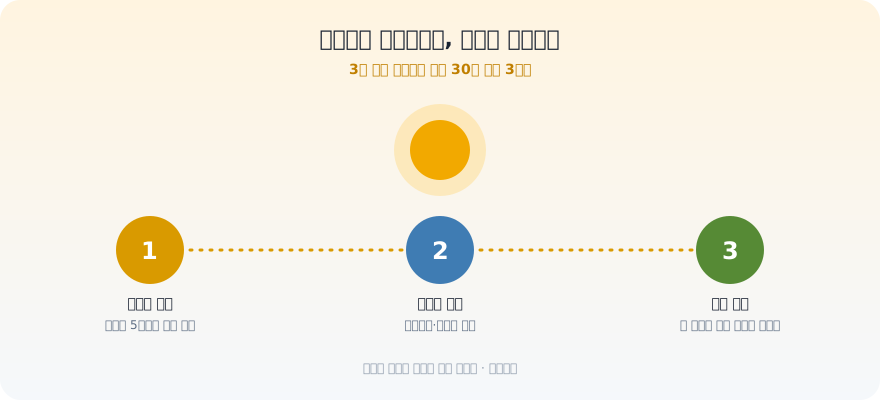
- Don't jump two hours. Ramp in 30-minute steps: week 1 = 30 min earlier + 1 action, week 2 = 45 min + 2 actions, week 3 = 60 min + 3 actions
- Decide the morning the night before, in blocks: 0–5 min water and light, 5–15 read, 15–25 move, 25–30 write today's One Thing
- It breaks in exactly four places — sleep debt, an undecided morning, invisible effort, and no rule for the day you miss
- Missing one morning is a statistic. Missing two in a row is a new default. On bad days run the half version: wake time only, one action, five minutes
- Morning isn't the only answer. If you get home at 23:00, work rotating shifts, or do your best thinking at night, optimize the evening instead — that's strategy, not surrender
What the Kim Mikyung Miracle Morning actually is
Strip away the hype and the method is simple: get up before the world does, and spend that quiet block on your own growth instead of everyone else's demands. Kim Mikyung's version leans on a few pillars — reading, affirmation, light movement, and writing down what matters — done consistently and, crucially, done where other people can see that you showed up. The magic isn't the pre-dawn darkness. It's that you touch your own life first, before email, school runs, and other people's urgencies bury it. (This is the same engine behind any miracle morning system — the morning is simply the least-contested hour you own.)
Pull it apart and there are three design choices, each doing a specific job:
| Element | Why it's built that way | How it collapses when you cheat |
|---|---|---|
| Before the household wakes | It's the only block nobody else can book. Nothing arrives to displace it | Moving it to "sometime before lunch" means the first request of the day eats it |
| A short, repeatable block | 30 minutes survives a bad night. A 2-hour morning ritual does not | A 90-minute routine works on holidays and dies on the first ordinary Tuesday |
| Visible to someone | Being seen converts an intention into a commitment | A private plan has no memory and no witness, so skipping costs nothing |
The one people underrate is the first. The moment you claim time before the day starts, this stops being a mood and becomes a physical appointment that has to be paid for in hours of sleep. Start without doing that subtraction and you will almost always hit the wall inside a week.
The subtraction nobody runs: what time you must be asleep
Assume you need 7 hours. Most adults land somewhere between 7 and 9, and 7 is the floor you can hold for months rather than days. Now read the row that matches the bedtime you actually keep — not the one you wish you kept:
| Asleep by | Wake time after 7 hours | Lights out (about 15 min to fall asleep) | Phone down (30 min before) |
|---|---|---|---|
| 22:00 | 05:00 | 21:45 | 21:30 |
| 22:30 | 05:30 | 22:15 | 22:00 |
| 23:00 | 06:00 | 22:45 | 22:30 |
| 23:30 | 06:30 | 23:15 | 23:00 |
| 24:00 | 07:00 | 23:45 | 23:30 |
Read the top row again. Waking at 5:00 is not a morning decision — it's a 21:30 decision. If your phone is still in your hand at 23:40, the 5 a.m. alarm was already impossible before you set it. That's not a motivation problem; it's a scheduling problem, and it's the single most common reason a Miracle Morning dies. If the phone is the actual thief here, fix that first with a phone addiction detox — a 5 a.m. plan sitting on top of midnight scrolling is a plan to fail on schedule.
Now the cost of ignoring the table. Here's what a 5:00 alarm does to you depending on when you actually fall asleep:
| You fall asleep at | Alarm at 5:00 gives you | Nightly deficit | Debt by morning 3 | What it feels like |
|---|---|---|---|---|
| 22:00 | 7 h 00 m | 0 h | 0 h | Sustainable. The alarm is annoying, not impossible |
| 23:00 | 6 h 00 m | 1 h | 3 h | Fine for two days, irritable and foggy by afternoon three |
| 24:00 | 5 h 00 m | 2 h | 6 h | You lose the fight with the snooze button — this is the classic day-three collapse |
| 01:00 | 4 h 00 m | 3 h | 9 h | Over by day two, usually with a headache |
Six hours of debt is roughly a whole night of sleep your body is owed, and it collects that debt whether you approve or not. This is the shape of three-day quitting in its purest form: a spike of motivation with nothing underneath it but subtraction. You do not fix it with a louder alarm. You fix it by moving bedtime first and the alarm second.
The practical rule: move your bedtime 30 minutes earlier for a week before you move your alarm at all. The first week of a Miracle Morning shouldn't be about mornings. It should be about nights.
The 3-week, 30-minute ramp
Here's the part that changes the outcome. Treat the first three weeks not as the routine itself, but as the period where you build a sleep schedule and a morning block that can carry the routine. Everything moves in 30-minute steps, and you add one action per week.
| Stage | How much earlier | Morning actions | Time used | What you measure | Gate to advance |
|---|---|---|---|---|---|
| Week 1 (days 1–7) | 30 min earlier (bed and alarm) | 1 action | about 15 min | Days you got up within 10 min of the alarm | Woke on 5 of 7 days, no afternoon crash nap |
| Week 2 (days 8–14) | 45 min earlier | 2 actions | about 25 min | Same, plus bedtime actually moved | 6 of 7 days, and you fell asleep before 23:00 at least 5 nights |
| Week 3 (days 15–21) | 60 min earlier | 3 actions | about 30 min | Same, plus whether the block finishes on time | 6 of 7 days, no snooze longer than 10 min |
| Week 4 onward | Hold at 60 min | 3 actions | about 30 min | Streak | — |
Two things make this work. First, the bedtime moves with the alarm — always. Pulling the alarm 30 minutes earlier without pulling bedtime 30 minutes earlier is just a smaller version of the midnight-to-5 disaster. Second, if you miss the gate, do not advance. Repeat the same week at the same setting. Running week 1 twice costs you nothing; someone doing an honest 15-minute morning for three weeks is far closer to day 100 than someone who attempted 5 a.m. on day one and vanished on day three.
Notice what the ramp implies: after three full weeks you're waking one hour earlier than your old normal, with a 30-minute routine and 30 minutes of slack. If your old normal was 7:30, you're at 6:30 — not 5:00. That's fine. The Kim Mikyung method is about owning the block before your obligations start, not about the digits on the clock. People who need 5:00 get there in month two, from a bedtime that supports it.
What to actually do in those 30 minutes
The second-biggest reason mornings die: you wake up on time, stand in the kitchen, and have no idea what you're supposed to be doing. Twelve minutes later you're on your phone and the morning is over. Decide the block the night before, and give every minute a job.
| Block | Minutes | What you do | Why it's there |
|---|---|---|---|
| 1 | 0–5 | Water, daylight or a bright lamp, make the bed | Light and movement shut off sleep inertia; the made bed is your first completed task |
| 2 | 5–15 | Read 10 minutes (paper, not a screen) | Input before output — this is the growth part, and 10 pages a day is about a book a month |
| 3 | 15–25 | Light movement: stretch, walk, bodyweight set | Raises body temperature and heart rate so the rest of the morning isn't a fog |
| 4 | 25–30 | Write today's One Thing in one line | Turns the morning into steering, not just activity — you leave the block with a decision |
Three notes on the block. No screens in blocks 1–3; the moment you open a feed you've handed the morning to someone else's agenda. Block 4 is the one that pays for the whole thing — a single written sentence like "Today I finish the second draft" is what makes the alarm feel worth it by 6 p.m. And if 30 minutes is too much this week, run blocks 1 and 4 only: five minutes, still a Miracle Morning. If you want to go further and give the rest of your day the same treatment, time blocking is the same idea applied to the other fifteen hours.
The four places it breaks on day three
In practice, this method fails in exactly four spots. Three of them are fixable in one evening.
| # | Failure point | The symptom | The actual cause | The fix |
|---|---|---|---|---|
| 1 | Sleep debt | Day 3 the alarm rings and you genuinely cannot get up | You moved the alarm without moving bedtime — 2 h short a night, 6 h by day 3 | Move bedtime first, 30 min at a time. Read the back-calculation table and pick your row |
| 2 | An undecided morning | You're up, but you drift, check your phone, and lose 25 minutes | Nothing was decided the night before, so the default (phone) wins | Write the 30-minute block on paper before bed. Every minute gets a job |
| 3 | Invisible effort | Week two feels pointless — "am I even doing this?" | Nobody sees it, including you. Invisible effort feels optional | Make it checkable: a streak, a heatmap, a partner who notices |
| 4 | No rule for the day you miss | One overslept morning turns into "well, that's ruined" and you never restart | You never decided in advance what a missed day means | The never-two-in-a-row rule plus the five-minute half version below |
Numbers 3 and 4 are the quiet killers. With 1 and 2 you can at least see the problem — you're exhausted, or you wasted the morning. With 3 and 4 the conclusion you reach is "I guess I'm not a morning person," which is both wrong and expensive.
The 3 differences that make it last
1. A realistic time beats an impressive one
Waking at 5:00 on four hours of sleep isn't discipline — it's a countdown to burnout with a three-day fuse. If you fall asleep at midnight, a 6:30 you keep beats a 5:00 you abandon by Thursday, and it isn't close: 6:30 held for 30 days is roughly 15 hours of reclaimed morning time; 5:00 held for three days is 4.5 hours and a week of recovery sleep. The Miracle Morning is about owning the block before your obligations start, not winning a bragging contest. Start 30 minutes earlier than usual. Earn the right to go earlier by proving you can move bedtime.
2. Accountability you can see
The reason Kim Mikyung's community works isn't the content — it's that someone notices whether you showed up. You don't need a crowd; you need visibility. A streak you can see, a box you tick, a record that quietly says "you kept your word 19 days out of 21." When the routine is invisible, missing it costs nothing. When it's visible, missing it costs a number you can see. That's the whole mechanism behind a habit tracker, and it's why small wins compound — the check is the proof, and the proof is the fuel.
Set the bar at 5 of 7 in week 1 and 6 of 7 after that, not 7 of 7. A target of 100% converts one ordinary bad night into total failure, which is exactly the collapse we're engineering out.
3. A morning tied to your vision
A routine done for its own sake becomes a chore you'll drop around day nine. A routine that visibly moves you toward something you want becomes a promise to yourself. Before you set the alarm, answer one question in writing: what future is this morning for? "I read 10 minutes at 6:20" is a task. "I read 10 minutes at 6:20 because I'm becoming someone who can teach this" is an identity — and identity is what survives a bad week. That's the difference between doing habits and being someone, the core of identity-based habits, and it's the same "why" that fuels any godsaeng routine: direction, not just discipline. If your mornings keep dissolving because the motivation itself keeps evaporating, build the motivation system underneath before you buy a louder alarm clock.
The rule for the morning you miss
Nobody runs 100 mornings without missing one. The difference between people who last and people who don't isn't whether they miss — it's what they do the next morning. Five rules:
- Never two in a row. This is the only absolute rule. One missed morning is a statistic; two consecutive is a new default called "not doing this anymore."
- On bad mornings, run the half version. Keep the wake time, do one action, five minutes — water, daylight, and today's One Thing in one line. The gap between 0 and 5 minutes is far larger than the gap between 5 and 30.
- Never repay a missed morning by waking earlier. Getting up at 5:00 tomorrow to make up for oversleeping today just deepens the debt and buys you a second failure.
- If you miss three or more mornings in a row, reset to week 1. Thirty minutes earlier, one action. Restarting cold at week-3 settings almost always fails, because your bedtime has already drifted back.
- Don't restart the counter. Keep the same record, gap and all. A clean new tracker creates the psychological weight of "starting over," and that weight is precisely what postpones the restart.
And on the morning you do oversleep, skip the shame spiral entirely. A little self-compassion is what keeps one missed morning from ending the whole habit — the research-backed finding here is unglamorous but reliable: people who are harsh with themselves after a lapse quit sooner than people who shrug and show up the next day. The goal was never a perfect record. It was becoming someone who shows up for their own life, most mornings.
Miracle morning vs. optimizing your evening: an honest comparison
Morning is not the only answer, and pretending otherwise is how people spend two years failing at 5 a.m. instead of one month succeeding at 21:30. Some lives are simply built for an evening block.
| Your situation | Better fit | Why | What to do instead |
|---|---|---|---|
| You get home at 23:00 or later most nights | Evening | A 5:00 alarm means 5 hours of sleep and 6 hours of debt by day 3 — the table above decides this, not your attitude | A 30-minute block right after you get home, before the couch |
| Rotating or night shifts | Anchored to your wake, not the clock | Your "morning" is whenever you wake up; the clock time is irrelevant | Run the same four blocks in your first 30 minutes awake, whenever that is |
| Young children who still wake at night | Hybrid, sleep first | Your sleep isn't yours to schedule, so protecting the 7 hours outranks the routine | The five-minute half version daily; add blocks only in weeks that allow it |
| Your best creative work happens at night | Evening | Forcing 5 a.m. spends your sharpest hours on a routine and your dullest on the work | Protect the night block; keep mornings for light input like reading |
| You're a genuine evening chronotype | Later morning | Shifting more than about an hour against your body clock rarely holds | Aim for 30–45 min earlier than usual, not two hours |
| Mornings are the only uninterrupted time you have | Morning | Nothing else can book that block — this is the classic case the method was built for | Run the full three-week ramp above |
If two or more rows above describe you, build an evening routine instead and stop feeling guilty about it. The goal was never the hour on the clock. It was one protected block a day that belongs to your own life — and an evening block you keep for a year beats a morning block you quit every February.
Three checkpoints
Twenty-one days is long enough that you need places to stop and look. If an answer comes back wrong, adjust on the spot instead of grinding.
| Checkpoint | Question | If the answer is bad |
|---|---|---|
| Day 7 | Did you get up within 10 minutes of the alarm on 5 of 7 days? | If not, your bedtime didn't actually move. Repeat week 1 and pull bedtime 30 min earlier |
| Day 14 | Are you napping or crashing in the afternoon? | That's sleep debt, not laziness. Go back one step and hold for another week |
| Day 21 | Does the morning block end with a written One Thing? | If not, you have activity but no steering. Cut a block and keep block 4 |
| Day 30 | Would you notice if you stopped? | If not, the routine isn't tied to anything you want. Rewrite the "what future is this for" line |
A weekly look at these four questions costs about ten minutes and prevents most collapses — the same reason a weekly review habit outperforms trying harder. And if the real problem is that you're awake but foggy for the first hour, the fix is upstream in your sleep and light exposure, not in trying to improve focus with more coffee.
Build your own version this week
Don't copy Kim Mikyung's schedule. Copy her structure. Back-calculate your wake time from a bedtime you can actually keep. Move bedtime first, 30 minutes at a time. Choose one action for week one — 10 minutes of reading, or one written line about today. Make it checkable. Tie it to a future you actually want. Then protect the streak, not the perfection.
🌱 Put this into practice with VisionDream
Keep the paper if you like paper — but what protects a morning routine is the record. Log your wake-up and your morning action under Action in the Today tab (B·T·A), and the calendar heatmap shows the streak at a glance, which is the visibility a community gives you, in your pocket. On the morning you oversleep, a streak shield (2 per month, applied automatically, no carryover) protects the run so one bad night doesn't erase three good weeks, and each checked morning grows your Success Tree through its seven stages from seed to full bloom. Set a morning reminder for your new bedtime-adjusted wake time, and let the Sunday Weekly Review answer the day-7 and day-14 checkpoint questions for you. The tool is the app; the protagonist is you.
Tonight, in five minutes
Do exactly two things before you sleep tonight.
- Back-calculate. Take the time you honestly fall asleep, add 7 hours, and write that number down. That is tomorrow's alarm — not 5:00, not the number from a video you watched. If you want an earlier one, move tonight's bedtime 30 minutes, not tomorrow's alarm.
- Pick one action. One. Ten minutes of reading, or one line naming today's One Thing. Write it on a sticky note and put it where you'll stand when you wake up.
That's the entire assignment. Not a 5 a.m. transformation — a bedtime and a sticky note. Closing the whole idea on day three was never a verdict on your discipline; you had signed up for a two-hour nightly sleep deficit and called it a personality flaw. Change the subtraction and the whole story changes. Plant your vision, and the fruit will come. 🌱
Frequently Asked Questions
What is the Kim Mikyung Miracle Morning?
It's a morning-routine movement popularized in Korea by self-development mentor and author Kim Mikyung. The core idea is to wake before your obligations begin and spend that quiet block on your own growth — reading, affirmation, light movement, and writing down what matters — done consistently and with visible accountability. Three design choices make it work: it happens before the household wakes so nothing can displace it, it's short enough to survive a bad night, and someone can see whether you showed up. The point isn't the exact hour; it's claiming one protected block for your own life before the day claims you.
Do I really have to wake up at 5 a.m.?
No, and copying the 5 a.m. hour is exactly why most people quit in three days. Waking at 5:00 after falling asleep at midnight gives you five hours against a seven-hour need — a two-hour deficit every night, and about six hours of sleep debt by the third morning. A 6:30 you actually keep is worth more than a 5:00 you abandon by Thursday: 6:30 held for 30 days is roughly 15 hours of reclaimed morning time, while 5:00 held for three days is 4.5 hours plus a week of recovery sleep. Start 30 minutes earlier than usual and earn the right to go earlier.
What time do I have to go to bed to wake up at 5 a.m.?
Assuming a 7-hour requirement, you have to be asleep by 22:00 — which means lights out around 21:45, allowing about 15 minutes to fall asleep, and phone down around 21:30. The same subtraction gives you the other rows: asleep at 22:30 wakes at 5:30, 23:00 wakes at 6:00, 23:30 wakes at 6:30, and midnight wakes at 7:00. In other words, 5 a.m. is not a wake-up decision, it's a 21:30 decision. If your phone is still in your hand at 23:40, the 5 a.m. alarm was already impossible before you set it.
Why do most people quit the miracle morning on day three?
It fails in four specific places. First, sleep debt: you moved the alarm without moving bedtime, so by morning three you're roughly a full night of sleep behind. Second, an undecided morning: you're up but nothing was planned the night before, so the phone wins and 25 minutes disappear. Third, invisible effort: nobody sees it, including you, so it starts to feel optional around week two. Fourth, no rule for the day you miss, so one overslept morning becomes permanent quitting. Fix them in that order — bedtime first, then a written block, then a visible streak, then a recovery rule.
If I miss a morning, do I have to start over?
No. One missed morning is just a statistic; what actually kills the routine is missing two in a row. On bad mornings run the half version — keep the wake time, do one action for five minutes: water, daylight, and today's One Thing in one line. Don't try to repay the gap by waking even earlier the next day, because that just deepens the sleep debt and buys you a second failure. If you've missed three or more consecutive mornings, reset to week 1 at 30 minutes earlier with one action, and keep the same record rather than starting a clean new tracker.
I get up on time but have no idea what to do. What should the morning look like?
Decide it the night before and give every minute a job. A workable 30-minute block is: 0–5 minutes for water, daylight and making the bed; 5–15 minutes reading on paper; 15–25 minutes of light movement like stretching or a walk; and 25–30 minutes writing today's One Thing in a single line. No screens in the first three blocks — the moment you open a feed, the morning belongs to someone else's agenda. Block four is what pays for the whole thing, because you leave with a decision instead of just activity. If 30 minutes is too much this week, run blocks one and four only: five minutes, still a Miracle Morning.
Should night owls do the miracle morning at all?
Often, no — and an honest answer here saves people years. If you get home at 23:00 or later most nights, work rotating shifts, have young children who still wake at night, do your sharpest creative work late, or are a genuine evening chronotype, an evening block will beat a morning one. Shifting more than about an hour against your body clock rarely holds, so aim for 30 to 45 minutes earlier rather than two hours. The goal was never the digits on the clock — it was one protected block a day that belongs to your own life, and an evening block you keep for a year beats a morning block you quit every February.
Plant a vision, and fruit will surely grow 🌱
Start in the app →Related posts
- 📲Goal-Tracking Apps — How to Pick One and Actually Finish Your Yearly Goals
- ⏰How to Stop Procrastinating — Break the Habit With Systems, Not Willpower
- 🖼️How to Make a Digital Vision Board on Your Phone (So You Actually See It Daily)
- 🌄5 Miracle Mindsets That Change Your Morning — Why Willpower Fails and What Works Instead