Self-Efficacy — How to Build the Belief That You Can Do It
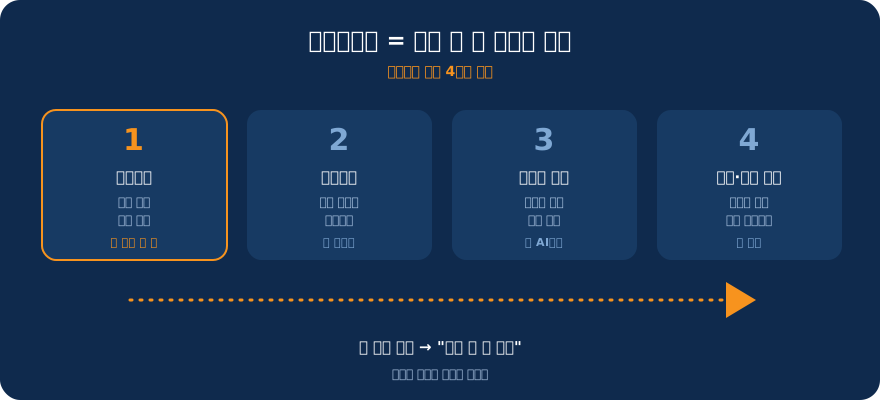
"I could never do that." We say it like a fact about who we are — as if some people simply have what it takes and the rest don't. But that feeling has a name in psychology, and a fix. It's self-efficacy: your belief that you can carry out the actions a goal requires. And the key insight from Albert Bandura, the psychologist who named it, is that self-efficacy isn't a fixed trait. It's built from evidence — and evidence can be manufactured on purpose, starting today, starting tiny.
Key takeaways
- Self-efficacy is the belief "I can do this" — built from evidence, not born as a trait
- Bandura's strongest source is mastery experience: small, repeated, winnable successes
- Self-esteem (liking yourself) and self-efficacy (believing you can act) are different things
- Self-efficacy is domain-specific — "I have no confidence" isn't a diagnosis, it's a blur (use the five-area self-check)
- The fastest evidence accumulates at a 70–85% success rate — 99% tasks don't count as proof, 40% tasks only produce counter-evidence
- Reframe failure as data, not a verdict — "that approach missed," not "I'm not capable" (verdict-to-data swap table)
- Restarting after a collapse is a design problem, not a motivation problem — a four-week rebuild starting at one 95% task, three minutes a day
- Three columns are enough to track it — a two-week evidence ledger (date · what I did · the odds I predicted)
Self-efficacy isn't the same as self-esteem
People blur these two, but they solve different problems. Self-esteem is how much you like and value yourself — your sense of worth. Self-efficacy is how much you believe you can pull off a specific thing — your sense of capability. You can have plenty of one and little of the other: a kind, well-liked person can still be sure they'll fail at public speaking, and a confident performer can privately dislike themselves. The distinction matters because the fix is different — worth is nurtured with self-acceptance, while capability is earned through evidence.
| Self-esteem | Self-efficacy |
|---|---|
| "I like and value myself" | "I can do this specific thing" |
| About your worth | About your capability |
| Grows through self-acceptance | Grows through earned evidence |
| Answers "Am I enough?" | Answers "Can I pull this off?" |
If it's your sense of worth that keeps wobbling, that's its own worthwhile project — see building real self-esteem. This piece is about the other lever: capability.
A 30-second self-check: self-efficacy is domain-specific
Bandura stressed one thing from his 1977 paper onward: self-efficacy isn't a report card attached to a whole person. It's scored separately in each domain. Which means "I have no confidence" is not a diagnosis — it's a blur. And a blur gives you nothing to work on.
Score each of the five lines below from 0 to 10. The question is: "right now, how much do I believe I can do what I said I'd do in this area?"
| Area | Question | Your score |
|---|---|---|
| Health & fitness | I can train this week as many times as I planned | ___ / 10 |
| Work & output | I can finish what I took on this week by the deadline | ___ / 10 |
| Learning | I'll still be holding onto this new thing a month from now | ___ / 10 |
| Relationships | I can raise the uncomfortable conversation instead of postponing it | ___ / 10 |
| Money | I can hold the saving and spending line I set this month | ___ / 10 |
Almost everyone ends up with at least one area above 7 and at least one below 3. That's normal, and it's the whole point. In your 7-point area you already know how to build evidence — you've simply never applied that method in the 3-point one.
What to do next depends on the score:
| Score | What it means | This week |
|---|---|---|
| 8–10 | You already have enough evidence | Raise the difficulty one rung and gather new proof |
| 5–7 | Sometimes yes, sometimes no | Use rungs 3–4 of the ladder below — repeat tasks at ~80% odds |
| 2–4 | "I've tried and it didn't work" has piled up | Drop to a 95% task and collect evidence for two weeks |
| 0–1 | You aren't attempting at all | This may be a starting-threshold problem, not a capability one — begin with the two-minute rule in beating procrastination |
Mastery experience: the strongest source
Bandura found four sources of self-efficacy, and they aren't equal. The most powerful by far is mastery experience — actually doing the thing and succeeding. Not a grand success. A small one. When you set a goal so small you can't fail — one push-up, one paragraph, one checked box — and then do it, you hand your brain a piece of undeniable evidence: "I said I would, and I did." Stack enough of those and the belief stops being a pep talk and becomes a track record. This is exactly why small wins beat willpower: they're not motivational fluff, they're the raw material self-efficacy is made of.
The difficulty ladder: 70–85% odds is where evidence accumulates fastest
Everyone has heard "start small." Nobody tells you how small, so most people miss in one of two directions: they repeat something so easy it never registers as an accomplishment, or they keep gripping something still too hard, which produces nothing but counter-evidence.
There's a useful number to anchor on. A 2019 Nature Communications paper, "The Eighty Five Percent Rule for optimal learning," found that learning proceeds fastest at an accuracy of about 85% (an error rate of 15.87%). It's a computational study on machine and perceptual learning tasks, so it doesn't transfer wholesale to life goals — but the direction matches practice exactly: the difficulty where you almost always succeed, but not every time, is where you improve fastest.
So lay your tasks out as a ladder and choose today's rung:
| Rung | Odds of success | Example (fitness) | Example (writing) | What this rung is for |
|---|---|---|---|---|
| 1 | 99% | Put on workout clothes | Open the doc, write one line | Removing the starting threshold (not evidence) |
| 2 | 95% | Walk 5 minutes | Write 100 words | The floor version for bad days |
| 3 | 85% | Walk 20 minutes | Write 500 words | Where evidence accumulates fastest |
| 4 | 70% | Jog 30 minutes | Finish a first draft | The stretch zone — occasional failure is normal |
| 5 | 40% or less | Run a 10K | Ship a finished manuscript | Not yet — starting here only builds counter-evidence |
Three operating rules:
- Five consecutive successes on rung 3 earns rung 4. Five is the smallest sample that isn't luck.
- Two consecutive failures on rung 4 sends you back to rung 3. Enduring failure isn't a virtue here; the job is collecting evidence.
- On terrible days drop to rung 2 rather than to zero. The gap between 0 and rung 2 is bigger than the gap between rung 2 and rung 4.
Don't confuse this ladder with small wins. Small wins are about shrinking the size of the task; the ladder is about tuning the odds. Shrink it all you like — if the odds are 40%, no evidence gets built.
Three more sources: models, words, and your body
The other three sources are quieter but real. Vicarious experience — watching someone like you succeed — tells your brain "if they can, maybe I can," which is why finding a believable model matters more than admiring an unreachable star. Verbal persuasion — genuine, specific encouragement from someone (or from yourself) — nudges you to attempt what you'd otherwise skip; vague flattery doesn't count, but "you handled last week's version of this, you've got this" does. And physiological and emotional state — because your body reads racing-heart and shaky-hands as evidence of inability unless you tell it otherwise. Learning to treat nerves as readiness rather than doom is a real skill, and a little self-kindness under pressure (self-compassion) keeps a bad moment from becoming a bad self-image.
Failure isn't a verdict — it's data
Here's the reframe that protects all four sources: failure is data, not a verdict. Low self-efficacy reads a setback as a final ruling — "see, I knew I couldn't." High self-efficacy reads the same setback as feedback — "that approach missed; what do I adjust?" Nothing about the event changes; the interpretation does, and the interpretation is what either builds or burns your belief. So when something flops, resist the sentence "I'm not capable" and swap in "that version didn't work." One closes the door. The other hands you the next experiment.
Swapping verdicts for data — a sentence table
"Read it as data" is advice nobody executes, because in the moment there's no sentence ready. Decide in advance what you'll write in the 30 seconds after a failure.
| The verdict that shows up | Why it's dangerous | The data sentence to write instead |
|---|---|---|
| "I knew I couldn't do this" | Expands one event into a whole person | "That approach missed this time. What do I change?" |
| "Three days again, typical" | Keeps the outcome, deletes the cause | "I collapsed on the evening of day three. That slot is the problem." |
| "I'm just not disciplined" | Leaves zero variables you can touch | "I was on rung 4. Dropping to rung 3." |
| "Everyone else manages, just not me" | Runs vicarious experience backwards (comparison, not modeling) | "Let me find out which rung that person started on." |
| "This time I'll do it properly" | Books the next failure in advance | "This time I change exactly one thing — the time of day." |
What the right column has in common: each one hands you a next action. A verdict closes the door; a data sentence gives you the next experiment. Once this reframe becomes automatic, consistency stops being a personality trait and becomes a procedure.
Three situations where self-efficacy drops — and what each needs
The same sentence, "I can't do this," calls for different treatment depending on where it came from. Misread this and your effort points the wrong way entirely.
| Situation | Signals | The real cause | Do this first | Don't do this |
|---|---|---|---|---|
| 1. Recovering from burnout | Rest doesn't restore you · what used to be easy feels heavy | Energy, not capability, is at the floor | One rung-2 task (95% odds) for two weeks, plus protected recovery time | Return straight to your old difficulty — the failures land as counter-evidence |
| 2. Entering a new domain | You're an 8 elsewhere but a 2 here | You have zero evidence in this domain yet | Start with vicarious experience — find one case that began where you are | Start at rung 4–5 because "I'm generally good at things" |
| 3. After repeated failure | Many attempts, each one breaking off midway | Not difficulty — design (wrong time slot, no record) | Run the two-week ledger to see exactly when you break | Retry the identical design and hope this time is different |
The first is the one most often misdiagnosed. When you're in the state where "just rest" is the most infuriating advice you can get, concluding "it's a willpower problem" slows the recovery and shaves your self-efficacy further. If the burnout signals are clear, read burnout recovery first and come back to this piece afterwards.
The four-week rebuild after a collapse
When self-efficacy is at the floor, what you need is not resolve but a schedule. The target isn't performance; it's producing 20-plus pieces of "I said I would and I did" over four weeks.
| Week | Task difficulty | Time per day | Goal of this week | Gate to advance |
|---|---|---|---|---|
| Week 1 | One rung-2 task (95% odds) | about 3 min | Produce five "I did it"s | Succeeded 5 of 7 days |
| Week 2 | One rung-2 + one rung-3 | about 10 min | First success at rung 3 | 3 or more rung-3 successes |
| Week 3 | One rung-3 task | about 15 min | Make rung 3 the default | 5 consecutive rung-3 successes |
| Week 4 | Hold rung 3, attempt rung 4 once | about 20 min | Taste the stretch zone | Hold rung 3 even if rung 4 fails |
Miss the gate and don't advance — repeat the same week. Running week 1 twice costs you nothing; not disappearing matters far more than reaching week 4 on schedule. The underlying rule — that one missed day doesn't break you but two in a row does — is the same one in how to stop quitting after three days.
The two-week evidence ledger: three columns
Evidence accumulates, but memory doesn't count it for you. In fact, the lower your self-efficacy, the stronger the bias that files successes as luck and failures as ability. Which is why you need a sheet of paper. Three columns will do.
| Date | What I did (the thing I said I'd do) | Odds I predicted yesterday |
|---|---|---|
| 8/26 | Walked 20 min ✅ | 70% |
| 8/27 | Walked 20 min ✅ | 75% |
| 8/28 | (missed) | 80% |
| 8/29 | Walked 5 min ✅ (dropped to rung 2) | 60% |
The third column is the point of the whole ledger. After two weeks you can see the gap between the odds you predicted and what actually happened, and people with low self-efficacy almost always predict lower than reality. "I wrote 70%, and I did it nine times out of ten" — that single line works harder than any pep talk. In Bandura's terms, the ledger is a device for collecting mastery experiences you would otherwise have thrown away.
For making the logging itself stick, see how to use a habit tracker; for turning two weeks of it into next fortnight's difficulty setting, see the weekly review.
Three common misconceptions
| Misconception | Reality |
|---|---|
| "Self-efficacy = positive thinking" | Groundless positivity reduces preparation. Self-efficacy is evidence-based, so raising belief without evidence just means a harder break at the first failure |
| "Confident people don't feel anxious" | High self-efficacy isn't the absence of nerves — it's reading the shakiness as readiness rather than as doom |
| "Once you have it, you keep it" | It's domain-specific and it decays without use. Rebuilding from rung 2 every time you enter a new field is normal |
The third matters most. When someone with a strong career collapses in a new field, it isn't because their ability evaporated — it's because they have zero evidence in that domain yet. What that calls for isn't self-criticism, it's rung 2. And if even the why is blurry, this may be a reasons problem rather than a capability one — start with building a motivation system.
How VisionDream stacks your evidence for you
Self-efficacy dies as an abstraction and lives as a record. VisionDream turns the theory into a running ledger of proof. Your Success Tree is that evidence log made visible — every small win you check off becomes a leaf, so your track record isn't a vague feeling but something you can see growing. Each tiny habit check is a fresh mastery experience, repeated daily until "I can do this" is backed by data. And the AI coach plays the verbal-persuasion role — specific, kind encouragement when you wobble, and a gentle "that approach missed, try this" when a day goes sideways, so a setback stays data instead of hardening into a verdict.
Your task today is exactly one thing. Pick the lowest-scoring area from the self-check above, choose one task in it with 95% odds of success (usually something that takes under three minutes), and finish it today. Then write the date and that one line on a sheet of paper. That's evidence, piece one.
You're not "just not capable." You simply haven't collected the evidence yet — and evidence is buildable, one small, winnable success at a time. Start with the smallest box you can't fail, check it, and let the proof accumulate. Plant your vision, and the fruit will come. 🌱
Frequently Asked Questions
What is self-efficacy, in simple terms?
Self-efficacy is your belief that you can carry out the actions a specific goal requires — essentially, 'I can do this.' The psychologist Albert Bandura showed it isn't a fixed personality trait but something built from evidence, most powerfully from small, repeated successes. When you set a goal tiny enough that you can't fail and then do it, you hand your brain proof, and enough proof turns belief into a track record.
What's the difference between self-efficacy and self-esteem?
Self-esteem is how much you like and value yourself — your sense of worth. Self-efficacy is how much you believe you can pull off a specific task — your sense of capability. They're separate: a well-liked person can be sure they'll fail at a task, and a capable performer can dislike themselves. Worth grows through self-acceptance; capability grows through earned evidence, which is why the two need different approaches.
How do I build self-efficacy when I keep failing?
Shrink the goal until success is almost guaranteed — one push-up, one paragraph, one checked box — and stack those wins as evidence. Just as important, reframe failure as data, not a verdict: read a setback as 'that approach missed, what do I adjust?' instead of 'I'm not capable.' The event doesn't change, but the interpretation either builds or burns your belief, so protect the interpretation.
How does VisionDream help build self-efficacy?
It turns the theory into a visible record. The Success Tree is your evidence log — every small win you check off becomes a leaf, so your track record is something you can see, not just feel. Each daily habit check is a fresh mastery experience, and the AI coach plays the verbal-persuasion role with specific, kind encouragement and a gentle 'that approach missed, try this' so setbacks stay data instead of verdicts.
How small does a goal have to be before it builds evidence?
Set it by odds rather than by size. At 99% odds your brain doesn't register the result as an accomplishment, so no evidence is built; at 40% or below you mostly accumulate counter-evidence. A 2019 Nature Communications paper, 'The Eighty Five Percent Rule for optimal learning,' found the fastest learning happens around 85% accuracy (a 15.87% error rate), and practice agrees — the difficulty where you almost always succeed but not every time is where you improve quickest. So default to tasks with 70–85% odds (walk 20 minutes, write 500 words), move up a rung after five consecutive successes, and drop a rung after two consecutive failures.
I'm confident about some things and hopeless at others. Is that normal?
It's normal, and it's the core of the concept. From the beginning Bandura treated self-efficacy as domain-specific rather than as a single score attached to a person. Rate yourself 0–10 across health, work, learning, relationships and money and most people land with at least one area above 7 and one below 3. So 'I have no confidence' is a blur, not a diagnosis. The fastest route is to copy the method you already use in your 7-point area — start small, repeat, keep a record — into the 3-point one.
Where do I restart after burnout or a big failure?
Don't return to your old difficulty. In recovery it's energy, not capability, that's at the floor, so resuming at your previous intensity turns each failure into fresh proof that 'I really can't.' Use the four-week rebuild instead: week 1 is a single 95%-odds task (about three minutes) repeated until you have five 'I did it's, week 2 adds one rung-3 task, week 3 makes rung 3 the default, and week 4 attempts a single stretch. If you miss a week's gate, repeat that week rather than advancing.
Is self-efficacy the same as positive thinking?
No. Groundless positivity tends to reduce preparation, which makes the first failure hit harder. Self-efficacy runs the other direction: instead of inflating belief first, you manufacture small successes and let the evidence pull belief up behind them. Nor are high-self-efficacy people free of anxiety — the shakiness is the same, they just read it as readiness rather than as a sign of impending disaster.
I record my wins but they don't seem to register. Why?
The lower your self-efficacy, the stronger the bias to file successes as luck and failures as ability, so memory alone never collects the evidence. That's what the three-column ledger is for: date, what you did, and the odds you predicted the day before. After two weeks the gap between prediction and reality becomes visible, and it almost always shows you've been predicting lower than the truth. 'I wrote 70%, and I did it nine times out of ten' works harder than any amount of encouragement.
Plant a vision, and fruit will surely grow 🌱
Start in the app →Related posts
- 🛡️How to Build Mental Strength — The 4-Week Drill That Starts With Timing Your Recovery
- 🦥How to Overcome Laziness — It's Not a Character Flaw, It's a Signal
- 🪨Grit and Consistency — Why the Person Who Lasts Beats the Talented One
- 🌱Growth Mindset vs Fixed Mindset — The 3 Reactions That Reveal Which One You Have