Goal Management — Why Goals Die After You Set Them (and How to Keep Them Alive)
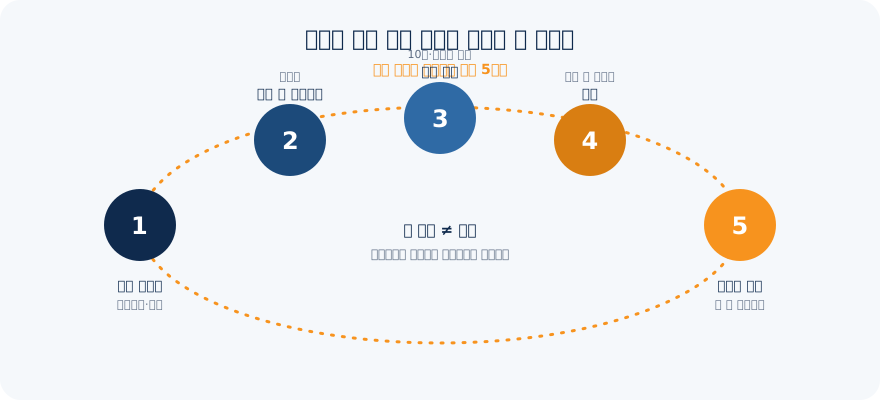
Almost everyone knows how to set a goal. Far fewer know how to manage one — and that gap is where most goals quietly die. Not on the day you write them, full of resolve, but three weeks later when nobody has looked at them since. Setting a goal and managing a goal are two different jobs. Setting is a single moment; managing is a repeating loop. If you've ever set an ambitious goal and watched it fade without a single dramatic failure, you didn't lack willpower — you lacked a management loop.
Key takeaways
- Setting ≠ managing. A goal set once and never revisited is already half-dead
- The goal management loop has 5 steps: make it visible → break into this week's actions → weekly review → adjust → connect to vision
- Track leading indicators (actions you control) more than lagging indicators (outcomes you can only wait for)
- A goal isn't carved in stone — adjusting it on a schedule is management, not failure
Setting vs. managing: what's the difference?
Goal setting is choosing the destination and making it specific — the work of turning "get fit" into "run a 10K by October." That's real and it matters (if your goal is still vague, start with SMART goal setting first). But setting is a one-time act. Goal management is everything that happens after — the weekly, repeating work of keeping the goal alive, visible, and moving.
| Goal setting (once) | Goal management (repeating loop) |
|---|---|
| Choose the destination | Steer toward it, week after week |
| Make it specific and measurable | Break it into this week's actions |
| Write it down | Look at it on a fixed day |
| Feels motivating | Feels ordinary — that's the point |
| Done in an hour | Done a little, every week |
Most advice obsesses over the left column. But a perfectly set goal with no management is just a well-worded wish.
Step 1 & 2: Make it visible, then break it into this week
A goal you can't see is a goal you forget. The first act of management is simply keeping the goal in view — a dashboard, a tracker, a board you glance at daily — so it stays in your decisions instead of drifting out of memory. Out of sight really is out of mind. The most physical version of "keep it in view" is writing your goal 100 times a day — the same sentence, by hand, every day; keep it to six words or fewer and the whole thing costs about 20 minutes instead of the 47 that makes people quit on day three.
Then comes the move that separates managers from wishers: break the goal into this week's actions. Not "what will I do this year," but "what, specifically, this week." A yearly goal is too far away to act on today; a weekly action is close enough to actually do. This is where big ambitions become small wins you can string together. And if you can’t even see the staircase from a yearly goal down to this week’s action, the middle steps are missing — dream backcasting builds that bridge by coming down from the future to three months, then to this week.
Step 3 & 4: Review weekly, then adjust
Here's the engine of the whole loop: a fixed weekly review. Same day, ten quiet minutes — what moved, what stalled, what's next. Without a scheduled review, a goal drifts silently for weeks before you notice; with one, you catch drift within days. If you build only one habit from this article, build this one (here's how to make the weekly review a habit).
And when the review shows something is stuck, you adjust — the target, the timeline, or the weekly action. This is the part people get wrong: they treat any change to the goal as failure, so they either abandon it or grind against a plan that no longer fits. A goal isn't carved in stone. Tuning it in response to real data is exactly what management is.
Leading indicators beat lagging ones
Why do so many goals feel discouraging to manage? Because people track only lagging indicators — the outcomes. Weight on the scale. Revenue. The finished manuscript. Lagging indicators are real, but they move slowly and you can't control them directly, so week to week they mostly deliver anxiety.
Leading indicators are the actions you can control that predict the outcome: workouts completed, sales calls made, pages drafted. Manage those, and the lagging numbers follow. A good weekly review looks mostly at leading indicators — "did I do the actions I committed to?" — because those are the only levers you actually hold this week.
Managing goals with OKR — one method, not the only one
Once you're managing goals, you'll want a framework to structure them, and OKR (Objectives and Key Results) is one of the best. It pairs an inspiring Objective with a few measurable Key Results, and it's built for exactly the review-and-adjust rhythm above. But it's worth being clear: OKR is one management method, not a synonym for goal management itself. If it fits your work, learn to run your goals as OKRs; if it doesn't, the five-step loop above works with any framework — or none.
How VisionDream keeps your goals alive
Goal management dies when it lives on a page nobody reopens. VisionDream is built to keep the whole loop running. Your goals sit inside the Success Tree (S = B·T·A), connected to the vision above them, so they stay visible instead of forgotten. You break each goal into habits you check off — turning "this week's actions" into daily taps. The tree grows as you complete them, making leading indicators something you can see. And when a goal stalls, the AI coach notices the drift and suggests an adjustment — a smaller action, a shifted timeline — right when the weekly review needs it. Setting the goal was the easy part; VisionDream is for the part that keeps it alive.
Your goals aren't dying because you set them wrong. They're dying because no one is managing them. Make them visible, break them into this week, review on a fixed day, adjust without guilt, and keep them tied to a vision you care about. Plant your vision, and the fruit will come. 🌱
Frequently Asked Questions
What's the difference between goal setting and goal management?
Goal setting is a one-time act — choosing a specific destination and writing it down. Goal management is the repeating loop that happens afterward: keeping the goal visible, breaking it into this week's actions, reviewing it weekly, and adjusting when something stalls. Most goals aren't set badly; they're simply never managed after the first day.
How often should I review my goals?
Weekly is the sweet spot for most goals. A fixed weekly review — same day, about ten minutes — is close enough to catch drift within days but not so frequent that it becomes noise. In each review, look mostly at leading indicators (the actions you committed to) rather than only the slow-moving outcomes.
What are leading and lagging indicators in goal management?
Lagging indicators are outcomes you can only wait for — weight, revenue, a finished project. Leading indicators are the actions you control that predict those outcomes — workouts done, calls made, pages written. Managing leading indicators is more effective because they're the only levers you actually hold this week; the lagging numbers follow.
How does VisionDream help me manage goals?
VisionDream keeps the full management loop running. Your goals live inside the Success Tree connected to your vision so they stay visible, you break each one into habits you check off daily, the tree grows as you complete them, and the AI coach suggests an adjustment when a goal stalls — exactly when a weekly review needs it.
Plant a vision, and fruit will surely grow 🌱
Start in the app →