A Top Performer Isn't the Fastest Worker — It's the Most Predictable One
I stayed later than anyone. I was usually the one turning off the office lights. And every review cycle, I landed squarely in the middle.
It stung enough that I finally asked my manager what else I should be doing. The answer has stuck with me ever since: "It's not that you can't do the work. It's that I never know when it will be done, so I can't hand you anything big."
I was indignant for a long time, because I almost never missed a deadline. I just built the whole thing the night before and dropped it on their desk in the morning. From where my manager sat, my work was a black box that revealed nothing until it was finished. Meanwhile, the colleague who left two hours earlier than me got better reviews — because on Wednesday she sent one line: "About halfway. You'll have it Friday morning."
Looking back, everything I was doing came from the same illness. I couldn't start until I was fully prepared, I spent whole days making the plan look pretty, and building the template quietly replaced doing the work. Being busy with nothing to show for it wasn't laziness. It was this.
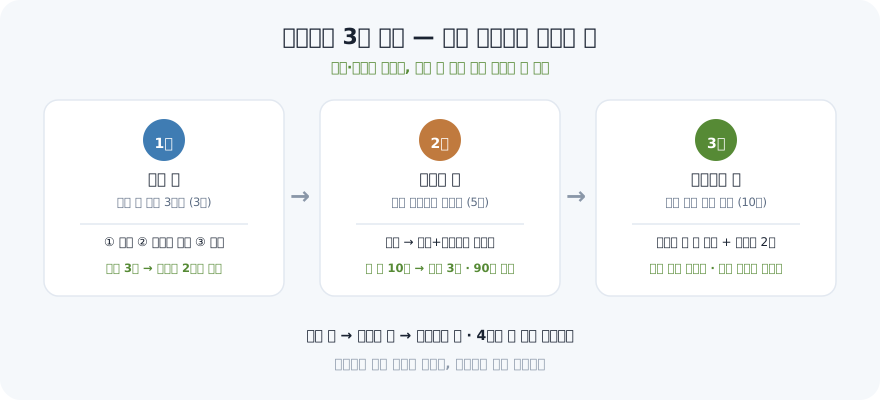
I used to write ten things on my to-do list every day. When I cut it to three, the number of things I actually finished went up. This article is that trial and error, organized into three layers. 🌱
Key takeaways
- A top performer isn't someone who does more or moves faster — it's someone who lets other people predict when their work will land
- When a hard worker gets mediocre reviews, the cause is rarely skill. It's how they accept work and how they show progress mid-flight
- Layer 1, intake — confirm purpose, definition of done, and deadline within 3 minutes of being asked
- Layer 2, breaking down — write tasks as verb + object (the next physical action), not nouns, and keep only three per day
- Layer 3, handing back — share a half-finished draft at the halfway point instead of a finished one at the deadline
- When you're going to be late, what's needed isn't an apology — it's a new date plus two options
- Skipping a 3-minute check buys you 2 hours of rework. One misfire a week is about 8.6 hours a month
The definition is wrong to begin with — it's predictability, not throughput
In one sentence: a top performer isn't the person who does the most work fastest. It's the person who makes their finish line visible to everyone else.
Picture two people who submit the same deliverable on the same day. A sent a note Thursday — "Structure is about half done, you'll have it Friday at 11." B posted the finished file Friday at 11 with no warning. Even if the quality is identical, next week's big project goes to A.
The reason is simple. Handing someone work means putting your own schedule up as collateral. If you don't know when they'll finish, you can't plan your week. So you have to ask — and the moment you have to ask, managing that person starts costing something. In practice, "they're good at their job" usually decodes to one thing: low management cost.
What matters here is how trust actually accumulates. Trust isn't the average of your ability; it's the running count of predictions that came true. Someone who has delivered what they said on the day they said it five times gets the next project even when a deliverable falls a little short. Someone whose work is excellent but whose timing is a mystery quietly gets excluded from the big stuff.
That's the common thread among hardworking people with mediocre reviews. They spend 100% of their energy on the quality of the artifact and 0% on making their progress visible. But the person evaluating you doesn't experience one artifact — they experience the entire two weeks that work was in flight. If there was no signal for two weeks, what they remember is "I was anxious."
Protecting focus time is a separate problem. If you can't get into deep work at all, start with Deep Work — How to Focus Deeply in a Distracted Age. This article only covers how you take work in and how you hand it back.
Top performer vs. person who does a lot — 5 forks in the road
The difference between the two isn't a stat sheet. It's five behaviors.
| Fork | Person who does a lot | Top performer |
|---|---|---|
| ① Taking the request | "Sure, got it" and starts immediately | Spends 3 minutes confirming before starting |
| ② Declaring the deadline | Accepts whatever date they're given | States their own date first (with a 20% buffer) |
| ③ Mid-flight update | Silent until it's finished | Shares an unfinished draft at the halfway point |
| ④ Rework rate | 40–50% rebuilt after the direction turns out wrong | Around 10%, because it was aligned early |
| ⑤ Declining and renegotiating | Can't say no, absorbs it with overtime | Picks what to push back together with the requester |
The row to study is ④. Most of what looks like a speed difference is actually a rework difference. If two people each spend eight hours and one reworks 40% of it, only 4.8 hours moved forward. Same hours, 3.2 of them thrown away. And the cause of rework is almost always ① — they didn't ask when they took the work.
⑤ is widely misunderstood too. The idea that top performers are good at saying no is half wrong. In practice, "I can't do it" is almost never used. The sentence that actually gets used is: "I can't do both this week. Which one should I look at first?" That isn't a refusal — it's handing the prioritization back to the requester, and the requester almost always pushes one out.
Layer 1. Intake — three sentences, three minutes
Most work goes sideways not during execution, but in the 30 seconds when you accept it.
There are exactly three things to confirm.
- Purpose and decision criteria — who makes what decision using this deliverable
- Definition of done — what state counts as finished
- Deadline and priority — by when, and what comes first if it collides with existing work
Written out so you can copy them verbatim:
- ① Purpose → "Can I ask who's using this and what decision they're making with it? That'll make it much easier to choose what to include."
- ② Definition of done → "What does finished look like here — just the table, or do you want the conclusion written out as well?"
- ③ Deadline and priority → "When do you need this? Project A is due Thursday — which of the two should I take first?"
All three take less than three minutes. Here's what skipping those three minutes actually costs.
| Item | Skipped the check | Spent 3 minutes |
|---|---|---|
| Time before starting | 0 min | 3 min |
| How often direction is wrong | 1+ per week | 1 or fewer per month |
| Rework when it is wrong | 2 hours on average | — |
| Monthly loss (4.3 weeks) | 2 hrs × 4.3 = about 8.6 hours | 3 min × 4.3 = about 13 minutes |
| Annualized | About 103 hours (roughly 13 working days) | About 2.6 hours |
One misfire a week costs 8.6 hours a month — about 13 working days a year lost to rework. The check costs 13 minutes a month. It's a trade where you pay 13 minutes and buy back 8.6 hours, and most people decline it.
They decline it not because the time is precious, but because of a worry: "They'll think I should already know this." The reality is the opposite. The person who takes the work without asking and comes back two days later with the wrong thing looks far less competent. There is one rule about how you ask, though — ask everything at once, on the spot, and then stop asking. Dribbling questions out over two days is when you genuinely become a management cost.
Managers who don't give you criteria are common, and there's a specific move for that. "Just to confirm I've understood: I'll build it through the summary table and get it to you Thursday. Let me know if that's off." It isn't a question — it's declaring your interpretation. People find it hard to articulate their criteria from a blank page, but they can spot instantly whether someone else's sentence is wrong. That single confirmation sentence catches half of all direction errors.
If several requests have collided and the priority itself is murky, it's faster to set your quarter's top-level goals with Goal Management — How to Keep the Goals You Set Rolling before you litigate the individual requests. When the top is settled, you can answer "which one first?" yourself.
Layer 2. Breaking down — into next physical actions
Your to-do list doesn't shrink because the items on it are topics, not actions.
"Clean up the report" is not an action. It's the name of a territory. Your brain reads that sentence, spends about three seconds hunting for a starting point, and in those three seconds the dread rises — and when dread rises, your hand goes somewhere else. So it gets pushed to tomorrow every time you look at the list.
There's one fix. Turn the noun into a verb + object. The sentence has to contain how your body will move right now.
| Vague task (noun) | Next physical action (verb + object) | Est. time |
|---|---|---|
| Clean up the report | Open last year's folder, copy the Q3 table into a new doc | 10 min |
| Handle the vendor | Write a 3-line email to Kim confirming the delivery date | 5 min |
| New proposal | On half a page, write 1 problem sentence and 3 candidate solutions | 20 min |
| Research | Run 2 searches, collect 5 links, write down only the titles | 15 min |
| Prep for the meeting | Note 3 agenda lines and the 1 sentence I'll say | 8 min |
The test after converting is one question. Does reading it tell you which window to open? If not, it's still a noun.
What comes next matters more. Keep only three per day.
I wrote ten for years. And every evening I finished three or four. Objectively that's a day I completed three or four things — but what stayed in my head was the six I didn't do. I was banking six failures a day. When I cut the list to three, two things changed. First, the time spent choosing what to start disappeared, so I started faster. Second, "done" started showing up in the evening. The feeling of having finished is what sets tomorrow's starting speed.
Place the three like this: one in each of three 90-minute blocks. Ninety minutes is about the ceiling most people can hold focus, and you leave 15 minutes empty between blocks. That 15 minutes is the buffer that absorbs meetings, messages, and admin. Without it, the 30 minutes you lost in the first block pushes everything to the end of the day. The step-by-step method for actually putting blocks on a calendar is in Time Blocking — Designing Your Day in Blocks.
If you keep getting bounced out of a block, that's not a layout problem. The causes vary by person, and the type-by-type prescriptions in How to Improve Focus are more precise.
Layer 3. Handing back — the 50% draft rule and renegotiating deadlines
The cheapest way to cut rework isn't raising quality — it's showing the work once before it's finished.
Direction errors are already decided around the 20% mark. But they get discovered at 100% — after submission. So fixing one error means unwinding everything you built. Show it at the halfway point and the same error costs half as much to fix.
The rule I use: when half the estimated time has passed, share it exactly as it is, at 50% completion.
A 50% draft contains only three things.
- The outline or structure — what order this will go in
- One candidate conclusion sentence — based on the data so far, the conclusion looks like this
- Explicit gaps — leave what you haven't filled in inside square brackets
The message reads like this: "Sharing this at the halfway point. Here's the structure I've landed on, and the conclusion is trending toward X. If that direction is right, I'll fill in the rest by Thursday."
The fear people have here is "won't showing something unfinished make me look incompetent?" The actual reaction is the reverse. The other person relaxes because they now know where things stand. That's exactly where the predictability described earlier gets built. Between someone who drops one finished file and someone who sent one signal at the halfway point, the second gets the next project.
When you're going to be late — not an apology, a new date and options
The worst response to a deadline you're going to miss is only saying sorry. An apology carries no information, so the other person can't decide anything. What's needed is a new date (a number) and two options.
- ① Scope adjustment → "A is done and B is bigger than expected. Would you rather have A on Friday and B next Tuesday, or both on Tuesday?"
- ② Quality adjustment → "I can get you draft quality by Thursday, or fully reviewed by Monday. Which do you want?"
- ③ Sequence adjustment → "Project C came in this week and now two things overlap. Tell me which to push back and I'll match that."
The four shared rules: don't open with an apology · say the new date as a number · give two options to choose from · say it while half your slack is still left, not on the due date.
That last one is decisive. The same words land completely differently depending on when they arrive.
| When you say it | What they hear | Options still available |
|---|---|---|
| Half the slack still left | "This person is managing it" | Scope, sequence, staffing — all adjustable |
| The day before it's due | "Why am I only hearing this now?" | One: lower the quality |
| The day it's due, or after | "I can't hand this person anything" | None — damage control |
Same delay, but the first row builds trust and the third row destroys it. The difference wasn't ability. It was timing.
Where you are right now — a 5-question self-check
Answer based on the last two weeks. Yes = 2 points, sometimes = 1, no = 0.
| # | Question | Yes | Sometimes | No |
|---|---|---|---|---|
| 1 | I asked about the definition of done when taking work | 2 | 1 | 0 |
| 2 | I stated the deadline first, with a buffer | 2 | 1 | 0 |
| 3 | I shared progress at the halfway point, before finishing | 2 | 1 | 0 |
| 4 | My to-do items are written as verb + object | 2 | 1 | 0 |
| 5 | When slipping, I led with a new date and options | 2 | 1 | 0 |
Three bands:
- 8–10 — already predictable. What you need next isn't a personal technique but weekly load management. Jump straight to week 4 of the switch plan.
- 4–7 — one of the three layers is empty. Low on 1 and 2 means intake; low on 4 means breakdown; low on 3 and 5 means handback. Fix only the lowest layer for two weeks.
- 0–3 — the classic gap between hours worked and how you're rated. Trying harder from here only adds overtime. Repeat week 1 (intake) alone for all four weeks and you'll feel the difference.
The most common combination is a high score on 4 with zeros on 1 and 3 — managing your tasks diligently while nobody knows about it. That person works the longest hours and gets a middling review.
The 4-week switch plan
Trying to change all three layers at once collapses in week one. Add one per week.
| Week | The one thing this week | Daily cost | Metric | Bar to move on |
|---|---|---|---|---|
| Week 1 | Intake — three confirmation sentences on every new request | 3 min | Requests confirmed ÷ requests received | 2 of 3 or better |
| Week 2 | Breakdown — convert to verb + object, three per day | 5 min | Days you finished all three | 3 of 5 days |
| Week 3 | 50% draft — share one in-flight item at its halfway point | 10 min (once) | Drafts shared | At least 1 actually sent |
| Week 4 | Weekly load check — next week's volume and deadline collisions | 20 min (once) | Collisions caught in advance | Renegotiate 1 in advance |
What you look for in week 4 isn't "did my workload shrink." It's did I see next week's blowup this week. Spend 20 minutes on the weekend putting next week's three deadlines on a calendar and you'll see two of them landing on Tuesday. Send renegotiation script ③ right then and that week ends without overtime. How to make that 20 minutes a habit, format and all, is in The Weekly Review Habit.
Three common misconceptions
| Misconception | What's actually true |
|---|---|
| ① Top performers are good at saying no | It's renegotiation, not refusal. "I can't" barely gets used in practice. What gets used is "I can't do both this week — which should I look at first?" Refusal spends the relationship; renegotiation makes the other person the decision-maker |
| ② Top performers are good with tools and templates | The trap where tool setup replaces the work is far bigger. A day spent three hours building a template is a day you did nothing. One rule blocks it — batch tool maintenance into 20 minutes once a week. Don't touch it on weekdays |
| ③ Top performers are fast | They're not fast, they just rework less. Same eight hours: a 40% rework rate means 4.8 hours of real progress, 10% means 7.2. That 1.5× gap looks like speed, and it was decided in the three minutes at intake |
② catches conscientious people especially. I rebuilt my Notion dashboard three times, and all three were weeks with a deadline right in front of me. Grooming the tool feels like working. The real work is uncomfortable and the tool is comfortable. That's why I still only touch my tools for 20 minutes on Friday afternoon.
🌱 Putting this into practice with VisionDream
The layer that breaks most often is layer 2 — choosing three things every day. VisionDream's four-level planner (yearly, monthly, weekly, daily) lets you tag today's tasks with A/B/C priority and shows, on the same screen, which higher-level goal each task automatically connects to — so "which three do I keep?" becomes a question of connection rather than gut feel. Unfinished items roll over to the next day automatically, so the list never resets to zero, and the weekly One Thing pins the single commitment for the week at the top. Week 4 of the switch plan (the weekly load check) is covered by Sunday's weekly review — what went well, what didn't, what you learned, and next week's One Thing. The app is the tool; you're the one doing it.
Do exactly one thing today. Delete two items from today's list and move them to tomorrow. You'll feel guilty deleting them, and those two were never going to happen today anyway. Rewrite what's left as verb + object, and when one of them is about halfway done, send one line to whoever is waiting: "About halfway — you'll have it Thursday."
The year I worked the longest hours, my mistake wasn't a lack of effort. It was that I worked in a way that made the effort invisible. A top performer isn't someone who does more. It's someone who lets other people see where their work will land. Plant a vision, and the fruit will surely come 🌱
Frequently Asked Questions
How do I become a top performer at work?
Stop optimizing for doing more or moving faster, and start optimizing for letting other people predict when your work will land. Three layers, in order. First, when you take work, confirm the purpose, the definition of done, and the deadline within three minutes. Second, write tasks as verb + object (open last year's folder and copy one table) rather than nouns (clean up the report), and keep only three per day. Third, instead of a finished file at the deadline, share an unfinished draft at the halfway point. Fixing just the emptiest of the three layers for two weeks changes how you're perceived.
I'm junior — isn't it rude to ask questions when I'm handed work?
It's the opposite. Taking the work without asking and returning two days later with the wrong thing is the bigger burden. There is a rule about how, though: ask everything at once on the spot, and don't dribble follow-ups out over the next two days. If asking feels awkward, declare your interpretation instead of asking a question. 'Just to confirm I've understood: I'll build it through the summary table and get it to you Thursday. Let me know if that's off.' People struggle to articulate their criteria, but they can spot instantly whether someone else's sentence is wrong.
I work remotely and never see my manager. How do I build trust?
In remote work, predictability is essentially everything. The information that used to travel through face time is gone, so progress signals become the only evidence. Fix two things. One: right after you take work, put 'I'll get you X by Y' in writing (verbal-only leaves no record and effectively never happened). Two: when half the estimated time has passed, share the work exactly as it is at 50%. An outline, one candidate conclusion sentence, and bracketed gaps are enough. Those two signals beat adding a daily status report.
My manager never gives me criteria or a definition of done. What then?
Usually the criteria exist but haven't been put into words. That's why open questions ('how should I do this?') fail and closed confirmations work. Use two moves. First: 'What does finished look like here — just the table, or the conclusion written out as well?' Two options make it easy to answer. Second, if the answer is still vague, throw them a draft at the halfway point. People find it hard to state criteria from a blank page but find it easy to look at something concrete and say 'not this.'
Isn't it better to make it perfect and deliver once?
Only if the direction is right. The problem is that direction errors are decided around the 20% mark but discovered at 100% — after you submit. So delivering one finished file means unwinding everything you built when something is off. Show it at the halfway point and the same error costs half as much. Concretely, the difference between a 40% and a 10% rework rate is 4.8 hours versus 7.2 hours of real progress out of an eight-hour day. That's what people are seeing when they think someone is 'fast.'
Work keeps piling on, I can't say no, and I'm surviving on overtime.
Don't refuse — renegotiate. What works in practice isn't 'I can't do it' but 'I can't do both this week, which should I look at first?' It hands the prioritization decision back to the person who asked, so it doesn't spend the relationship, and they usually push one out. Timing is decisive. Say it while half your slack remains and scope, sequence, and staffing are all still adjustable; say it the day before it's due and the only lever left is lowering quality. Twenty minutes on the weekend laying next week's deadlines side by side lets you find Tuesday's collision on Sunday.
Plant a vision, and fruit will surely grow 🌱
Start in the app →