The 90-Second Rule for Envy: 4 Steps to Stop Comparing Yourself to Everyone Else
Anyone can be gracious on a good day. The difference shows up on the day someone else gets the good news.
I learned that late. A few years ago I opened a group chat and saw that someone who started the same year I did had just been promoted. I tapped a party emoji, put my phone face down, and then got nothing done for the rest of the evening. Through dinner, through the shower, the same sentence kept looping: what exactly am I doing with my life. By the time I got into bed I had spent thirty minutes scrolling his LinkedIn and Instagram, fully aware that every additional post made me feel worse, and completely unable to stop my thumb.
If I describe that state honestly: rest didn't restore anything, and one small piece of criticism could take down a whole day. I had told myself I was recovering. One person's good news showed me the floor.
Two things became clear much later. First, the feeling itself was fine — normal, even useful. Second, the behavior I chose during those minutes (the thirty-minute scroll, the interrogation I ran on myself) did far more damage than the feeling ever did. The emotion passes in a couple of minutes. What you do inside those couple of minutes sets up the next several days.
This isn't a piece about eliminating envy. It's about how to get through the ninety seconds after it hits, and the four steps that redirect it afterward. 🌱
Key takeaways
- Inferiority is not a defect. The problem is when it hardens into an inferiority complex — an excuse for not acting
- Upward comparison helps only when you can see the path. When you can only see the outcome, it corrodes
- Self-loathing comes in three types — Ability, Pace, Identity. Different type, different prescription
- The physiological surge of an emotion largely passes in about 90 seconds. The whole trick is not judging, searching, or scrolling during them
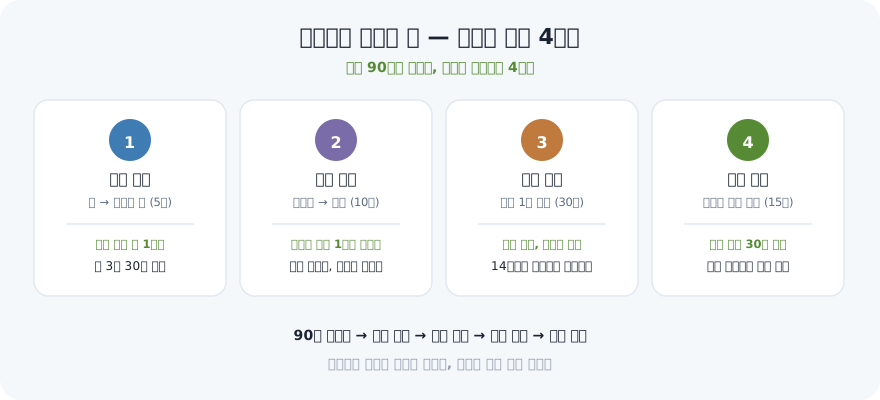
- After the 90 seconds, four steps — reframe the baseline → translate the envy → collect evidence → design your exposure
- Three responses that make it worse — downward comparison for comfort, proving yourself through output, and trying to delete the feeling
- Today's job is one thing: write one 30-second line of evidence
An inferiority feeling and an inferiority complex are completely different things
In one line: an inferiority feeling is something almost everyone has, and an inferiority complex is what you call it when that feeling becomes your reason not to try.
The distinction comes from Alfred Adler's individual psychology. Adler did not treat the inferiority feeling as pathology. He treated it as the ordinary engine that moves people toward being better than they currently are — the gap between the ideal self and the present self, felt as discomfort. Someone who never feels short of anything never learns anything and never practices anything either.
The trouble starts when that feeling fuses with one particular sentence: "Because I'm [X], I can't."
| Inferiority feeling | Inferiority complex | |
|---|---|---|
| What it is | An emotion arising from the gap between your ideal self and your current self | A thinking habit that uses that gap as grounds for not acting |
| Who has it | Almost everyone, almost every week | People who left the feeling unexamined for a long time |
| How it sounds | "I'm not as good at this as she is yet" | "I didn't go to the right school, so it was never going to happen" |
| What comes next | You go looking for what to learn | You postpone the attempt and reinforce the reason |
| Over time | Your skill grows | Your list of reasons grows |
| The prescription | Leave it alone, just aim it | Break the sentence into testable pieces |
What makes the right-hand column dangerous is that the sentence usually isn't false. There really are rooms where pedigree helps. Starting late really is a disadvantage. So arguing with it loses, and losing the argument makes the person defend it harder.
What worked wasn't rebuttal. It was splitting. Take "my background means it won't happen" and write it out like this:
- What exactly do I want? (One sentence, under twelve words.)
- Which specific part does my background actually block? (Name the gate, not the vibe.)
- What parts have nothing to do with my background? (At least three.)
- Which single item from #3 can I start in the next thirty minutes? (Pick one.)
Item 3 almost always runs longer than expected. And the moment you do one thing from item 4, the complex settles back down into a plain feeling. This move — taking a sweeping declaration and lowering it into testable fragments — is exactly the mastery-experience design covered in how to build self-efficacy.
Two directions of comparison — when it heals and when it harms
Social comparison theory (Festinger, 1954) starts from a simple observation: when people lack an objective standard for evaluating themselves, they use other people as the standard. Comparison isn't a habit you can delete. But the direction decides whether the result is fuel or damage.
| Upward comparison (people ahead of you) | Downward comparison (people behind you) | |
|---|---|---|
| Immediate effect | Stimulation, a target becomes visible | Relief, mood recovers |
| Helps when | You can see that person's process and path | You are genuinely about to collapse — and only briefly |
| Harms when | You can only see the outcome (exactly how social feeds are built) | It becomes a habit — your standard keeps sliding down |
| What it leaves behind | One specific thing to learn next | Nothing at all |
| Healthy frequency | Once or twice a week, deliberately | Effectively zero |
| Good use | Find and read the first three months of someone who started three years before you | — |
Here is the crux. Upward comparison flattens people not because the other person is impressive, but because the outcome is visible and the process is not. A feed is structurally designed to display results. You see the promotion announcement; you don't see the three years of rejections behind it. That's why scrolling upward comparison almost always ends badly.
Flip it and the same comparison becomes useful. Go find that person's earliest posts instead of their latest. The instant you can see "oh, her first year looked like this too," the feeling changes from envy into reference material. My own rule now: when someone makes me feel small, I read their oldest work before I read their newest. That one habit measurably reduced the damage social feeds do to me.
Three types of self-loathing — a quick self-diagnosis
If you lump everything under one word, you can't choose a prescription. In practice, self-loathing splits into three fairly distinct branches. Pick the sentence that has run through your head most often in the past month.
| Type | The sentence | The real problem | The right prescription | What not to do |
|---|---|---|---|---|
| 1. Ability type | "She's that good and I'm still like this" | You're comparing their outcome to your process | Change the comparison target to that person's earliest work | Go find even more impressive people |
| 2. Pace type | "We started together and I'm the only one standing still" | You're measuring progress in elapsed time. Starting conditions were never equal | Change the unit from time elapsed to cumulative reps completed | Double your workload to match someone else's speed |
| 3. Identity type | "Even doing well doesn't help. The problem is me" | Your sense of worth itself wobbles regardless of results | Log one line a day from outside the performance domain (relationships, care, taste) | Try to disprove it with achievement |
Of the three, the Identity type is the most dangerous, because results don't lower the feeling. Try to solve it with output and you will push forever: every time performance rises, the standard rises with it, so you never arrive. If that's you, an article about executing harder is the wrong medicine. Read self-compassion — how to get back up after you fail and how to build self-esteem first.
If you're the Pace type, changing one unit of measurement changes how the whole thing feels. Not "three months and I'm still nowhere," but "twenty-two sessions done." Time passes whether you show up or not; reps only accumulate when you do. That's the same accumulation logic described in the power of consistency.
If you're the Ability type, the prescription from the previous section applies directly. Change the target. Not that person today — that person three years ago.
The 90 seconds after it hits: pass through it, don't judge it
The physiological surge an emotion produces in the body generally peaks and subsides in about ninety seconds. The reason feelings continue past that is that we keep re-playing the story that triggered them. In other words: the first ninety seconds are automatic, and everything after is a choice.
So the rule is exactly one line. For ninety seconds after the feeling arrives, you make no judgments, run no searches, and open no apps. Deciding in advance what goes into those ninety seconds — down to the second — raises your execution rate dramatically.
| Window | Move | Specifically | Why this one |
|---|---|---|---|
| 0–10s | Change location | Stand up and walk to another room, a hallway, a window. Leave the phone behind | Changing your visual field interrupts the rumination loop. Take the phone and you will be back in the feed within seconds |
| 10–70s | Six-count exhale | Inhale four counts, exhale six, six times. Make the exhale longer than the inhale | A longer exhale brings arousal down. The counting itself crowds out rumination |
| 70–90s | One-line note | In your notes app, write only: "Inferiority came up just now, triggered by [X]" | Naming an emotion lowers its intensity. Add no interpretation and no evaluation |
There's one rule for the note. Do not write "why am I like this." That sentence isn't a record, it's an interrogation, and an interrogation turns ninety seconds into ninety minutes. Facts only — when, what you saw, what came up.
After the ninety seconds, add a second rule: make no decisions for at least ten minutes. Decisions made from that state are almost always extreme. I'm quitting this job. I'm deleting every account. Starting today I study five hours a day. Nearly all of them get reversed within two days.
If it hits hardest at night, that may be a condition problem rather than an emotion problem. I've made this kind of self-assessment a banned activity after 1 a.m. If you have a time of day where you reliably fall apart, apply the recovery-first principle from how to break out of a slump before you apply anything here.
The four steps that break the comparison loop
Once you're through the ninety seconds, it's time to change direction. Order matters. Start at step 4 (exposure) and it becomes avoidance; start at step 3 (evidence) and you have no standard, so you won't know what to write.
Step 1 — Reframe the baseline (5 minutes, once)
Move the comparison target from other people to yesterday's you. But resolving to "compare myself to yesterday" never works on its own, because comparison requires a measurable indicator. So you fix on exactly one.
- Good: walk 30 minutes three times a week / study 20 minutes a day / revise the résumé twice a week
- Bad: get healthy / work hard / grow
With two or more indicators, any day you miss one gets filed as total failure. With one, the day is either kept or not kept — unambiguous. If you can't extract an indicator, work backward from the state you want using backcasting goal setting and the indicator falls out on its own.
Step 2 — Translate the envy (10 minutes)
Envy is information. Wanting what someone else has is the most accurate available signal about what you actually want. The problem is that undifferentiated envy ("I want his whole life") produces no action whatsoever. So you translate it.
The translation is three lines:
- Narrow the envy to a single point. Not "that person, generally" but "the way she finishes her sentence in a meeting even when someone talks over her."
- Rewrite it as your own goal sentence. "I say at least one thing in every meeting."
- Write the first action you can take in the next thirty minutes. "Read tomorrow's agenda tonight and prepare one comment."
The narrowing is the whole trick. Once you look closely, what you envy is almost never a person's entire life — it's one or two capabilities. At that moment the person stops being a rival and becomes a reference. If step 2 generated several goal sentences at once, sort them by life area with a Mandalart planner and each one finds its own square.
Step 3 — Collect evidence (30 seconds a day, minimum 14 days)
Self-esteem does not rise on encouraging words. It rises on evidence. So every day you write exactly one line: what you got done.
- Format: "9/3 — walked 30 minutes" / "9/4 — fixed one paragraph of the résumé"
- Banned: attaching evaluations ("only thirty minutes"), listing what you failed to do, batch-writing a week at a time
Why this works: at the moment inferiority spikes, your brain calculates your own track record as zero. You did things over the past two weeks, and what surfaces anyway is "I've done nothing." Fourteen lines on a page physically refute that distortion. I keep mine on a widget on my lock screen.
The minimum window before it starts working is fourteen days. Write three lines, decide it's underwhelming, and quit, and nothing happens. The mechanism by which tiny records change your posture is covered in more depth in the power of small wins.
Step 4 — Design your exposure (15 minutes, reviewed monthly)
Not looking, by willpower, fails. You have to design it out of view. But extreme measures like deleting accounts tend to reverse within a week, so go in order.
| Measure | How | Intensity | When to use it |
|---|---|---|---|
| List the triggers | Write down, on paper, the accounts and chats that destabilized you in the last two weeks | Low | Always the first step |
| 30-day mute | Instead of unfollowing, mute notifications and feed for 30 days | Medium | People you can't afford to disconnect from |
| Time-window block | Block the apps only during your vulnerable hours (say 11 p.m.–7 a.m.) | Medium | When you only collapse at particular hours |
| Off the home screen | Remove the app from the home screen; reachable only via search | Medium | When you open it unconsciously |
| Prune the list | Actually unfollow or block | High | Only when a 30-day mute wasn't enough |
The common mistake here is blocking without installing a replacement behavior. If you block social apps at 11 p.m., that slot goes empty, and an empty slot eventually gets refilled by the same app. Put step 3's one-line evidence entry there and it takes thirty seconds. If phone use in general is outside your control, it's faster to fix the shape of the day first with how to improve focus and time blocking.
A four-week run sheet
Try to do all four steps at once and you'll break in week one. Add exactly one thing per week.
| Week | What you do this week | Daily cost | Indicator | Gate to advance |
|---|---|---|---|---|
| Week 1 | Practice the 90-second sequence + choose your single indicator | Under 2 min | Times you ran the 90-second protocol | Ran it 3+ times |
| Week 2 | Write one line of evidence every day | 30 sec | Days recorded | 5 of 7 days |
| Week 3 | One envy translation + execute the first action | 10 min (once) | One goal sentence secured | You actually did the first action |
| Week 4 | Review your exposure design + a four-week retrospective | 15 min (once) | Days destabilized vs. week 1 | Fewer destabilized days |
What you're looking for in the week 4 retrospective is not "has the inferiority gone away." It's has the time-to-recovery shortened. If something that used to cost you an entire day now costs two hours, that is the win. Set "never feel it again" as the target and you are guaranteed to fail.
Three responses that make it worse
| Common response | Why it looks like it works | What it actually costs |
|---|---|---|
| 1. Downward comparison for comfort | "Plenty of people are worse off than me" — instant mood relief | Your standard slides downward. Self-esteem that requires other people to be beneath you collapses again the moment they do well |
| 2. Proving yourself through output | Powerful motivation; you go explosively hard for a few days | The goal mutates from "live well" into "win and show them." Even winning raises the bar, so there's no end — and it usually terminates in burnout in two or three weeks |
| 3. Trying to delete the feeling | "I shouldn't think like this" suppresses it and buys quiet | Suppressed emotion returns amplified. Worse, you start criticizing yourself for having felt it, adding a second layer of self-blame |
Number 2 catches conscientious people especially. Cut your sleep, double your schedule, hold it for a few weeks, and results do move a little. But that route walks straight into the collapse pattern described in how to overcome perfectionism: the standard keeps climbing until you can't be satisfied by your own results.
Number 3 is the most common mistake of all. Inferiority isn't a bad feeling — it's a signal with directional information attached. Turn off the signal and you lose the direction with it. For building the capacity to sit with the feeling rather than erase it, how to build mental strength goes deeper.
What to say in the moment — scripts by situation
When your head won't organize itself, it's much faster to have a sentence ready to say out loud. These are the ones I actually use.
- A friend gets good news and congratulations won't come out. Internally: "Yes, I'm envious. Envy means I want that, not that I'm a bad person." Out loud: "Genuinely, congratulations. At some point tell me how you prepared for it." That last sentence is the load-bearing one — the instant you convert it into a question, the person stops being a competitor and becomes a source.
- A promotion post lands in the group chat. Send one line of congratulations and then close the app without leaving the chat. Then run the 90-second sequence. If you stay and keep scrolling, rumination starts.
- Someone junior to you is moving faster. "I accept that our starting lines were different. My indicator is my own, and there's one of it." Then write that day's line of evidence. Your rank against other people is outside your control; your indicator is inside it.
- You're scrolling and suddenly feel small. "Right now I am comparing their outcome to my process." Say it out loud and close the app. Long sentences don't come out under pressure, so memorize a short one.
- A holiday dinner or family gathering, and the comparisons start. "So what are you doing these days?" — answer with one present-tense line: "I'm working on [X] right now." No defense, no explanation. The longer the explanation, the longer the interrogation.
What these scripts have in common is that none of them deny the feeling. Say "I'm not jealous" and your brain knows you're lying. "I'm envious — so what do I do with that" is the version that produces a next action.
🌱 Put it into practice with VisionDream
The step that breaks most often is step 3: stacking one line of evidence every day. Put your single indicator into the Today tab (B·T·A) as an Action check and the goal sentence from step 2 into Belief (the affirmation check), and the record takes thirty seconds a day while the calendar heatmap shows your last two weeks at a glance — a screen that physically refutes "I've done nothing." As the checks accumulate the Success Tree grows stage by stage, and on the day you miss, a streak shield (2 per month, applied automatically) protects the run for you. Sunday's Weekly Review — what went well, what didn't, what you learned — stands in for the week 4 retrospective. There is no screen anywhere in the app that ranks you against other people. The tool is the app; the protagonist is you. If you'd rather keep your goal in front of you as an image, see how to make a digital vision board.
Do exactly one thing today. It takes thirty seconds. Open your notes app and write today's date plus one line about something you got done. Size doesn't matter. "Did the dishes" counts. "Fixed one line of the résumé" counts. One line tomorrow, one line the day after. Once fourteen lines have stacked up, the next time inferiority insists that you've done nothing, the page argues back on your behalf.
On the evening that promotion post took down my whole day, my mistake wasn't feeling envious. It was stretching a ninety-second feeling into a three-hour one. Emotions arrive like guests and they leave. All you have to decide is where you let them sit. Plant a vision, and the fruit will come 🌱
Frequently Asked Questions
What should I do when the feeling of inferiority is overwhelming?
Get through the first ninety seconds before you do anything else. Stand up and walk to a different space, leaving your phone behind (0–10s), inhale for four counts and exhale for six, six times (10–70s), then write one line in your notes app: 'Inferiority came up just now, triggered by X' (70–90s). Do not write 'why am I like this' — that is an interrogation, not a record, and it stretches ninety seconds into ninety minutes. After the ninety seconds, make no decisions for at least ten more; decisions made in that state are usually reversed within two days.
What is the difference between an inferiority feeling and an inferiority complex?
In Adler's individual psychology, an inferiority feeling is the ordinary emotion produced by the gap between your ideal self and your current self, and it functions as an engine for growth. The problem is when that feeling hardens into 'because I'm X, I can't' — that is an inferiority complex. The feeling sends you looking for what to learn; the complex postpones the attempt and lengthens your list of reasons. The test is simple: if an action follows the sentence, it's a feeling. If a surrender follows it, it's a complex.
Social media makes me feel terrible about myself. Should I delete my accounts?
Not immediately. Extreme measures tend to reverse within a week. Going in order has a much higher success rate: (1) write down on paper the accounts and chats that destabilized you in the past two weeks, (2) mute for 30 days instead of unfollowing, (3) block the apps only during your vulnerable hours, such as 11 p.m. to 7 a.m., (4) remove them from your home screen so they're reachable only by search, and only if none of that works, prune the list. Crucially, install a replacement behavior in the freed-up time — blocking and leaving the slot empty means you'll open the app again. A thirty-second 'one thing I got done today' line fits there perfectly.
I feel a sting when friends succeed. Does that make me a bad person?
No. Envy is not a moral event, it's information — the most accurate signal you have about what you actually want. You become unkind not at the moment you feel it, but at the moment you use it to diminish someone. In practice, do this: internally acknowledge 'yes, I'm envious,' and externally say 'genuinely, congratulations — at some point tell me how you prepared for it.' The instant you convert envy into a question, the other person stops being a competitor and becomes a source.
Is low self-esteem the same thing as feeling inferior?
They're different. Inferiority is situational — it rises in relation to a particular person or domain. Self-esteem is the underlying trust you have in yourself regardless of comparison. With solid self-esteem, an inferiority spike stops at 'she's good at that part.' With low self-esteem, the same trigger generalizes into 'I am an inadequate person.' The prescriptions differ accordingly: inferiority is handled by changing the comparison baseline, self-esteem by accumulating evidence that you keep small promises to yourself. If both apply to you, start with the one-line evidence log.
How do I tell which type of self-loathing I have?
Use the sentence that has run through your head most often in the past month. If it's 'she's that good and I'm still like this,' you're the Ability type — comparing their outcome to your process. If it's 'we started together and I'm the only one standing still,' you're the Pace type, measuring progress in elapsed time. If it's 'even doing well doesn't help, the problem is me,' you're the Identity type. Ability type: change your comparison target to that person's earliest work. Pace type: change your unit from time elapsed to cumulative reps completed. Identity type: log one line a day from outside the performance domain.
When should I see a professional about this?
Everything in this article is a self-management toolkit for everyday inferiority, not treatment. If any of the following has continued for two weeks or more, talk to a professional: daily functioning has broken down (work, sleep, eating), interest and motivation have drained out across the board, or self-criticism has moved toward thoughts of self-harm or death. Piling on more self-help techniques when the intensity is beyond what you can carry alone tends to add another layer of self-blame. Asking for help isn't a failure — it's the most efficient available move.
Plant a vision, and fruit will surely grow 🌱
Start in the app →Related posts
- 🍬The Science of Self-Control — It's Not Willpower, It's What the Marshmallow Test Actually Found
- 🤍After You Fail — How Self-Compassion Restarts You Faster Than Self-Criticism
- 🏅The Power of Small Wins — Why Tiny Progress Beats Big Goals
- ⚡When You Have No Motivation — 4 Systems That Don't Rely on Willpower