How to Improve Focus — Diagnose 3 Root Causes, Then Train for 4 Weeks
You're at the desk. The files are open. And yet you've read the same paragraph three times, and your hand has already reached for the phone twice. The frustrating part isn't the distraction — it's that you don't know why. Yesterday you worked for two straight hours. Today you can't hold ten minutes.
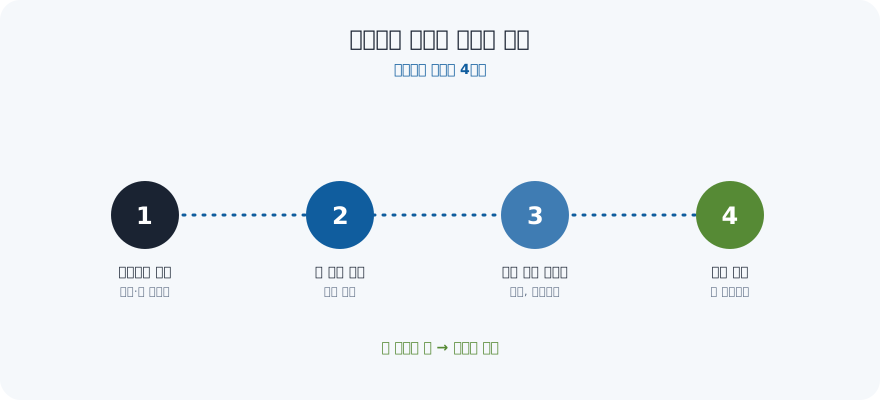
So "I can't concentrate" is usually a symptom, not a diagnosis. Most people say it like a fixed trait — as if some are simply born able to focus and the rest aren't. But attention isn't a gift; it's a skill you build — and before you build it, there's one step almost everyone skips: splitting the cause into three. Different causes need different fixes, and applying the wrong fix long enough leaves you with the wrong conclusion: "I'm just not a focused person."
Key takeaways
- Focus is not a talent — it's an attention muscle you can train
- Split the cause first — environment, energy, or meaning (each needs a different fix)
- Before you rely on willpower, clear distractions in three layers — physical, digital, internal: 6 minutes total
- Doing one thing at a time beats juggling — switching drains you through attention residue
- Attention grows in reps: 10 → 15 → 25 → 40 → 50 minutes, promoted after three clean sessions in a row
- The recovery cost of one interruption is 10 minutes even on a conservative estimate — six a day and a whole deep block is gone
- A realistic ceiling for deep work is 3–4 hours a day — past that, it's mostly performing work
The scattered brain vs. the trained one
A distracted mind and a focused mind aren't different people — they're the same brain under different conditions. The difference is whether the environment fights you or works for you, and whether attention has ever been stretched on purpose.
| Scattered brain | Trained focus |
|---|---|
| Reacts to every ping | Chooses one thing, protects it |
| Ten tabs, none finished | One task, seen through |
| Willpower alone (runs out) | Environment does half the work |
| "I can't concentrate" (fixed) | "I'm training this" (growing) |
| Blames itself without knowing why | Splits the cause, changes the fix |
| Holds the whole day, moves nothing | Protects 90 minutes, releases the rest |
Split the cause first — the three types of "can't focus"
The same complaint has one of three roots. Misdiagnose your type and no amount of distraction-clearing will help.
| Type | Signals | Real cause | Fix first |
|---|---|---|---|
| Environment | Reaching for the phone or a new tab every five minutes / one notification breaks the thread | The distraction is within sight and reach | The three-layer sweep below (6 min) |
| Energy | Words stop registering every afternoon / you wake up unrefreshed | Sleep and recovery debt, early burnout | 90-minute rhythm + 15-min recovery; if severe, burnout recovery |
| Meaning | You can lose three hours in some work — just not this work | You can't explain why this task matters | Connect it to goals and vision — a motivation system |
A 30-second self-check. Whichever line collects the most yeses is your type.
- You touch the phone more than five times per session / you often start without turning notifications off → Environment
- Mornings are fine but afternoons always collapse / you rest all weekend and are tired again by Monday → Energy
- You can do it when the deadline is on top of you / you lose track of time on work you like → Meaning
One more caveat: if the problem isn't scattering after you sit down but not getting to the desk at all, that's a starting-threshold problem, not an attention one — start with the 2-minute rule in how to overcome laziness instead.
Remove the distraction before you fight it (3 layers, 6 minutes)
Willpower is a terrible first line of defense. Every time your phone buzzes and you resist, you've already lost a little focus just by resisting. The trick is to not need willpower at all — remove the temptation before the session starts. Most people stop at one layer ("phone face-down"). There are three.
| Layer | What you clear | Time |
|---|---|---|
| Physical | Phone in another room (a bag or a face-down screen isn't enough — if you can reach it, you'll take it). Desk holds only what this task needs. Door closed | 2 min |
| Digital | All notifications off, one tab, browser full-screen, chat apps quit | 3 min |
| Internal | Write intrusive thoughts on a single parking-lot note and defer them past the session ("buy milk", "reply to that email") | 1 min |
The third layer is the one almost everyone skips — a clean desk with a loud head. Once a stray item is on paper with a promise to handle it later, your brain stops holding it open. One sheet of paper buys back thirty minutes of willpower. (This pairs naturally with deep work, where a protected block only works if the block is actually clean.)
Do one thing at a time — the quiet cost of attention residue
Multitasking feels productive, but the brain doesn't run two focused tasks at once — it switches, and every switch has a cost. You lose the thread, spend seconds reloading it, and the residue of the last task lingers into the next. That residue is the real story: "just five minutes" never costs five minutes, because after you put the phone down, part of your head is still occupied by what you just saw. Your body came back; your attention is still halfway there.
So the training rules are simple:
- Single-task. One task, until a natural stopping point, before you touch anything else.
- The 15-second rule. The moment you notice you've drifted, come back within fifteen seconds — without scolding yourself. A minute spent on self-criticism costs another five from the session.
- Noticing is the rep. Drifting isn't failure; it's one set. Drift twenty times and return twenty times, and you did twenty sets today.
If the problem is that you never start at all, read how to stop procrastinating first — starting problems and sustaining problems need different fixes.
Do the math on one notification — the recovery-cost table
How long it takes to get back to where you were after an interruption has been reported at around 20 minutes in several observational studies of office work. That's an average, and it varies a lot by task and by person, so you don't have to take it at face value. But even if you halve it to a conservative 10 minutes, the arithmetic is unpleasant.
What you're counting here isn't how many notifications fired — it's how many times you actually reacted and looked at the screen. A banner you ignored doesn't go in the tally (not because ignoring is free, but because counting everything blurs the number).
| Real interruptions per day | At 10 min · lost per day | Lost per 5-day week | At 20 min · lost per day | Lost per 5-day week |
|---|---|---|---|---|
| 6 | 60 min | 5 hours | 120 min | 10 hours |
| 12 | 120 min | 10 hours | 240 min | 20 hours |
| 24 | 240 min | 20 hours | 480 min | 40 hours |
That last row exceeds a working day on paper. So 24 doesn't mean "you lost 40 hours" — it means the next interruption arrives before you've finished recovering from the last one. You never reached a whole state all day. That is usually what's behind a day with nothing to show for it and an evening where you're unusually tired.
The interruptions column of the two-week focus log further down is the input for this table. It's also why six is worth calling a personal threshold: even on the most conservative 10-minute estimate, six interruptions is an hour — the exact size of one deep block, evaporated. Before you redesign your whole day, halving that single number changes how the day feels. The full rebuild of the day comes later, in how to be more productive.
The 4-week focus-muscle training table
You wouldn't expect to lift heavy on day one, and attention is no different. Start with a session short enough that you can't fail, and move to the next row only in a week where you met the pass criteria.
| Week | Session length | Per day | Pass criteria to advance |
|---|---|---|---|
| Week 1 | 10 min | 2× | 4 successful days out of 5 |
| Week 2 | 15 min | 2–3× | Zero phone pickups during a session |
| Week 3 | 25 min | 3× | Leave one finished artifact per session |
| Week 4 | 50 min | 1–2× (+ one 25-min) | One uninterrupted 50-minute block |
Only three principles: ① start small enough that failure is impossible, ② advance only after meeting the criteria, ③ never skip two days in a row. The third is the whole game — habits don't break by missing one day, they break on the second. This is exactly how you beat the three-day quitting trap, and where grit and consistency start beating talent.
And once those sessions grow into 25 or 50 minutes, give them a fixed home on the calendar: time blocking decides when you focus in advance, so you stop spending willpower every morning re-deciding it.
After the four weeks — the promotion and demotion ladder
The 4-week table runs on the calendar. From week five, switching the unit to the session holds up much better. The whole rule is two lines: three clean sessions in a row moves you up a rung; one failure moves you down on the spot.
| Rung | Session length | Promote after (3 in a row) | Demote when | What usually trips you here |
|---|---|---|---|---|
| 1 | 10 min | Three completed sessions in a row | (Floor — nowhere lower) | You start clearing the phone away after the timer starts |
| 2 | 15 min | Three in a row with 2 or fewer interruptions | One abandoned session → back to 10 | The "quick check" around minute 12 |
| 3 | 25 min | Three in a row, each leaving one artifact | One session past 6 interruptions → back to 15 | The sudden boredom at minute 20 |
| 4 | 40 min | Three in a row where your hands still move in the last 10 minutes | Two consecutive finishes under 40 min → back to 25 | Physical stamina at minute 30 (posture, water) |
| 5 | 50 min | Holding is the goal — no rung above | Two failures in one week → back to 40 | Trying to stack three 50s into one day |
Why a 40-minute rung exists. Twenty-five to fifty is a doubling in one step, and that gap is exactly where people drop out. One intermediate stair changes the pass rate noticeably. Jump straight from 25 to 50 and you're usually back at 25 within three days.
Three rules run it: ① never climb two rungs in one day. ② Demotion is an adjustment, not a punishment — clear three at the lower rung and you're straight back. ③ Don't judge promotion session by session; judge once, after three sessions. And once the rungs get long, give them a permanent slot instead of fitting them into leftovers — that's the job of time blocking, and the weekly count of promotions and demotions is exactly what belongs in the weekly review.
Build the day around a 90-minute rhythm
Alertness doesn't stay flat all day; it rises and falls in cycles of roughly 90 minutes. Design around that and you fight yourself far less.
- Hardest work in your sharpest hours. For most people that's 2–4 hours after waking. Don't slot it into leftovers — place it first.
- 15 minutes of recovery after 90. Off-screen, water, a short walk. Recovery isn't waste; it's the quality of the next block.
- 3–4 hours a day is the real ceiling. Nobody does eight hours of deep focus. One or two deep blocks plus a few 25-minute sprints is plenty; past that it's mostly performing work.
- Go shorter in the afternoon. If you're the energy type, stop insisting on 50 minutes after lunch and drop to 25-minute sprints.
Three studies behind these numbers
Before jumping to "I just have weak willpower," here's the evidence behind the methods above.
| Study | What it measured | Key figure | Practical takeaway |
|---|---|---|---|
| Gloria Mark et al., UC Irvine, 2008 | Observed office workers during real work | Average 23 minutes 15 seconds to return to the original task after an interruption | The 10–20 minute estimate in the recovery-cost table above is actually conservative — it's the evidence behind putting the phone in another room |
| Ariga & Lleras, University of Illinois, 2011 | Compared a 50-minute continuous task with and without brief breaks | Inserting two short breaks (tens of seconds) kept accuracy near-stable through the back half; the no-break group dropped noticeably | One or two deliberate 20–30 second glance-aways in the middle of a 90-minute block don't break the flow |
| Multiple meta-analyses on aerobic exercise and attention (e.g., Chang et al., 2012) | Compared inhibitory-control and attention-switching performance before and after a single ~20-minute aerobic session | Repeated reports of improved attentional control for roughly 30 minutes right after exercise | On a day you can't focus, a 20-minute walk before restarting may beat gluing yourself to the desk harder |
All three point at one thing: focus is something you manage, not something you endure. Remove the distraction (1), design the short break in advance (2), and tend to your body (3), and the same amount of willpower produces a different result. The place those repeated wins accumulate is self-efficacy — the belief "I can focus" isn't an empty affirmation, it's data built from small, repeated successes.
The desk environment table — light, temperature, noise
Run the same three-layer sweep in the wrong environment and its effect is cut in half. General office-environment guidelines look like this.
| Factor | Recommended range | What happens outside it |
|---|---|---|
| Desk-surface light | 500–750 lux | Too dim and eye fatigue brings on drowsiness quickly; too bright and glare scatters attention after about 20 minutes |
| Room temperature | 21–23°C (70–73°F) | Above 25°C alertness drops and you get sleepy; below 19°C hands stiffen and typing errors climb |
| Background noise | Under 50dB (library level) | Conversation noise past 60dB eats into language-processing resources, raising re-entry cost on reading and writing tasks |
| Monitor distance/height | 50–70cm, top of screen at eye level | Too close and eye fatigue builds within 20 minutes; too low and your neck juts forward, with pain starting around minute 30 |
Fixing all four takes five minutes, and it's a completely different layer from willpower — you can let go of perfectionism all you like, but drowsiness is hard to beat in a 300-lux room. Fitting the environment to your body and building the mental strength to sit back down without self-blame after a collapse are different muscles, and you need both.
Caffeine, naps, and sound — a timing table
Supports only work after the three-layer sweep. And what decides whether they help isn't the kind — it's the timing.
| Support | When to use it | Sensible range | When it backfires |
|---|---|---|---|
| Caffeine | First cup 90 minutes to 2 hours after waking | Two cups a day at most; last cup 8 hours before bed | Straight out of bed (alertness is already high) and late afternoon. One late cup turns tomorrow into an energy-type failure |
| Naps | The post-lunch dip | 10–20 minutes, alarm mandatory | Past 30 minutes you spend another 20–30 groggy — that's a loss, not recovery |
| Sound (white noise, instrumental) | When ambient noise is uneven | One track or one album on repeat, at the lowest volume that covers conversation | The moment you spend more than 3 minutes picking something, the picking is the distraction. No lyrics for language work — reading, writing, editing |
| Water and walking | The 15 minutes between 90-minute blocks | 5–10 minutes off-screen | Take the phone with you and it stops being recovery and becomes a switch |
One line sums it up: no row in this table comes before putting the phone in another room. Changing your coffee and your playlist while the phone still sits on the desk is turning up the heat with the window open.
Choosing session length — 25 vs. 50 vs. 90 minutes
Once you finish the four weeks, the next question arrives: which length should I actually use? The answer isn't preference — it's the task's re-entry cost, meaning how long it takes you to get back to where you were after an interruption.
| Session length | Re-entry cost | Fits | Per day | Common failure |
|---|---|---|---|---|
| 25 + 5 min | Low (1–2 min) | Email, gathering sources, memorization, repetitive problem sets | 6–8 | Used on deep work, you repeat the warm-up every time |
| 50 + 10 min | Medium (~5 min) | A report draft, one feature, one lecture chapter | 3–4 | Boredom hits around minute 45 and the phone wins |
| 90 + 15 min | High (10–15 min) | Design, writing, research, complex debugging | 1–2 | Stamina runs out and it collapses at 60 |
One sentence decides it: if the re-entry cost is over five minutes and you use a 25-minute timer, you spend a third of your day getting back up to speed. Attach 90 minutes to a low-cost task and the last 30 minutes sag instead. Write one number next to today's task — how many minutes to get back in if I'm interrupted? — and the length picks itself.
Pomodoro, 90-minute blocks, time blocking, deep work — which and when
Once the length is settled, the next choice is format. These four get introduced as if they were interchangeable, but their setup costs and their failure points are completely different.
| Method | Task type it fits | Setup difficulty | Where it breaks |
|---|---|---|---|
| Pomodoro (25/5) | Volume and repetition — problem sets, email, gathering sources | Low (one timer, 30 seconds of setup) | The moment a 5-minute break becomes 15. Skip the long break after four sets and quality drops from set three |
| 90-minute block | High re-entry cost — design, writing, complex debugging | Medium (clearing 90 minutes means negotiating with someone at least once) | Stamina at minute 60. Schedule three a day and the second one already collapses |
| Time blocking | Mixed days — meetings, real work, and admin in the same day | High (needs 10–15 minutes of planning the night before) | Fill more than 90% of the day and one delay takes the whole thing down. Fill 40–60% |
| Deep work sessions (booked weekly) | Large deliverables on long deadlines — a proposal, a paper, one product | Highest (needs agreements: notifications off, an away notice) | Walking in with no start-up ritual and burning the first 20 minutes warming up |
Adopt them in order and they stick. Week one is Pomodoro only — one tool means that if it fails, the cause is obvious. Week two adds one 90-minute block. Then wrap the whole day in time blocking, and only at the end book one or two deep work sessions a week. Most people invert this and start from the plan; build a tightly packed day before you own a single session you can hold, and in three days all you have left is the plan.
The two-week focus log — three columns, nothing more
Training tables quietly disappear in week three for one reason: nothing is being measured. You don't need another app for this. One sheet of paper with three columns is enough.
| Date · start time | Interruptions (phone, new tab, someone talking) | One line: what you left behind |
|---|---|---|
| 8/12 09:10 | 4 | Outline of the proposal locked |
| 8/12 14:30 | 11 | (nothing) |
| 8/13 09:05 | 2 | 800 words of chapter 1 |
After a week you stop seeing moods and start seeing patterns. Three of them show up again and again:
- Afternoon sessions (2–4pm) collect two to three times the interruptions of morning ones → that's the energy type, not weak will, so drop that slot to 25 minutes
- Sessions with an empty artifact column almost always had a vague name — "work on the report" and "800 words of chapter 3" spend the same hour very differently
- Past six interruptions, the artifact column is nearly always empty — six tends to be the personal threshold
If the three columns come up empty two days in a row, step the training table down one row. Falling behind on a log makes you not want to open it again, which is exactly why fewer columns survive longer. For making the logging itself stick, see how to use a habit tracker; for turning a week of logs into next week's layout, see the weekly review.
And if the interruptions explode only at night, focus training isn't the fix — start with the three-day log in how to break phone addiction and find out which hour actually breaks you.
Same table, different layout — three real situations
The table is one; the shape of a day isn't. What changes is not the table but placement and length.
| Situation | What the log exposed | Layout | Four weeks later |
|---|---|---|---|
| Meeting-heavy office worker (3 a day) | Long blocks never form — sessions average 18 minutes before breaking | Book one 50-minute block at 9:10 on the calendar first, 25-minute sprints between meetings, afternoons fixed at 25 | Interruptions per session 11 → 3; the morning artifact column fills every day |
| Remote worker / freelancer | No start and no end, so the work smears across the whole day | One 90 + one 50 in the morning, after noon published as messaging hours | Less desk time, more output (the sagging final 30 minutes disappear) |
| Student in exam prep | Insisted on 50 minutes, quit on day three | Start with three 25s, add 50 only in a week that met the criteria; memorization at 25, comprehension at 50 | Finished four weeks without dropping out; the collapsing afternoon survives as sprints |
What the three share is that nobody rewrote the training table. They pinned the longest block to their sharpest hours first and chopped the rest small. And in week one, make success almost laughably small — the 50 minutes of week four are built on stacked small wins.
The 15-minute recovery protocol for low-capacity days
The days the training table collapses are fairly predictable: the day after bad sleep, the day meetings stack back to back, the day something drained you emotionally. Keep a two-week focus log and most of the sessions that crossed six interruptions fall into one of those three conditions. Insisting on 50 minutes on a day like that costs you the session and the streak together. What you need isn't training, it's a minimum version that runs on any day.
| Block | What to do | Why in this order |
|---|---|---|
| 0-2 min | Dump everything circling in your head onto one sheet (no sorting) | Unresolved thoughts stop looping when they're put down, not when they're suppressed |
| 2-4 min | Circle exactly one thing that must be finished today | On a low day, every extra option is friction |
| 4-5 min | Rewrite that one thing at a size that fits in 10 minutes | Not "the report" but "list five subheads for chapter 3" |
| 5-15 min | Phone in another room, 10-minute timer, that one slice only | Ten minutes clears almost every time, even at the bottom |
The point of this protocol isn't output, it's not breaking the run. Leave one 10-minute slice behind and the day stops being a failed day and becomes a day you held the minimum — and returning to the table tomorrow gets far easier. The reason it's the second consecutive miss that ends things, not the first, is laid out in grit and the systems that keep you consistent.
It also helps to decide in advance where you restart after missing several days. Decide in the moment and it almost always becomes "next Monday," and that Monday rarely arrives.
| Days missed | Restart point | What not to do |
|---|---|---|
| 1-2 | Resume at the same length as the week you were in | Cramming the backlog into one day |
| 3-6 | Drop one week back in length, clear three days, then return | Declaring a full restart |
| 7+ | Reset to week 1 (two 10-minute sessions) — but halve the pass mark for that first week | Starting at 50 minutes "properly this time" |
If your capacity collapses in the evening again and again, that isn't a focus-training problem, it's a problem at the end of the day — see building an evening routine for how to protect tomorrow's clear morning first. If, on the other hand, you hold the minimum version fine but never reach deep immersion, the next thing to change is structure rather than length: how to practise deep work covers the environment design that protects a 90-minute block.
When it falls apart: five fixes
| Symptom | Common cause | Fix |
|---|---|---|
| You grab the phone five minutes in | It's within arm's reach | Redo the physical layer — another room |
| You can't start at all | The first move is too big | The 2-minute rule — overcome laziness |
| Afternoons always collapse | Energy type (sleep/recovery debt) | Hard work in the morning, 25-min sprints after lunch / burnout recovery |
| Hours spent, nothing to show | The block's name is vague | Put the done-condition in the name — time blocking |
| Your head won't quiet down | Unresolved thoughts keep looping | Parking-lot note + three-minute breathing + silently label each thought "thinking" (vipassana noting) |
Nine distractions — the 60-second prescription table
Those five are the most common, but what actually cuts a session belongs to one of three families: external, internal, physical. Different family, different fix — apply an environment fix to a physical distraction and you can clear the entire desk without touching the drowsiness.
| Family | Symptom | What you do inside 60 seconds |
|---|---|---|
| External | The screen lights up and your hand moves before you do | Do-not-disturb on, phone to another room. Check all three with your eyes — sound, vibration, lock-screen previews (most people only think they turned them off) |
| External | A colleague or family member starts talking to you | Give them a time, not a mood: "I'm done at 10:40." Headphones are a signal, but only a stated time gets respected |
| External | Conversation or construction noise spikes | Cover it with steady, lyric-free sound. If that fails, move — this isn't the kind of thing you win by enduring |
| Internal | "Oh, that reminds me…" keeps surfacing | One line in the parking-lot note, finish the sentence with a full stop, close it. Don't sort or organise it |
| Internal | An unresolved item makes you anxious and your hands stop | Write only the next single action and a time to do it (today, 3pm). Do not handle it now |
| Internal | The urge to check email or chat | Pin checking times on paper (11:00, 14:00, 17:00). Urges lose to appointments, not to bans |
| Physical | You've read the same line three times (drowsy) | Stand up, one glass of water, one minute at the window. If that fails, take the 10–20 minute nap — don't cling to the 50 |
| Physical | You look at the clock every 15 minutes (hungry) | Something small and protein-led. Sugar alone buys you 40 minutes and a bigger crash |
| Physical | Shoulders, neck, or eyes hurt | Raise the top of the screen to eye level and look at something far away for 20 seconds. Pain doesn't yield to willpower; it shortens your sessions for you |
There's one way to use it. Every time a session breaks, log the cause as a single word (ping, talking, noise, wandering, anxiety, checking, drowsy, hungry, pain) and run only that row's fix, inside 60 seconds. Spend five minutes choosing a fix and that's your tenth distraction. After a week, count which family shows up most: mostly external means the environment still isn't cleared; mostly physical means the problem is sleep and meals rather than training; mostly internal means you need to empty the open loops first, which is what the weekly review is for. And if the external family explodes only at night, breaking phone addiction comes before any of this.
Connect focus to something you actually want
Here's the quiet truth: it's easy to focus on what matters to you, and nearly impossible to focus on what doesn't. If concentration keeps slipping, sometimes the fix isn't more discipline — it's a clearer why. When a task is visibly a step toward a vision you care about, attention comes far more willingly. Focus is downstream of meaning, which is why a real motivation system beats raw willpower every time.
If you're the meaning type, try this today. Next to the task you can't focus on, write one line: "When this is done, what moves forward?" If no answer comes, it may not be a focus problem at all — it may be a task that belongs off the list.
🌱 Putting it into practice with VisionDream
A training table that isn't visible quietly disappears by week three. Put "one 25-minute focus block" into the Action row of VisionDream's Today tab (B·T·A) and a single check records the day's rep, while the calendar heatmap shows at a glance whether you met this week's pass criteria. Miss a day and your streak shields (2 per month, used automatically) keep the chain alive, so one gap doesn't become "well, that's over" — and the reps you do bank grow into your Success Tree. Each session stays linked in the planner to the goal and vision above it, so you can always see what the deep work is for. And if too many blocks are competing this week, put just one of them into the planner's weekly One Thing — that narrows the ladder down to the single rung you're trying to climb.
You're not "bad at focusing." You've just never split the cause or trained it — surrounded by things built to distract you. Today, do only two things: put the phone in another room, and start a 10-minute timer. Those ten minutes are the fifty minutes you'll hold four weeks from now. Plant your vision, and the fruit will come. 🌱
Frequently Asked Questions
Should I keep the training table on a day when I have nothing left?
Drop the length, keep the run. Insisting on 50 minutes the day after bad sleep or a stack of meetings costs you the session and the streak at once. Use the 15-minute recovery protocol instead: two minutes dumping everything in your head onto paper, two minutes circling the one thing that must be finished today, one minute rewriting it at a size that fits in ten, then phone in another room and a 10-minute timer on that slice only. The goal isn't output, it's leaving the day marked as one where you held the minimum.
I missed several days. Where do I restart?
Decide it in advance, by the number of days missed. One or two days: resume at the same length as the week you were in. Three to six: drop one week back in length, clear three days, then return. Seven or more: reset to week 1, two 10-minute sessions, with the pass mark halved for that first week. The most common failure is coming back after a long gap and starting at 50 minutes to do it 'properly this time'.
Is focus something you're born with, or can you train it?
You can absolutely train it. Attention works like a muscle — it stretches with use. A scattered mind is usually one that's never been trained and is surrounded by distractions by design. Start at 10 minutes twice a day in week one and advance to 15, 25, and 50 minutes only in weeks where you meet the pass criteria, and the same brain that scatters can hold 50 minutes within four weeks.
Why can't I concentrate even when I try hard?
Often because there are three causes and you're only using one fix. If you reach for your phone every five minutes, you're the environment type (clear distractions in three layers). If afternoons always collapse and rest doesn't refresh you, you're the energy type (90-minute rhythm and recovery; burnout recovery if it's severe). If you can lose hours in other work but not this one, you're the meaning type (connect it to goals and vision). And willpower is a weak first line anyway — resisting a buzzing phone already spends focus.
Does multitasking hurt focus?
Yes. The brain doesn't run two focused tasks at once — it switches, and every switch costs you the thread plus seconds of reloading, with residue from the last task bleeding into the next. That residue is why 'just five minutes' never costs five minutes. Single-task until a natural stopping point, and when you notice you've drifted, return within fifteen seconds without scolding yourself.
How many hours a day can I actually focus?
The realistic ceiling for deep focus is about 3–4 hours a day. Since alertness rises and falls in roughly 90-minute cycles, the arrangement that lasts longest is one or two 90-minute deep blocks in your sharpest hours (usually 2–4 hours after waking), each followed by 15 minutes of recovery. In the afternoon, drop to 25-minute sprints rather than insisting on 50.
Do coffee, white noise, or music help me focus?
They're supports, not the main move — and the order matters. Changing the music without clearing distractions is like turning up the heat with the window open. If you use them, instrumental or steady ambient sound is the safe choice, and one coffee in the early afternoon dip is usually fine. Caffeine late in the day cuts into sleep and turns tomorrow into an energy-type failure.
How do I choose between 25, 50, and 90 minutes?
It isn't preference — the task's re-entry cost decides. If getting back to where you were after an interruption takes more than five minutes (design, writing, complex debugging), a 25-minute timer means you spend a third of the day warming up again. Attach 90 minutes to something with a one-to-two-minute re-entry cost, like email or gathering sources, and the last 30 minutes sag. For the middle ground — a report draft, one feature — 50 minutes with a 10-minute break is the safe default, and in the afternoon it's usually better to drop one step shorter for the same task.
How should I actually log whether a session worked?
You don't need another app; one sheet of paper with three columns is enough — date and start time, number of interruptions, and one line naming what you left behind. A week of that exposes your pattern: afternoon sessions between 2 and 4pm usually collect two to three times the interruptions of morning ones, sessions with an empty artifact column almost always had a vague name, and past six interruptions a session nearly always ends empty-handed. If all three columns come up blank two days in a row, step the training table down one row.
Could this be ADHD?
This article isn't a diagnosis, and diagnosis belongs to a professional — but there is a line worth drawing. If you've cleared distractions in all three layers, run week one (two 10-minute sessions) and still can't hit the lowest bar of four successful days out of five, week after week — and if that difficulty isn't recent but has followed you since childhood across two or more settings such as school, work, and home — you're past what self-training covers. That's the point to get an evaluation from a psychiatrist or a qualified clinician. The training table doesn't replace a diagnosis, but walking in with a two-week focus log (date, interruption count, artifact) moves the conversation far faster than the sentence 'I can't concentrate.'
Why is focusing harder when I work from home?
Not because there are more distractions — because there are no boundaries. An office supplies external signals (commute, meetings, leaving); a home doesn't, so the work smears thinly across the entire day. In a log it shows up as long total desk time with an empty artifact column. Three fixes: pin one 90-minute and one 50-minute block in the morning before anything else, publish everything after noon as messaging hours so the urge to check becomes an appointment, and physically separate working space from resting space — a different chair counts if it's the same room. Once the sagging final 30 minutes disappear, total hours go down and output goes up.
How many days until I notice a difference?
The first thing to change isn't session length, it's interruption count. Most people see it drop noticeably within the first five days — if you're the environment type, the three-layer sweep alone can halve it — while the felt increase in session length usually arrives in week three. So judging by 'I still can't do 50 minutes' in week one or two is far too early. If, on the other hand, you've run three honest weeks and neither the interruptions nor the artifacts have moved, the likeliest explanation is that the type was misdiagnosed — usually an environment fix applied to what is actually an energy or meaning problem.
How does VisionDream help me focus?
Add 'one 25-minute focus block' as an Action habit in the Today tab (B·T·A) and one check records the rep, while the calendar heatmap shows whether you met this week's pass criteria. Miss a day and two monthly streak shields keep the chain alive automatically, and the reps you bank grow into your Success Tree. Each session stays linked in the planner to the goal and vision above it, so you're never concentrating in a vacuum.
Does exercise actually help focus?
Yes — multiple meta-analyses report improved attentional control for roughly 30 minutes after a single ~20-minute aerobic session. On a day you can't focus, a 20-minute walk followed by restarting a 10-minute timer may beat gluing yourself to the desk longer. Use it first as an emergency fix for a session that's already collapsed, not as a new habit to add on top.
Do desk lighting and temperature really affect focus?
Yes, and they operate on a different layer than willpower. General guidelines are 500–750 lux at desk level, 21–23°C room temperature, and background noise under 50dB (library level). Too little light brings on drowsiness faster; above 25°C alertness drops; noise past 60dB raises the re-entry cost of reading and writing. If focus still won't come after the three-layer sweep, check these four numbers before blaming willpower.
Plant a vision, and fruit will surely grow 🌱
Start in the app →