You Closed the Planner on Day 3 — The Planner Isn't the Problem
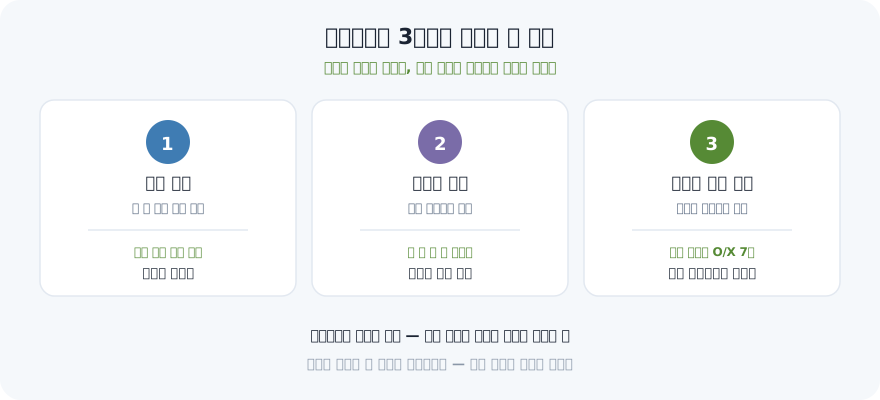
You bought the planner. You filled in the first few pages. Then you put it in a drawer.
Day one, you wrote everything. Day two, you managed. Then day three came — the late night at work, the cold, the evening you just wanted to shower and lie down — and you left one box empty. The next morning you saw that empty box, and something in you closed. "I'm just not the type," you thought, and the planner went into the drawer.
But what broke that day wasn't your willpower. It was the fact that nothing in that planner catches you when you miss a day. Paper says nothing. It doesn't roll anything over, doesn't grant exceptions, doesn't say "that's fine, start again today." It just sits there, blank, staring at you.
This isn't a planner review. It's about the three exact points where a planner dies on day three — and how to reopen the one already in your drawer. Read this for five minutes before you buy another one. (If you are still choosing, the 3 checks to run before you buy come first.)
Key takeaways
- Your planner didn't stall from weak will — it stalled because there was no rule for a missed day
- Planners die at exactly three points: the blank-box dread · no rollover · no reason to look back
- Don't buy a new planner. That's the most expensive way to repeat day three
- Cut it to 90 seconds a day and write one "buffer rule" on the first page — that's the whole restart
- One rule only: never miss two days in a row. One miss is an accident; two is a new habit
Why day three, specifically?
Motivation doesn't expire in 72 hours. It's that within three days, a day you simply cannot write is guaranteed to arrive.
Think about it. Overtime, a dinner you can't skip, a cold, a kid with a fever — one of these shows up at least once a week. Statistically, one lands inside your first three days. So day three isn't the limit of your character. It's the first time your plan collides with reality.
The damage comes after. When a work project slips a day, you adjust the schedule. When a planner slips a day, nothing happens. Yesterday's box stays empty forever, and it tells you the same thing every morning: you didn't keep it.
So people do one of two things. (1) Try to backfill yesterday, find it heavy, postpone — now two days are owed — then declare bankruptcy. (2) Stop looking at it. Drawer. Same ending either way.
The real problem was never "I only lasted three days." It was that nobody told you what to do with a missed day. The planner is a fine tool. Tools just don't write your rules for you.
| The way it dies in 3 days | The way it lasts a year |
|---|---|
| Goal: write every single day | 5 days a week = success (2 buffer days built in) |
| A missed day is failure | A missed day is a budget spend — planned from the start |
| Backfill the empty boxes | Drop them. Start from today's box |
| 15 minutes, must fill every field | 90 seconds — one line is success |
| If I can't do it perfectly, skip it | Never two days in a row — the only rule |
| Buy a new planner | Open the one you already have, today |
Death point 1 — The blank-box dread
If the first thing you see when you open it is the day you failed, you will stop opening it.
That's not laziness; it's a completely normal avoidance. Nobody wants to pull out an object that grades them at the end of a long day — especially when the report card already opens with an X.
The fix is almost insultingly simple. Write one rule in the margin of the first page.
"A missed day gets one slash. Never backfill. Five days this week = this week was a win."
That single line changes what a blank box means. It stops being evidence of failure and becomes a day you spent from budget. Same missed day, but the self-blame is gone. And when the self-blame is gone, you open the book again tomorrow. Ninety percent of restarting is decided right here. (More on this in letting go of perfectionism.)
Death point 2 — Nothing rolls over
Where did yesterday's unfinished task go? Nowhere. It's still trapped on yesterday's page.
This is a structural limit of paper. Open today's page and yesterday's misses are invisible. Two things happen at once. (1) Important tasks quietly evaporate. (2) You know they evaporate — so you stop trusting the planner.
A tool you don't trust is a tool you don't use. That's the real story behind "I write in it, but nothing turns into action." If the planner won't carry your execution, the important things migrate to your head or a message to yourself, and the planner becomes decor.
To patch this on paper, you need a rule: as the last move of the day, carry exactly one unfinished item onto tomorrow's page. Not two, not three. One. Carry three and tomorrow feels heavy — and a heavy tomorrow doesn't get opened.
Death point 3 — No reason to look back
When did you last reopen a page you wrote a month ago? Almost never, right?
This is the saddest part. The entries pile up and tell you nothing. When do you break down? Which weekday is your weak one? Which goal hasn't moved in three weeks? You'd have to flip through and count by hand — and nobody does that.
So the planner ends up as a diary, not data. Satisfying in the moment, powerless to change next week's you.
Build one minimal device: seven O/X boxes in the corner of the weekly page. Mark kept days and missed days. Don't evaluate, don't reflect — just O or X. Four weeks in, that little grid talks. Mine said Thursday night. I only ever had to fix Thursdays. (How to use a habit tracker walks through building it.)
4 steps to reopen the planner you already own
Don't buy a new one. A new book gives you the illusion of a fresh start, but in practice it just makes you run the day-three stretch one more time. Get the one from the drawer and do these four steps in the next five minutes.
- Turn past the missed pages. Empty since March? Do not backfill. Draw one slash across the blank pages and open today's date. The moment you try to repay the debt, you go bankrupt again. The backlog doesn't exist.
- Write three rules on the first page. (1) 90 seconds a day; one line is success. (2) A missed day gets one slash — never backfill. (3) Five days a week = the week was a win. Without these three lines, it closes again in four weeks.
- Anchor it to an existing trigger. Don't invent a new time slot. Hang it off something you already do daily — "right after brushing my teeth," "while the coffee brews," "the second I sit on the bed." And keep the planner right there. If it takes more than ten seconds to reach, you won't reach.
- One line a day + roll one item forward. One line about what you did, one unfinished item copied to tomorrow. That's 90 seconds. Try to fill every field and it becomes 15 minutes — and a 15-minute habit dies on day three. (Identity-based habits explains why the anchor matters more than the ambition.)
This isn't an argument against paper
There's a reason you bought a paper planner. Writing by hand sorts your thinking, no notification interrupts you, and the year survives as a physical object. An app can't do that.
The problem is that you're asking paper to do what paper cannot do. Paper can't roll a task forward. It can't account for a missed day. It can't summarize four weeks and tell you "you break down on Thursdays." That's not a flaw in paper — that's the nature of paper.
So split the roles. Meaning on paper, continuity in a structure. Write the sentence and the feeling by hand; hand the catching — missed days, rollovers, streaks — to something that runs automatically. Then a missed day stops taking the whole thing down with it.
One thing to do today
You have enough information. Do only this.
Take the planner out of the drawer, slash the blank pages, and write one line in today's box. It can be something that takes a minute, like "a glass of water in the morning." Then put the planner somewhere you'll physically collide with it tomorrow morning — beside the coffee machine, inside your bag.
Check one box today. Paper or app, it doesn't matter. The goal isn't completion — it's not breaking the thread. 🌱
🌱 Doing it with VisionDream
You don't beat three-day quitting. You build a structure that survives it. VisionDream ships with the catch built in: two streak protection passes every month, applied automatically, so missing a day doesn't wipe your streak — the anti-perfectionism device paper simply doesn't have. The 4-level planner (yearly, monthly, weekly, daily) rolls unfinished items forward automatically, so yesterday's task isn't stranded on yesterday's page. The Today tab (belief, thinking, action) and the calendar heatmap show you, four weeks in, exactly which weekday you break down on. And the big picture a planner can't hold goes on the Dream Map — one central vision plus five life areas — so every check today visibly attaches to a dream.
Before you buy another planner, look at a structure that doesn't collapse when you miss a day. The app is the tool; you're still the one doing it. Plant your vision, and the fruit will come. 🌱
Frequently Asked Questions
I quit my planner after three days. Am I just undisciplined?
No. Day three isn't the limit of your willpower — it's the first time your plan meets reality. A day you can't write (overtime, illness, a family emergency) statistically lands within the first three days. The problem isn't that the day arrived; it's that you had no rule for it. Write one rule for missed days on the first page and day three stops being fatal.
It's been empty for months. Should I backfill the missed pages?
Don't. Draw a single slash across the blank pages and open today's date. What kills a planner isn't the missed day — it's the pressure of trying to repay it. The backlog compounds like debt, and when it grows past repayment, people close the book. One rule: start from today's box, and never miss two days in a row.
Would buying a nicer planner help?
A new planner gives you the illusion of a fresh start, but in practice it just makes you repeat the day-three stretch. The issue was never the paper's quality — it's the absence of a missed-day rule and any rollover mechanism. Without those, any planner closes at the same spot four weeks later. Opening the one you already own is faster and free.
Can I use a paper planner and an app together?
That's the recommended setup — just split the roles. Paper is better for meaning, emotion, and thinking with your hand. But protecting a missed day, rolling unfinished tasks forward, and summarizing four weeks of records are things paper structurally cannot do. VisionDream's two automatic monthly streak protection passes and the planner's automatic rollover fill exactly that gap.
Plant a vision, and fruit will surely grow 🌱
Start in the app →Related posts
- ⏰How to Stop Procrastinating — Break the Habit With Systems, Not Willpower
- 🌙The Evening Routine — Ten Minutes Tonight Decides Tomorrow Morning (4-Step, 10-Minute Checklist)
- 🌙How to Do a 5-Minute Daily Review — Stop Grading 'What You Didn't Do' (3-Line Format + Timebox)
- 📔Before You Buy a Planner — 3 Checks That Decide Whether You Finish the Year