How to Be More Productive — Not Willpower, But a 4-Step Structure That Survives a Missed Day
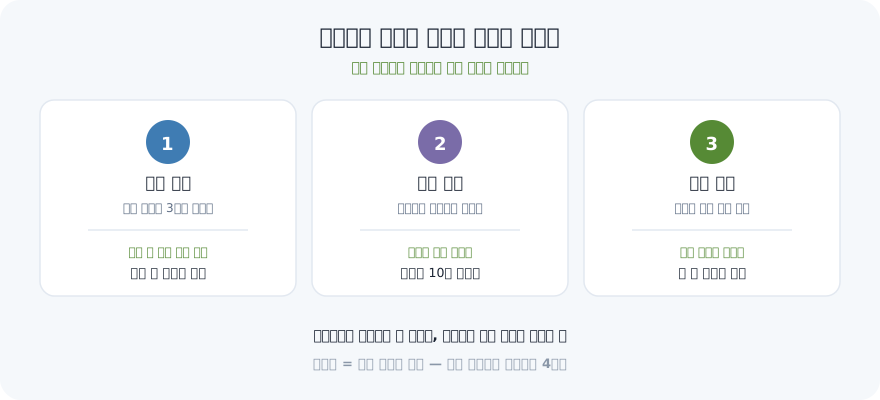
Your New Year's goal fizzled out in a few weeks. The moment you slipped once, you dropped the whole thing. And with no one checking, nothing kept you honest. If that loop keeps repeating, your problem isn't willpower.
You've read ten productivity books, bought a fresh planner, tried the 5 a.m. wake-up — and still couldn't make it past two weeks. Each time, the conclusion was "I'm just not disciplined." But it was never about discipline. There was simply no structure to catch you when you missed a day.
Productive people aren't people with strong willpower. They're people with a structure that recovers automatically after they collapse. This isn't a "try harder" article. It's a 4-step design that doesn't fall apart when you skip a day — and you can set it up in 30 minutes.
Key takeaways
- Productivity is a design problem, not a willpower problem — what you do after collapsing decides everything
- Don't beat three-day quitting. Build a structure that survives a missed day and there's nothing to beat
- Four steps: 1) shrink the goal, 2) design the environment, 3) set a reset rule, 4) add a safety net
- One rule only: never miss two days in a row. One miss is an accident; two is a new bad habit
- "If I can't do it perfectly, skip it" kills productivity. The goal is connection, not completion
Why willpower-based productivity always collapses
Willpower is a battery. Full in the morning, drained by evening, and it discharges fast under stress, poor sleep, and hunger.
That's why a plan that starts with "this time I'll really try hard" runs fine for the first three or four days — the battery is charged. The problem is the day it drains, which always comes: the late night at work, the sick day, the emotionally wrecked day. Statistically, one lands every week. You break one item that day, and the next morning, seeing the gap, you abandon the whole thing.
Here's the key: productive people miss days too. The only difference is that they built a device in advance that snaps them back into place the next day. They don't survive on willpower; they designed it to run even when willpower is empty. (This is exactly the "system, not willpower" point from how to overcome laziness.)
| Willpower-based productivity | Design-based productivity |
|---|---|
| "This time I'll really try" | "Build a structure that tolerates missing first" |
| Big, perfect plan | A minimum goal where one line = success |
| Resist distraction with willpower | Clear distraction before you start |
| A missed day = failure & quitting | A missed day = a budget spend, planned in |
| Collapse, then "starting next week" | Automatic recovery the day after |
| Vow alone and forget | A visible record keeps you honest |
Step 1 — Shrink the goal until you can keep it
Most plans die from being too big. Start with "put on running shoes," not "exercise one hour a day."
We set goals when motivation is high, so we calibrate to a fully charged version of ourselves: read an hour a day, work out 30 minutes, publish a post daily. The trouble is you have to keep those goals even on the days your battery is dead. Miss them, and failures pile into quitting.
The fix is to shrink the goal to the size you can keep on your hardest day. Not an hour of reading but one page. Not 30 minutes of exercise but changing into workout clothes. If that feels laughably small, that's precisely why you've failed until now. It has to be small enough to survive a drained day. And small actions usually snowball anyway — once the shoes are on, you tend to go. (Use SMART goal setting to carve out a daily unit that small.)
Step 2 — Design the environment; don't test your willpower
You sit at your desk and reach for your phone within three seconds. That's not weak willpower — it's that the phone is within reach.
What productive people share isn't resisting temptation; it's removing it up front. They don't resist the phone with willpower — they put it in another room. They don't resist distracting tabs — they close them before starting.
Design in two directions. Remove friction from what you want to do (workout clothes by the bed) and add friction to what you don't (delete and log out of social apps). If it takes more than 10 seconds to start, people don't start. Conversely, if a distraction takes more than 20 seconds to reach, people don't get distracted. This "10-second, 20-second rule" is far stronger than willpower. (The core of deep work and focus is also clearing, not resisting.) This design is far easier to do at night than during the day — moving the phone charger out of the bedroom and writing one line for tomorrow is exactly what the 10-minute evening routine does, and it's the cheapest way to have tomorrow morning's environment already built.
Step 3 — The reset rule: the real game is after you collapse
In three-day quitting, "three days" isn't the problem. The problem is that after slipping on day three, you don't know what to do, so you drop everything.
This is the heart of the article. Most productivity advice obsesses over how to start. But 90% of failure is decided at the restart, not the start. Slip on Tuesday, and Wednesday feels like a two-day debt; by Thursday it's "this week's ruined, I'll start next week." And next week never comes.
There's one rule: never miss two days in a row. One missed day is just an accident — everyone misses. The danger is that missing two in a row starts a bad habit. So the day after a miss, do at least one minimum unit, no matter what. Don't try to repay the backlog — treat it as gone. Start from today's box; just never miss two in a row. That's the entire restart. (Beating three-day quitting goes deeper on this reset rule.)
Step 4 — The safety net: switching off perfectionism
"If I can't do it perfectly, I won't do it at all" is the number one killer of productivity.
Perfectionism seems like the opposite of laziness, but the result is identical: both make you do nothing. Miss one day on a 30-day streak, and the perfectionist declares it "reset to zero" and quits — 29 days of progress wiped by a single slip.
So the final device is a safety net that keeps the streak alive even if you miss a day. Give yourself two "buffer days" a month. Missing up to twice this month isn't failure — it's a budget spend. When you plan misses in from the start, the self-blame on a missed day disappears, and without self-blame you come back the next day. You beat perfectionism not with stronger willpower but with slack designed in advance so that slipping is okay. (Letting go of perfectionism and a New Year plan system that doesn't collapse make this net clearer.)
The 30-minute setup you can do today
You have enough information. Spend exactly 30 minutes today, in this order.
- Shrink the goal to a quarter of its size. If it's "an hour a day," make it "10 minutes a day." Shrink it until it feels trivial.
- Physically remove exactly one distraction. Phone in another room, log out of social apps, close the distracting tabs — just one.
- Write the reset rule where you'll see it. "Never two days in a row. Skip the missed day. Start from today's box." Put those three lines on your desk or phone wallpaper.
- Declare two buffer days for this month in advance. "Missing twice this month still counts as a win."
Set up these four, and the next time you collapse, you won't collapse entirely. The goal isn't completion — it's not breaking the thread. 🌱
🌱 Doing it with VisionDream
Productivity is design, not willpower. Managing those four steps by hand every day is its own burden — so that's the first thing you drop. VisionDream builds the structure into the app. The Today tab (daily B·T·A) collapses belief (affirmation), thinking (one thing), and action (habit check) into a single daily screen, doing the "shrink the goal" work for you, while the calendar heatmap shows you which weekday you break down on. Remember, the game is after the collapse — two streak protection passes used automatically each month are the recovery device that keeps your streak alive even when you miss a day. When perfectionism tries to reset 30 days to zero, the app spends a pass instead and keeps the thread. The 4-level planner (yearly, monthly, weekly, daily) rolls unfinished items forward automatically, so yesterday's task isn't stranded on yesterday — running the reset rule for you.
Before you buy one more productivity book, set up a structure that doesn't collapse when you miss a day. The app is the tool; you're still the one doing it. Plant your vision, and the fruit will come. 🌱
Frequently Asked Questions
To be more productive, don't I ultimately need stronger willpower?
No. Willpower is a battery that drains within a day, so any plan leaning on willpower alone collapses on the day it runs dry. Productive people aren't more disciplined — they designed a structure that keeps running when willpower is empty. That structure is the four steps: shrink the goal, design the environment, set a reset rule, and add a safety net. You can set it up in 30 minutes today.
How do I beat three-day quitting?
Don't try to beat it. In three-day quitting, the real problem isn't slipping on day three — it's not knowing how to recover, so you drop everything. There's one rule: never miss two days in a row. One miss is an accident, but two in a row starts a new bad habit, so the day after a miss just do one minimum unit. Don't repay the backlog; restart from today's box.
Doesn't setting a big goal keep me motivated?
Big goals are set on a high-motivation day, but you have to keep them on the day your battery is dead. So the bigger the goal, the more often you miss it, and failures pile into quitting. Shrink the goal to the size you can keep on your hardest day. It has to feel almost trivially small to survive a drained day — and small actions usually snowball into more anyway.
How does the VisionDream app help me be more productive?
VisionDream builds the survive-a-miss structure into the app. The Today tab (daily B·T·A) collapses your day into one screen to help shrink the goal, and two streak protection passes used automatically each month keep your streak alive even when you miss a day, preventing perfectionist collapse. The 4-level planner's automatic rollover brings yesterday's unfinished task into today to automate the reset, and the calendar heatmap shows you which weekday you're weak on.
Plant a vision, and fruit will surely grow 🌱
Start in the app →Related posts
- ⏰How to Stop Procrastinating — Break the Habit With Systems, Not Willpower
- 🌙The Evening Routine — Ten Minutes Tonight Decides Tomorrow Morning (4-Step, 10-Minute Checklist)
- 🌙How to Do a 5-Minute Daily Review — Stop Grading 'What You Didn't Do' (3-Line Format + Timebox)
- 📔Before You Buy a Planner — 3 Checks That Decide Whether You Finish the Year