Before You Buy a Planner — 3 Checks That Decide Whether You Finish the Year
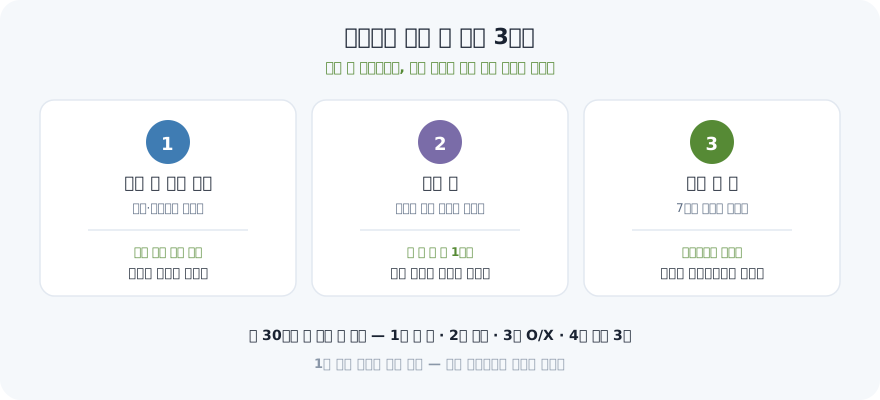
The cover still looks new. The pages stop in the first week of January.
If you're reading reviews right now, deciding which planner to buy, here's the thing worth knowing before you pay: the planner you pick matters far less than what happens on the first day you skip. People rarely quit because the paper was wrong. They quit because a blank box showed up, and nothing in the book told them what to do about it.
So this isn't a review. It's the three checks to run before you buy — plus a 4-week plan for the first 30 days, which is where almost every planner is won or lost.
Key takeaways
- The failure point isn't day one — it's the day after the first miss
- Check three things before buying: a place for the missed-day rule, a carry-over slot, a weekly view
- Match the format to your real life — daily, weekly, bullet, and app formats break in different places
- Week 1 is one line a day. Nothing else. Depth is added in weeks 2–4
- The only rule that matters all year: never skip two days in a row
Why a nicer planner gave you the same result
Buying a better book feels like solving the problem, because the purchase itself is a burst of motivation. But a planner is a container, not a system. If the rules you carry into it are the same, the outcome is the same by February.
| What we blame | What actually happened |
|---|---|
| "The layout didn't suit me" | The first missed day had no defined response |
| "I'm not a planner person" | Day one demanded ten minutes; you had two |
| "I lost motivation" | Nothing ever showed you the progress you did make |
| "I'll start fresh next year" | Restarting from zero threw away three weeks of data |
If you already own a planner sitting in a drawer, don't buy another one — that one isn't the problem, and it can be reopened tomorrow.
The 3 checks to run before you buy
Open the sample pages online, or flip through it in the store, and look for exactly these three things.
| Check | How to verify it | Pass condition |
|---|---|---|
| 1. Room for the missed-day rule | Is there any margin or box you can mark without "ruining" the page? | You can leave a single slash on a skipped day and move on |
| 2. A carry-over slot | Does the daily page have space to move one unfinished item forward? | One item moves to tomorrow without rewriting the whole list |
| 3. A weekly view | Can you see seven days on one spread? | You can spot where you break down, not just that you did |
Two more practical notes. Box size beats page count — if the daily box expects eight lines, you'll write three and feel behind on day four; a small box you can fill completely beats a large one you can't. And the size has to survive your bag. A planner you leave at home gets written in from memory, and memory-written planners quietly become fiction.
Where each format actually breaks
| Format | Best for | Where it breaks | The fix |
|---|---|---|---|
| Daily (a page a day) | Days with lots of appointments | Blank pages pile up fast when you travel or get sick | One line per page counts as "written" |
| Weekly (a spread a week) | Habit and routine tracking | Too little room for detail; entries thin out | Pair it with a plain notebook for depth |
| Bullet / undated | Irregular schedules | No structure means you design it every day | Fix a 3-line template once and never change it |
| App only | Reminders, streaks, carry-over | Easy to open, easy to bury under notifications | Anchor it to one fixed time of day |
There is no "best" here — only a match. If your schedule is unpredictable, an undated book saves you the guilt of empty dated pages.
The first 30 days, one week at a time
The most common mistake is doing everything in week one — habits, gratitude, goals, the year plan — and burning out by day nine. Add one layer per week instead.
| Week | What you do | Time per day | Done when |
|---|---|---|---|
| Week 1 | One line a day. What you did, that's all | Under 1 min | 5 days out of 7 have a line |
| Week 2 | Add one unfinished item carried to tomorrow | 2 min | Nothing gets rewritten twice |
| Week 3 | Add a weekly O/X row (7 boxes in the corner) | 3 min | You can see which day you break |
| Week 4 | Add a 3-line monthly review — kept, dropped, next | 10 min once | One sentence about next month exists |
By day 30 you own a habit that takes three minutes, not a ritual that takes thirty. That's the version that's still alive in March. (This is the same escape route as beating three-day quitting — start small enough that a bad day can't beat it.)
Three rules for the day you will miss
Within the first three weeks, a day you can't write always arrives — a late night, a cold, a trip. Write these three rules on the first page before that day comes.
- A skipped day gets one slash. Never backfill. Backfilling turns a one-day gap into an hour of guilt-driven homework, and that homework is what closes the book for good.
- Never skip two days in a row. One miss is an accident; two is a new pattern. If today is the second day, write one word and the streak survives.
- A box is enough — completion isn't the goal. A planner that's 40% filled all year beats one that's 100% filled for nine days. (Perfectionism is what empties the other eleven months.)
Paper or app — or both
| Paper | App | |
|---|---|---|
| Sticking with it | Visible on the desk, but silent when you slip | Reminds you, and can protect the streak |
| Carry-over | You rewrite it by hand | Moves forward automatically |
| Looking back | Great for a full year at a glance | Great for patterns and stats |
| Connecting to goals | Depends entirely on your own discipline | The daily entry links up to the goal above it |
Most people don't have to choose. Paper for thinking and writing, an app to catch the missed day and carry things forward — and a habit tracker to keep the record visible either way.
🌱 Putting it into practice with VisionDream
The three checks above describe exactly what an app can do for you automatically. In VisionDream, unfinished items carry forward on their own, so you never rewrite yesterday's list. Two streak shields per month are used automatically when you miss a day, so a single gap doesn't erase the run — the exact moment paper planners lose people. The Today tab (B·T·A) keeps the daily entry to one check, the calendar heatmap shows the week at a glance the way a weekly spread does, and the 4-stage planner links today's line up to the goal and vision above it, so a diary entry stops being a diary entry and becomes a step.
Whichever planner you buy, buy it. Just write the three rules on the first page first — one slash for a missed day, never two in a row, one box is enough. And if you'd rather have the missed day handled for you, try VisionDream alongside the paper; the two aren't competing. Plant your vision, and the fruit will come. 🌱
Frequently Asked Questions
Does an expensive planner actually help me keep it up?
Only at the start. A nicer book gives you a burst of motivation for about a week, but what determines whether you finish the year is what you do the day after your first miss. Before you look at price, check three things: is there room to mark a skipped day without ruining the page, is there a slot to carry one unfinished item forward, and can you see a whole week on one spread.
Daily or weekly — which format should I choose?
Match it to your schedule, not to what looks nicest. If your days are full of appointments, a daily page helps; if you're tracking habits and routines, a weekly spread does more with less writing. If your schedule is irregular, an undated or bullet-style book saves you from staring at empty dated pages. And whichever you pick, make sure the daily box is small enough that you can actually fill it.
What should I do when I miss a day?
Leave one slash and move on — never backfill. Backfilling turns a one-day gap into an hour of guilt-driven catch-up, and that catch-up session is usually the last time the planner gets opened. The only rule that matters is never skipping two days in a row: one miss is an accident, two is a new pattern.
What should I write in the first week?
One line a day, and nothing else. Most people load week one with habits, gratitude, goals, and a year plan, then quit around day nine. Add one layer per week instead: line only in week 1, carry-over in week 2, a weekly O/X row in week 3, and a 3-line monthly review in week 4. By day 30 it's a three-minute habit rather than a thirty-minute ritual.
Should I use paper or an app?
Most people don't have to choose. Paper is better for thinking and for seeing a year at a glance; an app is better at the two places paper fails — reminding you and handling the missed day. In VisionDream, unfinished items carry forward automatically and two monthly streak shields cover a skipped day, so one gap doesn't end the run. Use the paper for writing and let the app catch the misses.
Plant a vision, and fruit will surely grow 🌱
Start in the app →Related posts
- ⏰How to Stop Procrastinating — Break the Habit With Systems, Not Willpower
- 🌙The Evening Routine — Ten Minutes Tonight Decides Tomorrow Morning (4-Step, 10-Minute Checklist)
- 🌙How to Do a 5-Minute Daily Review — Stop Grading 'What You Didn't Do' (3-Line Format + Timebox)
- 📖How to Build a Reading Habit — No Finish-the-Book Guilt, a 3-Step System That Survives a Missed Day