Why Your Vocabulary Workbook Always Dies at Page 30 — A 40-Day Plan to Actually Finish One
The first 30 pages are marked up in three colors of ink. The rest looks like it just came off the shelf. How many of those workbooks do you own?
I owned three. Different covers, different publishers, each bought with the same belief — this one is sorted by priority, so this time it'll be different. The result was identical every time. I always started at A, and I always stopped somewhere around week three. Then, months later, I bought another one, convinced the book was the problem.
The book was never the problem. A well-edited, frequency-ordered workbook is already good enough. The real problem is that a book tells you a total, not a today. Open a 1,200-word workbook and what you see is 1,200 words — not the 30 you're supposed to learn this morning. So week one runs on motivation, week two runs behind, and week three you attempt a "restart from the beginning" and quietly close the book.
This isn't a workbook review. It's a design for turning one workbook into a habit and finishing it in 40 days — answering, in order, the five questions people actually search for: what order, how many a day, how many days per book, when to review, and what to do when you fall behind.
Key takeaways
- Workbooks don't die from weak willpower; they die at the point where there is no "today's amount"
- Follow the priority order printed in the book. Redesigning the order is procrastination wearing a productive hat
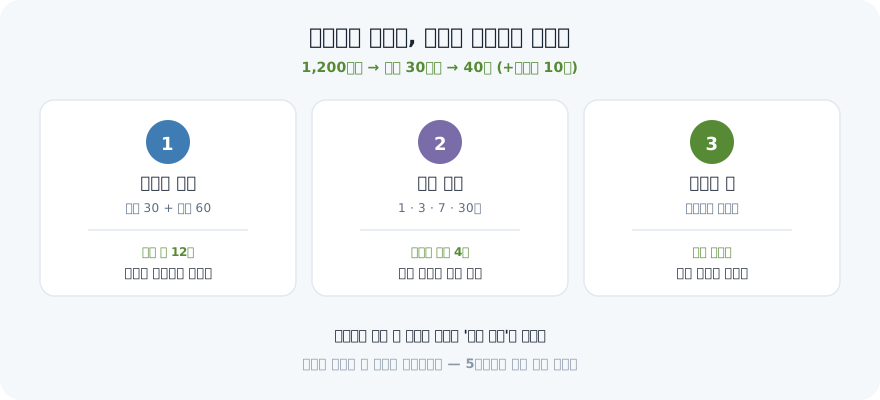
- 30 new words + 60 review words ≈ 12 minutes/day is the finishable dose (1,200 words → 40 days)
- Review on a fixed 1-3-7-30 day schedule, not by feel. Pencil the dates in the margin
- When you fall behind, don't catch up — start from today. Only one rule matters: never miss two days in a row
Q1. What order should I study a workbook in?
Exactly the order it's printed in. If your workbook is edited by priority (frequency), that order is already optimal — the earlier words are the ones you're statistically most likely to meet in real text. The moment you start redesigning the sequence, you've stopped studying and started planning to study.
This is where most people fall into the first trap. "Instead of going Day 1 in order, I'll pick out only the words I don't know…" It sounds efficient. In practice it takes 40 minutes, and you learn zero words that day. Spending three seconds on a word you already know is not waste — it's free review.
Customize exactly one thing: mark every word as Don't know / Shaky / Know. If you leave those marks on the first pass, the second pass takes a third of the time.
| What most people do | What finishers do |
|---|---|
| Spend two weeks comparing workbooks | Open the one they already own — today |
| Rearrange into a personal order | Keep the printed priority order |
| Pre-select only unknown words | Skim all, but mark know / shaky / don't know |
| Master a page before moving on | Move at 60% and recover it in review |
| Look at all 1,200 words | Look only at today's 30 |
Q2. How many words per day?
30 new + 60 review, about 12 minutes. Below that you stall out of boredom; above it you collapse by day three.
The math is simple. Ten words a day means 120 days — four months — for a 1,200-word workbook. Your motivation will die twice in that window. A hundred words a day is possible on day one, but the review load snowballs until it's a 40-minute daily obligation, and obligations get dropped. Twelve minutes is one and a half subway stops, or the time it takes to brew a coffee. It's genuinely hard to build an excuse against.
| New words/day | Time to finish 1,200 | Real time cost | Where it breaks |
|---|---|---|---|
| 10 | 120 days (4 months) | 4 min | Boredom — no end in sight |
| 30 | 40 days | ~12 min | Rarely (recommended) |
| 60 | 20 days | 25+ min | Week 2, review explosion |
| 100 | 12 days | 40+ min | Day 3 |
Here's the part that matters: an amount you can't do on a bad day was never a plan. Don't build a schedule around your best day. Build it around the day you worked late and came home with a headache. It's the same principle as beating three-day quitting — the plan that wins is always the one that runs on your worst day.
Q3. So how many days does one workbook take?
Total words ÷ daily new words × 1.25 = a realistic finish date. The 1.25 is your buffer.
A 1,200-word book at 30 a day is 40 days — but only if you never miss. You will miss. There will be dinners, colds, and kids with fevers. So plan 40 days of work with 10 buffer days built in, and call it 50.
Those 10 days are psychologically decisive. Miss a day in a plan with no buffer, and it's a failure. Miss a day in a plan with a buffer, and it's a budgeted expense. Same missed day; the self-blame disappears. And self-blame is the most expensive emotion there is, because it's what stops you from opening the book tomorrow.
Finish-date worksheet 1,200 words ÷ 30 per day = 40 days
- 25% buffer (10 days) → 50 days total Start July 14 → target finish September 1
Write those three lines in the margin of page one. They're the most practical three lines in this article.
A goal with no date is a wish — that's the "T" in SMART goals. The moment you set a finish date, the workbook stops being "a book I'll finish someday" and becomes "the book that ends on September 1."
Q4. When and how often should I review?
Four times, at 1-3-7-30 days. Not by feel — by date.
Half of the 30 words you learn today are gone by tomorrow, and most are gone within a week. That's not a character flaw; it's how memory works. Which is why the real failure isn't "I didn't finish the workbook." It's "I finished it and kept nothing." That one hurts more — you spent the 40 days and have nothing to show.
The method is almost embarrassingly low-tech. After studying, pencil four review dates into the page margin. Day 1's page reads "7/15, 7/17, 7/21, 8/13." Then, before each day's new words, open only the pages carrying today's date and skim them for three minutes. No app. No spreadsheet.
| Pass | When | Time | What you look at |
|---|---|---|---|
| 1st | Next day (+1) | 2 min | "Don't know" marks only |
| 2nd | +3 days | 2 min | "Don't know" + "shaky" |
| 3rd | +7 days | 3 min | Fast skim of everything |
| 4th | +30 days | 3 min | Only what won't surface |
This keeps daily review at roughly 60 words. It's light at first, peaks around week two, then shrinks as more words move into "know." The whole point of this structure is that review gets lighter over time, not heavier.
Q5. What if I fall behind? (the question that decides everything)
Don't catch up. Start from today. What kills a workbook is never the missed day — it's the 90-word pileup you create trying to make it up.
The collapse is predictable. Tuesday: late at work, skipped. Wednesday: 60 words feels heavy, postponed. Thursday: now it's 90. "This week is ruined — I'll restart Monday." That Monday never arrives. Missed work compounds like debt, and once the balance is unpayable, people declare bankruptcy — they close the book.
So there are only three rules.
- Do today's words first. Yesterday's 30 are written off. Today always outranks the backlog.
- Never miss two in a row. One missed day is an accident; two is the beginning of a new habit. The day after a miss, open the book no matter what — even for five words. Those five words aren't about progress. They're about keeping the thread attached.
- Recover the backlog on a bonus day. Use a weekend or a light day, and spend the buffer you built in Q3. That's exactly what it was for.
The real enemy here isn't the missed words — it's perfectionism. "If I can't do it properly, better not to do it at all" is the sentence that closes workbooks. A five-word day is infinitely better than a zero-word day (more on that in letting go of perfectionism). You don't need completion. One square is enough.
The 40-day design, in 7 steps
- Lock the workbook. Don't buy a new one. Use the book you already have — the one you got furthest into. A new book feels like a fresh start but really just makes you repeat pages 1–30 again.
- Count the total words. It's usually printed on the back cover. If not, estimate (pages × words per page).
- Write three lines in the front margin. Total ÷ 30 = X days → +25% buffer → target finish date.
- Anchor it behind an existing habit. "Right after the coffee finishes brewing." "The second I sit down on the train." Don't invent new time — attach it to something you already do every day. A habit without a trigger disappears the moment motivation cools (this is how identity-based habits work).
- Put the book next to the trigger. Reducing friction beats summoning willpower. Beside the coffee machine, in the bag, on the pillow — if it takes more than 10 seconds to retrieve, you won't.
- Do 30 words, then write the four review dates. That's the last motion of the day, every day.
- For 7 days, mark only hit/miss. Don't grade yourself; just leave an O or an X. A week later, that row will show you when you break — usually the same weekday, the same time slot. Fix that one spot and the rest holds.
5 common mistakes
- Buying a new workbook → The problem was never the book. A new one only makes you re-run pages 1–30.
- Starting at 100 words a day → Planning from day-one enthusiasm leaves day-three you with an unpayable debt.
- Progress without review → You'll "finish" in 40 days and keep only the feeling of having finished.
- Trying to catch up → The 90-word pileup is what closes the book. Today's words first — that's the only rule.
- Not tracking anything → The 30 seconds you spend each day figuring out where you left off is exactly why you stop opening it. Whether it's a habit tracker or the margin of the book, a visible trace makes tomorrow easier.
Do exactly one thing today
You have enough information. Do this one thing.
Take the workbook you got furthest into and write three lines in the front margin: total words ÷ 30, +25% buffer, target finish date. Three minutes. Then put that book where tomorrow morning's you cannot avoid it — beside the coffee machine, or in your bag.
For the next 7 days, mark only the days you did it and the days you didn't. A week later, that little row will tell you exactly what to change. 🌱
🌱 Put it into practice with VisionDream
"Finish the workbook" is a goal, and goals only get done once they're broken into today's 30 words. In VisionDream, set the finish date in the 4-level planner (yearly, monthly, weekly, daily) and let it drop down into a daily habit check on the Today tab. As checks accumulate, the calendar heatmap shows you exactly which weekday you break on, and the 2 monthly streak shields (applied automatically) stop one missed day from collapsing the whole streak — the built-in defense against perfectionism. Add one line to Sunday's weekly review about your actual progress, and 40 days later, finishing becomes a result rather than an event.
That workbook on your shelf didn't stop because your willpower is weak. It stopped because nobody ever told you which 30 words were yours today. Plant your vision, and the fruit will come. 🌱
Frequently Asked Questions
How many vocabulary words should I study per day?
About 30 new words plus 60 review words — roughly 12 minutes — is the finishable dose for most people. Ten a day means 120 days for a 1,200-word workbook, and boredom kills it. A hundred a day snowballs the review load until it's a 40-minute chore and collapses by day three. Set the amount by what you could do after a long workday, not by what you can do when motivated.
How many days does it take to finish one vocabulary workbook?
Total words ÷ daily new words × 1.25. A 1,200-word book at 30 a day is 40 days, plus a 25% buffer (10 days) for a realistic 50. The buffer matters psychologically: without it, a missed day is a failure; with it, a missed day is a budgeted expense. Removing the self-blame is what gets you to open the book again tomorrow.
I keep forgetting words I studied. What's the right review schedule?
Review four times, at 1, 3, 7, and 30 days. Don't do it by feel — after studying a page, pencil the four review dates into its margin. Each day, before new words, open only the pages carrying today's date and skim for three minutes. No app needed, and review gets lighter, not heavier, as more words move into 'know.'
I've fallen a few days behind. Should I catch up?
No. Do today's words and recover the backlog on a lighter 'bonus day.' What kills a workbook isn't the missed day — it's the 90-word pileup you create trying to make it up, which triggers the 'I'll restart Monday' spiral. The only rule that matters: never miss two days in a row. The day after a miss, open the book even for five words. Those five words exist to keep the thread attached, not to make progress.
Plant a vision, and fruit will surely grow 🌱
Start in the app →Related posts
- 📲Goal-Tracking Apps — How to Pick One and Actually Finish Your Yearly Goals
- ⏰How to Stop Procrastinating — Break the Habit With Systems, Not Willpower
- 🖼️How to Make a Digital Vision Board on Your Phone (So You Actually See It Daily)
- 🌄5 Miracle Mindsets That Change Your Morning — Why Willpower Fails and What Works Instead