5 Miracle Mindsets That Change Your Morning — Why Willpower Fails and What Works Instead
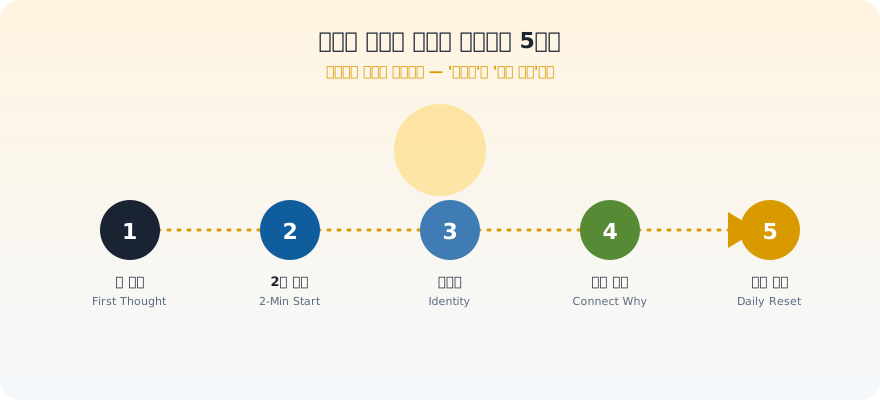
You set the alarm 30 minutes early, full of resolve. For two mornings it works. By day three, the snooze button wins and the whole idea quietly dies. Sound familiar? Here's the thing almost nobody tells you: the problem was never your willpower — it was your mindset the second your eyes opened. Motivation drops, and you stop. You read one more "morning routine" article and change nothing. The fix is smaller and more durable than discipline: five mindset shifts that make the morning carry itself. Below are the 5 miracle mindsets — and how to actually run them tomorrow.
Key takeaways
- The Miracle Morning collapses from a broken mindset, not weak willpower
- Your first thought on waking sets the tone for the entire day
- Start with 2 minutes, not a perfect 60-minute routine
- Anchor the habit to identity and vision, not fleeting motivation
- When you slip, reset the next morning instead of quitting — miss once, never twice
Why "just wake up earlier" always fails
Waking up earlier is a result, not a cause. When you attack it head-on with raw willpower, you're spending your scarcest resource at the hour it's lowest. Your brain, half-asleep and craving comfort, votes for the bed — every time. The people whose mornings last aren't more disciplined. They've simply installed mindsets that remove the fight. (The same trap runs the three-day quitting cycle — the vague and the heroic get dropped first.)
| The morning that collapses | The morning that lasts |
|---|---|
| First thought: "Five more minutes…" | First thought: "One thing I'll do today" |
| A perfect 60-minute routine | A 2-minute start you can't fail |
| "I'll go when I feel motivated" | "I'm someone who shows up in the morning" |
| Disconnected from any why | Tied to a vision that pulls you up |
| Miss one day → quit | Miss one day → reset tomorrow |
The 5 miracle mindsets
1. First Thought — win the first 30 seconds
The moment you wake, your brain reaches for a default thought, and usually it's dread. Replace it on purpose: before the mental noise starts, name one thing you'll do today. A single clear intention beats a foggy to-do list, because your brain can only act on something specific. (Pair it with an affirmation that actually works — one line, said with meaning.)
2. Two-Minute Start — shrink it until you can't fail
A grand routine is a promise you'll break by Thursday. Instead, make the entry so small it's laughable: one glass of water, one page, one stretch. The goal of the first two minutes isn't results — it's starting. Momentum does the rest. (Small wins beat heroic resolutions for exactly this reason.)
3. Identity over Mood — don't wait to feel like it
Motivation is weather; it changes hourly and you can't build on it. Identity is climate. Stop asking "do I feel like getting up?" and start acting from "I'm someone who takes care of my morning." Each morning you show up, you cast a vote for that person. (Identity-based habits explain why this sticks when motivation doesn't.)
4. Connect to Why — attach the morning to a vision
A routine with no reason is a chore, and chores get dropped. When your morning touches something you actually want — the future you're reaching for — it stops being a fight and becomes a pull. This is the Belief × Thinking × Action loop in miniature (the success formula): a morning connected to your vision renews its own motivation.
5. Daily Reset — miss once, never twice
You will miss a morning. The people who last aren't the ones who never slip; they're the ones who don't let one miss become three. Skip the guilt spiral, treat each dawn as a clean slate, and just show up again. A little self-compassion is what keeps a single off-day from ending the whole habit. (Designing the night before helps too — see the evening routine.)
Set your wake time backwards from your sleep time — the sleep math table
For half the people whose Miracle Morning dies in three days, the problem isn't mindset — it's arithmetic. Going to sleep at 12:30 a.m. with a 5 a.m. alarm is four and a half hours of sleep, and no mindset survives that. Adults need at least 7 hours, so your wake time always has to be calculated backwards from your sleep time. Add the roughly 15 minutes it takes to fall asleep and it looks like this:
| Target wake time | Asleep by (7 hours of sleep) | Lights out (+15 min) | Phone down (+30 min) |
|---|---|---|---|
| 5:00 a.m. | 10:00 p.m. | 9:45 p.m. | 9:15 p.m. |
| 5:30 a.m. | 10:30 p.m. | 10:15 p.m. | 9:45 p.m. |
| 6:00 a.m. | 11:00 p.m. | 10:45 p.m. | 10:15 p.m. |
| 6:30 a.m. | 11:30 p.m. | 11:15 p.m. | 10:45 p.m. |
The last column is the one that matters. The action that actually moves your wake time isn't the alarm — it's the time you put your phone down the night before. What usually breaks that is scrolling in bed, so the friction tricks in How to Break Phone Addiction — starting with charging your phone outside the bedroom — raise your wake-up success rate faster than anything else.
And don't pull it forward all at once. If you normally wake at 7 and jump to 5 tomorrow, your body experiences the equivalent of two hours of jet lag. The rule is 15 minutes earlier every 3–4 days. Getting from 7:00 to 6:00 takes about two weeks; to 5:30, about three to four. It looks slow, but it is far faster than quitting on day three and starting from zero again.
The 2-minute menu — pick in advance by energy level
The "two-minute start" breaks down because choosing what to do in the morning is itself a decision cost. So the night before, write one line per energy level for tomorrow morning. In the morning you don't choose — you just run the matching row.
| Morning state | 2-minute menu (just one) | If it keeps going (10–20 min) |
|---|---|---|
| Refreshed | Write today's one thing on paper and start it for 5 minutes | One 25-minute focus block on it |
| Normal | A glass of water + open the window for 1 minute of daylight | A 10-minute walk or stretch |
| Tired | Make the bed — that's it | One page of a book → five pages |
| Worst (after a late night or illness) | Sit and take 10 breaths | Nothing — two minutes still counts as a "done" day |
The last row is the important one. Lowering the bar for the worst days in advance keeps your record unbroken even then, and that's what makes mindset #5, "miss once, never twice," something you actually keep. The principle of designing a minimum version for bad days is covered in more depth in Grit and Consistency.
A 4-week transition roadmap — the order for adding each mindset
Trying all five at once is itself the "heroic routine" trap. Add one per week.
| Week | Wake-time change | Mindset added this week | Pass criterion |
|---|---|---|---|
| Week 1 | Keep your usual time | ① First thought (one thing today) + ② 2-minute start | Wrote down "one thing" on 5 of 7 days |
| Week 2 | 15 min earlier (another 15 after 3–4 days) | ③ Stick a one-line identity statement on a note | Woke on time + did 2 minutes on 5 of 7 days |
| Week 3 | Keep moving 15 min at a time | ④ Connect to why — link the first task to this month's goal | 5 of 7 days + first task goal-related 3 times |
| Week 4 | Reach or hold your target time | ⑤ Reset rule — never miss two days in a row | Zero back-to-back misses |
The pass criterion is "5 of 7 days" so that one missed day never counts as failure. Reviewing this table every Sunday and setting next week's row takes five minutes — fold those five minutes into your weekly review and you don't need to carve out extra time.
What to do when it breaks — decide in advance and there's nothing to negotiate
Morning routines don't end on ordinary days; they end on exceptional ones. Turn the exceptions into rules ahead of time and the dawn negotiation disappears.
| Situation | Typical reaction | Rule decided in advance |
|---|---|---|
| Late night at work or out, asleep at 1 a.m. | Same alarm → 4 hours of sleep → next day collapses | Push wake time back by 60 minutes at most and run the "worst" row of the 2-minute menu |
| Weekends | Sleep in 2–3 hours → Monday wake-up fails | Keep weekend wake time within ±60 minutes of weekdays |
| Turned the alarm off and fell back asleep | "Today's ruined" | Run the 2-minute menu whenever you get up — a late start still counts |
| Sick or run down | Drop the whole routine | Sleep first; take 10 breaths and mark it a "rest day" |
| Business trip or travel | Forget the routine entirely | Shrink it to writing "today's one thing" the night before |
How to lock the morning into your schedule so it doesn't drift is in Time Blocking; Hal Elrod's original six-step structure (Silence, Affirmations, Visualization, Exercise, Reading, Scribing) is in The Miracle Morning System; and Kim Mi-kyung's early-rising design, well known to Korean readers, is in Kim Mi-kyung's Miracle Morning. Think of the five mindsets in this article as the "operating system" you can run underneath any of those routines.
Mindset is the cause. A system makes it stick.
Here's the honest catch: mindsets fade if they live only in your head. You'll read this, nod, and by next Tuesday the first-thought habit has quietly slipped. That's exactly the gap VisionDream closes. Log your morning as a daily habit and it comes with a cue and a check-off, so "I meant to" becomes "done" — and every check grows a leaf on your Success Tree (S = B·T·A), turning invisible effort into visible proof you keep showing up. On empty, low-motivation mornings, the AI coach hands you one small next step instead of a blank page. And because a morning only lasts when it's tied to a why, VisionDream keeps each habit sitting right next to the vision and goals it's quietly building.
Tomorrow morning, set the alarm five minutes early and decide the one thing you'll do right now, tonight — before your half-asleep brain gets a vote. Then let VisionDream hold it for you, day after day. Plant your vision, and the fruit will come. 🌱
Frequently Asked Questions
What is a miracle mindset?
A miracle mindset is a small mental shift that makes a morning routine sustainable without relying on raw willpower. Instead of forcing yourself awake, you change how you think the moment you wake: set your first thought on purpose, start with just 2 minutes, act from identity rather than mood, connect the morning to your vision, and reset the next day after a miss. These five shifts remove the fight instead of adding discipline.
Why does the Miracle Morning fail after three days?
Because it bets everything on willpower at the exact hour willpower is lowest. Waking up early is a result, not a cause — when you attack it head-on with a grand, perfect routine and no reason behind it, your half-asleep brain votes for the bed. Mornings last when you shrink the start to 2 minutes, act from identity, and tie the routine to a vision that pulls you forward.
How do I actually change my mindset in the morning?
Make it concrete and small. The night before, decide the one thing you'll do first — so there's no dawn negotiation. On waking, name that single intention before dread sets in. Keep the entry to 2 minutes, act as 'someone who shows up' rather than waiting to feel motivated, and if you miss a day, reset the next morning instead of quitting. A cue and a daily check-off make each of these stick.
How does VisionDream help build a morning mindset?
VisionDream turns each mindset into a trackable daily habit with a cue and a check-off, so intentions become completed actions. Every check grows a leaf on your Success Tree (S = Belief × Thinking × Action), making consistent effort visible. On low-motivation mornings the AI coach offers one small next step, and every habit stays connected to the vision and goals it's building — so your morning always has a why.
What time do I have to wake up for it to count as a Miracle Morning? Does it have to be 5 a.m.?
No. The point of the Miracle Morning isn't a specific time — it's claiming time for yourself before the day starts pulling you around. The standard is a wake time that still lets you sleep 7+ hours. If your life means sleeping at midnight, 7 a.m. is right for you, not 5. Move your usual wake time 15 minutes earlier every 3–4 days, and settle on the time you can keep at least 5 days a week.
I woke up early but I'm sleepy all day. What should I do?
It's a sign you pulled your wake time forward too fast, or your bedtime didn't follow. Move your wake time back 15 minutes and put your phone down 30 minutes earlier the night before. Feeling groggy for 10–30 minutes after waking is normal sleep inertia, so use that window for no-decision items from the 2-minute menu (a glass of water, a minute of daylight). If you're drowsy in the afternoon, a nap of 20 minutes or less disrupts night sleep the least.
Plant a vision, and fruit will surely grow 🌱
Start in the app →