Lee Dong-jin's Reading Method — He Doesn't Read to 'Get Things Done,' So Why Does It Still Change His Life? (4 Steps to Copy It)
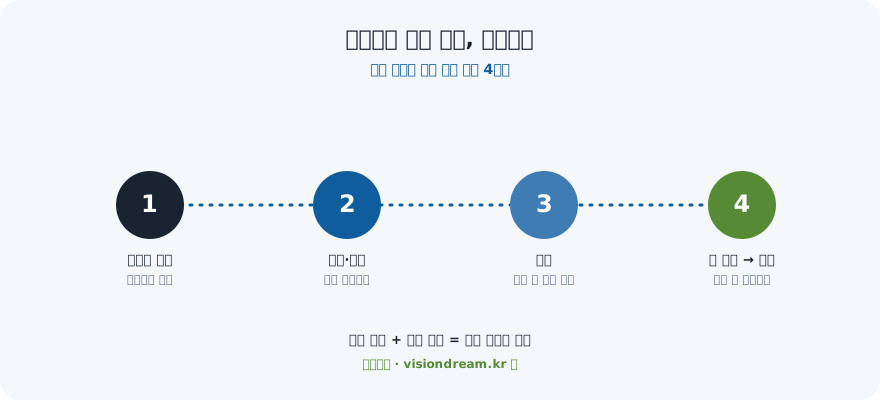
You joined the book club, you finished the pile on your nightstand, you even hit a "50 books a year" streak — and your life looks exactly the same. Here's a confusing fact: Lee Dong-jin, the Korean film critic known for a personal library so large it has its own name, doesn't read to "get things done" at all. He reads slowly, savors sentences, and re-reads books he loves. No productivity hack in sight. And yet his reading visibly shapes how he thinks and lives. So the real question isn't how do I read more — it's how do I read the way he reads, and then close the one gap he doesn't have to worry about: turning depth into action.
Key takeaways
- Lee Dong-jin's style is deep reading, not fast reading — quantity was never the point
- Four copyable moves: read slowly, mark and annotate, re-read, hold one sentence
- Deep reading builds a rich inner library, but insight alone still doesn't change behavior
- The missing step for most of us: translate one sentence into this week's action and attach it to a habit
Why "reading more" was never the answer
Most reading advice sells speed and volume: skim faster, finish more, hit the number. But if you've read twenty books this year and nothing changed, more books won't fix it — because you were solving the wrong problem. Lee Dong-jin is a useful counter-example precisely because he is famous for loving books, not for processing them. His reading isn't a race to a finish line; it's a slow, attentive relationship with a text. That attention — not the page count — is where the value lives.
| Shallow fast reading | Lee Dong-jin style deep reading |
|---|---|
| Goal is finishing | Goal is understanding |
| Read once, forget | Re-read the ones that matter |
| Underline everything | Mark and annotate deliberately |
| Chases a yearly number | Chases density, not quantity |
| Nothing sticks | A living inner library |
The 4 moves of deep reading you can copy
You don't need his library or his hours. You need his posture toward a book. Four moves recreate it.
1. Read slowly, on purpose
Deep reading starts by giving up the finish-line rush. Let yourself stop on a sentence, re-read a paragraph, close the book to think. A page you actually understood beats ten pages you merely passed your eyes over. Slowness isn't inefficiency here — it's the whole mechanism. (It's the same deep focus that makes any hard thing land.)
2. Mark and annotate — argue with the book
A great reader doesn't just receive; they respond. Underline the lines that hit, but also scribble in the margin: "why?", "not for me," "this is exactly my problem." Writing your reaction turns passive input into a conversation — and a conversation is remembered where a highlight is not.
3. Re-read the books that matter
This is the move most people skip. Re-reading isn't wasted time; a book you loved reads differently a year later because you changed. Lee Dong-jin's habit of returning to favorites is what turns a book from a one-time event into a lifelong companion. Pick one book that shaped you and read it again — you'll find lines you swear weren't there before.
4. Hold one sentence out of each book
Even in deep reading, you can't carry everything. So when you close a book, choose the one sentence you refuse to forget. Copy it somewhere permanent. A single sentence you actually keep beats a hundred you underlined and abandoned.
The one gap deep reading doesn't close by itself
Here's the honest limit. Deep reading builds a magnificent inner library — a richer way of thinking, better questions, more empathy. For a critic whose work is thinking, that's already the payoff. But if your goal is a changed life — a new habit, a reached goal, a project shipped — depth alone won't get you there. Insight is not action. You can understand a book perfectly and behave identically next week. That's not a flaw in deep reading; it's just that reading and doing are two different muscles. (This is the same trap behind why nothing changes after you finish a book.)
Add the action layer: from one sentence to this week
Keep everything Lee Dong-jin does — the slowness, the margins, the re-reading — and add one step he doesn't need but you do. Take the one sentence you held, and translate it into one action you can do this week. If the sentence is an insight like "attention is a form of love," the action might be "→ Put my phone in another room during dinner this week." Two rules only: this week, and small enough that you can't fail. Then attach it to a habit you already have so it doesn't evaporate — the moment a book's idea becomes a habit, that book stays in your life for good. This is how deep reading stops being a beautiful private pleasure and starts becoming visible change. (Small, kept actions beat grand resolutions every time.)
How VisionDream turns your reading into a life
Read like Lee Dong-jin — slow, marked, re-read. Then let VisionDream carry the part deep reading leaves open. Register the one sentence you held from a book as a goal or habit, and your daily habit check keeps that action alive, while each check stacks as a leaf on your Success Tree — visible proof that "this book actually changed something." When the sentence feels too abstract to act on, the AI coach helps you translate: "What would this line look like as one action this week?" Pair it with a weekly review and reading stops sliding back into "read and forget."
Read deeply, like he does. Then move one sentence into this week. Plant your vision, and the fruit will come. 🌱
Frequently Asked Questions
What is Lee Dong-jin's reading method?
Lee Dong-jin, the Korean film critic known for an enormous personal library, is associated with deep reading rather than fast or high-volume reading. In practice that means four copyable moves: reading slowly and on purpose, marking and annotating the text as a conversation, re-reading the books that matter, and holding on to one sentence from each book. The goal is understanding and density, not finishing a yearly number.
Is it better to read many books or read deeply?
If your aim is changing how you think and live, depth beats volume. Reading twenty books you forget changes less than truly absorbing one and returning to it. Deep reading builds a rich inner library of better questions and ideas. But note the limit: depth alone builds understanding, not new behavior — to change your actual life you still have to translate one idea into an action.
Why doesn't deep reading change my life on its own?
Because insight and action are two different muscles. Deep reading gives you a richer inner world, which is already the payoff for thinking work. But you can understand a book perfectly and behave exactly the same next week. To close that gap, take the one sentence you held from a book, translate it into one small action you can do this week, and attach it to a habit you already have.
How does VisionDream help turn reading into action?
VisionDream carries the step deep reading leaves open. You register the one sentence you held from a book as a goal or habit, and daily habit checks keep that action running while each check stacks as a leaf on your Success Tree — visible proof the book changed something. When a sentence feels too abstract, the AI coach helps translate it into one action for this week, and a weekly review keeps it from sliding back into read-and-forget.
Plant a vision, and fruit will surely grow 🌱
Start in the app →Related posts
- 📖Self-Help Book Recommendations: The Order Matters More Than the List — A Two-Line Quadrant for Picking the Right One Now
- 📚Why Book Clubs Quietly Die in 3 Months — And the 6-Week Blueprint for One That Lasts
- 📲Goal-Tracking Apps — How to Pick One and Actually Finish Your Yearly Goals
- ⏰How to Stop Procrastinating — Break the Habit With Systems, Not Willpower