OKR Goal Management — Made Simple for One Person
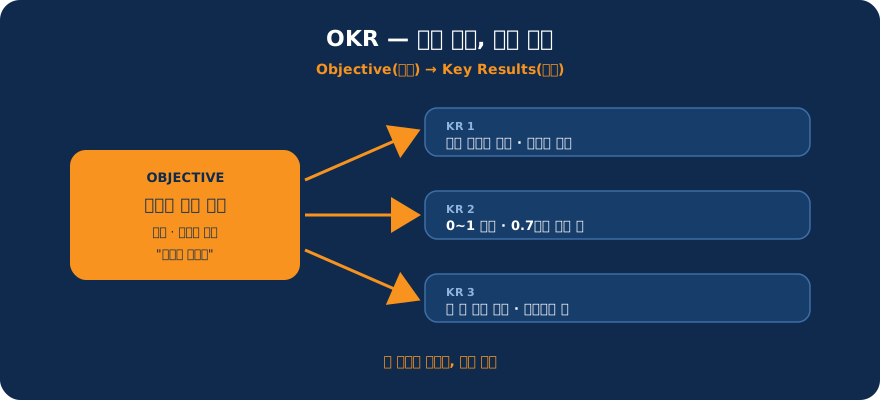
Most personal goals fail in the same quiet way: they blur the direction you want with the result that proves you got there. "Get healthier" is a direction with no finish line; "run 30 minutes on Monday" is a task with no meaning. OKRs — Objectives and Key Results — exist to keep those two things apart on purpose. Born inside high-growth companies, the framework works just as well for one person, once you strip it back to its simple core.
Key takeaways
- An Objective is one qualitative, inspiring direction — the what and why
- Key Results are 2–3 measurable outcomes that prove it — not a to-do list
- Set them by the quarter, check in once a week, score each 0 to 1 (0.7 = you did well)
- Three killers: KRs written as tasks, too many of them, and playing it too safe
Objective vs. Key Results: keep them apart
An Objective answers where am I going, and why does it matter? It should be qualitative, memorable, and a little inspiring — "Get noticeably fitter and feel strong again," not a metric. A Key Result answers how will I know I got there? It must be measurable, so there's no arguing at quarter's end whether you hit it. One Objective, two or three Key Results beneath it. That's the whole shape. This is a sharper, more focused cousin of general goal management — where OKRs shine is forcing you to name the outcome, not just the intention.
| Weak goal | OKR done right |
|---|---|
| "Get healthier" | O: Feel strong and energetic again |
| A vague wish, no finish line | KR: Run 3K under 10:00 |
| "Go to the gym more" | KR: Strength-train 3×/week for 12 weeks |
| Can't tell if you succeeded | KR: Resting heart rate down to 60 |
The #1 mistake: writing Key Results as a to-do list
This is the trap almost everyone falls into. "Go for a run," "read the book," "sign up for the course" — those are tasks, not results. A Key Result describes the outcome you'd see if the tasks worked, stated as a number: not "exercise more" but "run 3K under ten minutes," not "study Spanish" but "hold a 10-minute conversation." Tasks are how you might get there; Key Results are proof you did. If your KR doesn't end in a number, it's still a to-do — rewrite it. (For turning a fuzzy wish into a concrete target in the first place, setting goals the SMART way pairs perfectly with this.)
Set by the quarter, check once a week, score 0 to 1
A quarter — about twelve weeks — is long enough to move something real and short enough that you won't drift. Set your OKR at the start, then do one thing religiously: a weekly check-in. Once a week, score each Key Result from 0 to 1 — 0.3 if you've barely moved, 0.7 if you're on track, 1.0 if it's done. Here's the counterintuitive part borrowed straight from the original framework: 0.7 is a win, not a failure. If you're hitting 1.0 on everything, your targets were too safe. That weekly rhythm is the engine of the whole thing — it's the same muscle behind a solid weekly review habit, just pointed at your OKRs. And if you're stuck on what this quarter's Objective should even be, set the direction first with dream backcasting — come down from the person you want to be in three years, then lift its three-month column straight into this quarter's Objective.
The other two killers: too many, and too safe
Beyond writing KRs as tasks, two mistakes quietly wreck personal OKRs. Too many — five Objectives with four Key Results each isn't ambition, it's a to-do list wearing a costume, and none of them will get real attention. Hold yourself to one Objective, two or three Key Results for the quarter. And playing it too safe — sandbagging, setting targets you already know you'll hit so the score looks clean. OKRs are meant to stretch you; a 0.6–0.7 average across genuinely hard KRs beats a perfect 1.0 across easy ones every time.
A personal OKR, start to finish
Say your Objective is "Feel strong and energetic again." Inspiring, qualitative, no number. Now three Key Results that would prove it: run 3K under 10:00, strength-train 3× a week for 12 weeks, get resting heart rate down to 60. Notice none of them is "go to the gym" — each is an outcome you can measure. Each Monday you score the three from 0 to 1 and adjust the week's tasks accordingly. By quarter's end you're not asking "did I feel motivated?" — you're reading three honest numbers.
How VisionDream runs your OKRs
VisionDream is built around exactly this shape. Your Objective becomes your vision — the qualitative why you keep in view. Your Key Results become tracked goals and habits, each with a number attached, so "run 3K under ten minutes" turns into concrete habits you check off. The weekly check-in isn't a chore you forget — every week your Success Tree grows with the progress you actually made, giving that 0-to-1 score something you can see. And when a Key Result stalls, the AI coach helps you tell the difference between a target that's too hard and one you're simply avoiding.
Run OKRs on yourself and goals stop being vague wishes: one direction that inspires you, two or three results that can't be faked, checked every week. Plant your vision, and the fruit will come. 🌱
Frequently Asked Questions
What's the difference between an Objective and a Key Result?
An Objective is one qualitative, inspiring direction — the what and why, like 'feel strong and energetic again.' It has no number. A Key Result is a measurable outcome that proves you got there, like 'run 3K under ten minutes.' One Objective sits above two or three Key Results. The Objective motivates; the Key Results keep you honest.
Why shouldn't Key Results be a to-do list?
Because tasks describe activity, not achievement. 'Go for a run' can be done all quarter without you getting any fitter. A Key Result states the outcome as a number — 'run 3K under ten minutes' — so at quarter's end there's no arguing whether you succeeded. If your Key Result doesn't end in a measurable number, it's still a to-do and needs rewriting.
How do I score OKRs, and what does 0.7 mean?
Score each Key Result from 0 to 1 during a weekly check-in: roughly 0.3 if you've barely started, 0.7 if you're on track, 1.0 if it's fully done. Counterintuitively, 0.7 is a win — the framework assumes stretch goals, so hitting 1.0 on everything means your targets were too safe. Aim to make the targets genuinely hard, then measure honestly.
How does VisionDream help with OKRs?
Your Objective becomes your vision, and your Key Results become tracked goals and habits with real numbers attached, so measurable outcomes turn into habits you check off. The weekly check-in grows your Success Tree with the progress you actually made, and when a Key Result stalls the AI coach helps you tell a too-hard target from one you're avoiding.
Plant a vision, and fruit will surely grow 🌱
Start in the app →Related posts
- 🧩The Mandal-Art Chart — Ohtani's 9×9 Goal Grid and How to Fill Every Box (Template + 5 Steps)
- 🎯Goal Management — Why Goals Die After You Set Them (and How to Keep Them Alive)
- 📲Goal-Tracking Apps — How to Pick One and Actually Finish Your Yearly Goals
- ⏰How to Stop Procrastinating — Break the Habit With Systems, Not Willpower