How to Set SMART Goals — One Sheet of Paper, 15 Minutes, 'Someday' Becomes 'Today'
The busier you are, the further goals slide down the list. So skip the grand plan — this one takes one sheet of paper and 15 minutes.
"I want to get healthy." "I want to save money." These feel like goals, but they're wishes — and wishes don't tell you what to do today. The fix is a simple, decades-old framework: SMART. It turns a vague intention into a goal so concrete you can act on it this afternoon. 🌱
Key takeaways
- A wish names a destination; a SMART goal names the path
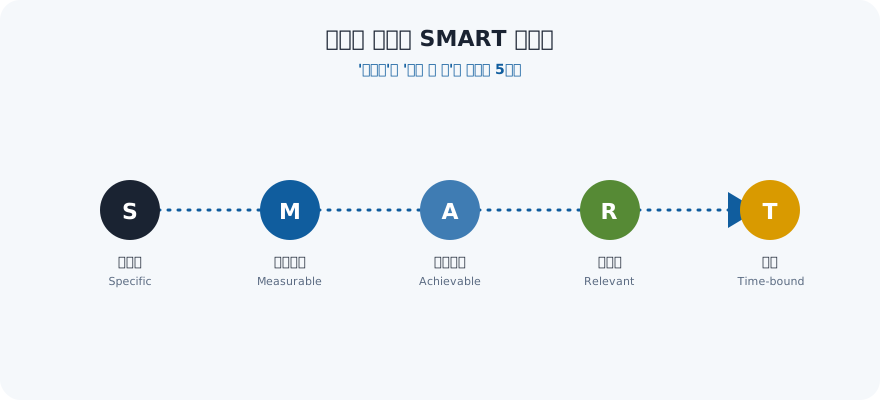
- SMART = Specific, Measurable, Achievable, Relevant, Time-bound
- The most common mistake is skipping Measurable — no number, no feedback
- Don't guess the number — measure two weeks, then add ~20%
- A SMART goal still needs to be broken down to a minimum unit you can do today
- Collapsing in week two isn't weak willpower — your first step was too big
Why a wish never becomes action
A wish like "get healthy" is impossible to start because it's impossible to picture. Your brain can't act on a fog. A goal becomes actionable the moment it's specific and measurable enough that you'd know, without arguing, whether you did it. That clarity is the whole point of SMART. (This is the "Thinking" in Success = Belief × Thinking × Action — turning vagueness into a plan you can execute.)
| Wish | SMART goal |
|---|---|
| "Get healthy" | "Run 5km three times a week by Aug 31" |
| "Save money" | "Save 3,000 by December via 250 a month" |
| "Read more" | "Finish one book a month this quarter" |
| "Study English" | "15 minutes of shadowing every morning before the November exam" |
| No way to measure | Clear yes/no every week |
The 4 ways goals collapse — diagnose before you rewrite
They all look like "failure," but the causes differ, and so do the fixes. Start by naming where your last goal stopped.
| Type | Symptom | Real cause | Fix |
|---|---|---|---|
| Fog | Never started — didn't know what to do first | No S (specificity) | Rewrite it with one verb and one place |
| Blind | You did things, but can't tell if you're improving | No M (number) | Attach one metric: frequency, volume, or completion |
| Week-two collapse | Strong start, dead around day 10–14 | The first step was too big | Drop the minimum unit to a 2-minute action |
| Drift | Still doing it, no idea why | R (relevance) snapped | Reconnect it to one sentence of your vision |
Week-two collapse is the most common and the most misread. New Year's goals vanish in February not because willpower is weak, but because the workload day one demanded was more than a bad day fourteen could carry. Self-blame isn't a diagnosis.
The 5 parts of a SMART goal — and what to check in each
S — Specific
Name exactly what you'll do. The narrower the target, the easier it is to aim. Check: does the sentence contain one verb and a place or time?
- ❌ "Exercise more" → ✅ "Three laps of the park track after work"
- ❌ "Read more books" → ✅ "10 pages of a paper book on the morning commute"
M — Measurable
Attach a number so progress is undeniable. Without a number you can't tell progress from wishful thinking — this is the part people skip most, and it's why goals quietly die. Check: can you answer yes or no on Sunday night?
A — Achievable
Stretch, but stay real. A goal so big it's hopeless kills motivation; one slightly beyond comfortable builds it. Check: is it small enough to do on your busiest day this week? If 5km feels impossible now, start at 2km (see beating three-day quitting).
R — Relevant
Make sure it ladders up to something you actually want. A goal disconnected from your vision becomes a chore you'll drop. Check: can you answer "does this serve the future I'm reaching for?" in one sentence?
T — Time-bound
Give it a deadline. "By August 31," not "someday." A date creates urgency and a natural checkpoint. Check: besides the final deadline, is there at least one mid-point review date on your calendar?
How to pick the number — three metric types and the baseline rule
People stall on "Measurable" because they try to pick the number by feel. Choose the metric type that fits the goal first.
| Metric type | Use it when | Example | Watch out |
|---|---|---|---|
| Frequency (n per week) | Building a new habit | 3 workouts a week, journal 5 days | Never start at 7/7 |
| Volume (a unit count) | Output accumulates | 500 words a day, 250 saved a month | Use your average day, not your best one |
| Completion (m of n) | Finishing a fixed scope | 1 lecture a week out of 12 | Define "done" before you start counting |
Then set the number like this: spend two weeks changing nothing and simply recording what you already do, then raise that baseline by about 20%. If you worked out once in the last two weeks, your next goal isn't four times a week — it's twice. A number picked without a baseline isn't a goal, it's a penalty, and penalties don't survive two weeks.
The one-sheet, 15-minute worksheet
The busier you are, the faster this order works. Take one sheet of paper and do four steps.
| Step | Time | What you do |
|---|---|---|
| 1. Three columns | 5 min | Label them "must this year / nice to have / not this year" and dump everything |
| 2. Cut it down | 3 min | Keep at most 3 in "must this year"; move the rest to "nice to have" |
| 3. Write the SMART line | 5 min | For each survivor: by when, what, how much — one sentence |
| 4. Set the minimum unit | 2 min | Under each goal, one 2-minute action you can do on a bad day |
The hidden hero here is the "not this year" column. Cutting down to three is hard because there's usually nowhere to put what you're dropping — that column gives it a home. Past five goals, priority disappears, and without priority everything gets postponed on a busy day.
Example: from wish to today
| Wish | SMART goal | Today's task (minimum unit) | Checkpoint |
|---|---|---|---|
| "I want to write a book" | 40,000-word first draft by April 30 | 500 words on weekday mornings (100 on a bad day) | Word count on the last day of each month |
| "I want to lose weight" | Keep three 30-minute walks a week through Dec 31 | Get off one stop early on the way home | 7-box O/X row every Sunday |
| "I want a certification" | Sit the November exam, finish 3 past papers | 5 practice questions, 15 minutes a day | One paper done by end of September |
What all three share is the last two columns. A SMART goal still has to land on a today's task to leave the page, and it needs a checkpoint so you catch drift while there's still time. The deadline sets the direction; the daily habit does the work. (Working backward from the deadline is exactly backcasting, and carving out the time inside a day is time blocking.)
SMART vs OKR vs backcasting — when to use which
They aren't competitors; they operate at different altitudes.
| Framework | Fits when | Core question | Limit |
|---|---|---|---|
| SMART | Making a personal goal executable | "How would I measure this?" | The "why" is on you |
| OKR | Tying direction to outcomes | "What has to change for this to be a win?" | Can be overkill for one person |
| Backcasting | Breaking down a 3–10 year vision | "If I walk back from that future?" | Doesn't reach this week's task |
In practice: backcast the far dream down to years, write this year's version as SMART, and if you're juggling several, hold them in a goal management system.
When it breaks in week two — a 3-step recovery
Throwing out the broken goal and setting a new one is the most expensive move available: you discard three weeks of data and restart at zero. Recover in this order instead.
- Halve the goal. If five times a week didn't happen, five times a week was the mistake. Twice a week sustained for eight weeks beats five times a week that dies in two — every time.
- Drop the minimum unit to 2 minutes. "Put on the running clothes." "Open the book, read one paragraph." You're not trying to change the outcome yet; you're restoring the sense of being someone who does this.
- Write the missed-day rule in advance. Mark the skipped day and move on, and never skip two days in a row. One miss is an accident; two is a new pattern. (Perfectionism is what empties the other ten months.)
The weekly 10 minutes that keeps a SMART goal alive
Goals don't die the day you set them — they die the day you forget them. Ten minutes on Sunday evening is enough.
- What was the number this week? (One yes/no)
- Which day did it break? (The day-of-week pattern is often the real culprit)
- If you changed exactly one thing next week? (Change the conditions — time, place, setup — not the goal)
Lock those three questions into a weekly review habit, and keep the record visible with a habit tracker, and the goal stops sleeping inside a notes app.
🌱 Putting it into practice with VisionDream
The trap with SMART goals is that they sit in a notes app, disconnected from your day. In VisionDream, the 4-stage planner (yearly, monthly, weekly, daily) links each goal to the one above it automatically and carries unfinished items forward on their own, so nothing you missed disappears. A measurable goal like "run 5km three times a week" comes down as a habit check in the Today tab (B·T·A), and the calendar heatmap shows which day of the week you break. Miss a day and two streak shields a month are used automatically, so the run survives — and the weekly review pulls up those ten minutes of checking for you every Sunday, all the way up to your year plan.
Take a sheet of paper now and draw three columns: must this year, nice to have, not this year. Fifteen minutes and your head is lighter. Stop wishing, start aiming — specific, measurable, and landed on today. Plant your vision, and the fruit will come. 🌱
Frequently Asked Questions
What does SMART stand for?
SMART stands for Specific, Measurable, Achievable, Relevant, and Time-bound. It's a framework for turning a vague wish into a clear goal you can act on. Each letter has one check question: does the sentence have a verb and a place, can you answer yes or no on Sunday, is it small enough for your busiest day, does it connect to your vision, and is there a mid-point review date on the calendar?
What's the most common mistake when setting goals?
Skipping the Measurable part. Without a number, you can't tell real progress from wishful thinking, and the goal quietly dies. Attach a concrete metric — '3 times a week,' '5km,' an amount — so every week gives you a clear yes or no. The second most common mistake is picking that number by feel.
How do I decide what number to use?
Pick the metric type first: frequency (n per week) for building a habit, volume (500 words a day) when output accumulates, completion (1 of 12 lectures a week) for a fixed scope. Then spend two weeks changing nothing and recording what you already do, and raise that baseline by about 20%. If you worked out once in the last two weeks, the next goal is twice a week — not four times.
My goal collapsed after two weeks. Should I start over?
Starting over is the most expensive option — you throw away the data you've accumulated and restart at zero. Recover in three steps instead: halve the goal (five times a week becomes twice), drop the minimum unit to a 2-minute action, and write the missed-day rule in advance — mark a skipped day and move on, but never skip two days in a row. A week-two collapse is a signal that the first step was too big, not that you're weak.
Are SMART goals enough on their own? How do they differ from OKR or backcasting?
A SMART goal sets the direction, but it still has to be broken down into today's habit or task. The three frameworks work at different altitudes: backcast a far dream (3–10 years) down to years, write this year's goal as SMART, and use OKR when you need to see what outcome would count as a win. They're layers, not competitors.
How many goals should I have at once?
Keep the core goals you're actively running to three or fewer. Past five, priority disappears, and without priority everything gets postponed on a busy day. Draw three columns on one sheet — must this year, nice to have, not this year — and keep at most three in the first column. Making a home for what you're dropping is the whole trick.
How does VisionDream help with SMART goals?
The 4-stage planner (yearly, monthly, weekly, daily) links each goal to the one above it and carries unfinished items forward automatically. Measurable goals come down as habit checks in the Today tab (B·T·A), and the calendar heatmap shows which day of the week you break. Miss a day and two monthly streak shields are used automatically, and the Sunday weekly review runs the checkpoint for you.
Plant a vision, and fruit will surely grow 🌱
Start in the app →Related posts
- 📲Goal-Tracking Apps — How to Pick One and Actually Finish Your Yearly Goals
- 🛰️What Is Dream Backcasting? Plan Backward from Your Future to Today in 5 Steps (30-Minute Worksheet)
- ✍️Writing Your Goal 100 Times a Day: Why It Dies on Day Three — And the 21-Day Ramp That Fixes It
- 🎯How to Set New Year's Goals — A 5-Step Annual Plan That Won't End as a Three-Day Resolution