What Is Dream Backcasting? Plan Backward from Your Future to Today in 5 Steps (30-Minute Worksheet)
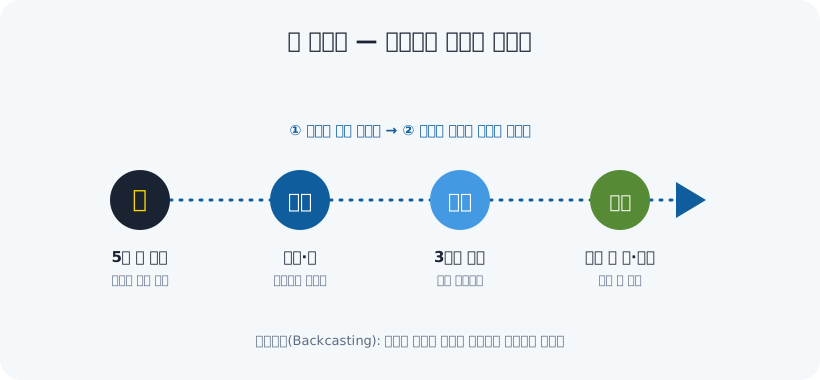
"Three years from now, things will be different." How many Januarys have started with that sentence? The problem isn't willpower — it's order. Most of us start from "what can I do right now" and draw the future forward from there. Which means today's bank balance, energy, and calendar quietly become the ceiling of your next three years.
Dream Backcasting flips that order. You fix the future first — "who am I in the future I actually want?" — and then fill in the steps backward from that future to the present, all the way down to one line you can do today. One sheet of paper and thirty minutes gets you a draft. This piece covers the difference from forecasting, the 30-minute worksheet, the 5-step method, three worked examples, and the five places where most people's backcasting quietly falls apart.
Key Takeaways
- Backcasting = drawing the path backward from your future goal point to today
- Forecasting makes your current resources the ceiling; backcasting redesigns the route
- Break it into five columns: "5 years → 1 year → 3 months → this week → today"
- One page, 30 minutes for a draft (5 + 5 + 5 + 10 + 5)
- Write the future as an already-achieved scene, in the present tense
- The last column must be an action you can finish today in 5–30 minutes
- Redraw it every 90 days — backcasting is a map you update, not a plan you write once
Backcasting vs. Forecasting — What's the Difference?
Most people plan with Forecasting. They look at the time, money, and ability they have now and set a goal, thinking "this much should be doable." The problem is that your current limits become the ceiling of your future.
Backcasting flips the order. You first declare an ideal future, then trace backward what must exist just before that future for it to come true.
| Category | Forecasting (ordinary) | Backcasting (dream backcasting) |
|---|---|---|
| Starting point | What you have now | The future you want |
| Direction | Present → Future | Future → Present |
| Core question | "What can I do right now?" | "What must exist just before that future arrives?" |
| Goal size | Realistic & incremental | Bold & leaping |
| Limits | Trapped in the present | Redesigns the path anew |
| When plans slip | You shrink the goal | You only change the route (goal stays) |
| Where you land in 3 years | An extension of today | Somewhere different from today |
Those last two rows are the real difference. A forecast-built plan gets trimmed the moment it slips ("this year's too much, let's do half"). A backcast-built plan keeps the goal and redraws the road ("that way is blocked, so another way").
Why Backcasting Works
1. You aren't trapped by current constraints
The thought "I have no money or time right now" makes the goal itself small. When you decide the future first, constraints become merely problems to solve — not reasons to shrink the goal. "This needs about $20,000 a year" isn't grounds for giving up the dream; it's one problem to write into the one-year column.
2. Vagueness turns into concrete action
The wish "I want to succeed" doesn't lead to action. But when you come down backward from the future, the single action you must do today remains. Psychologists call the trick an implementation intention — writing "when, where, and what I'll do" as one sentence in advance — and groups that do it have repeatedly shown execution rates roughly twice as high as groups who merely intended the same goal. That is exactly what the last column of a backcast does.
3. When you can see the path, you can keep going
A road with no visible end is easy to give up on. A path drawn through backcasting always makes "the next single step" clear, which builds consistency. And the days you keep that step stack up into small wins that fuel the following week.
The 30-Minute Backcasting Worksheet — One Page, Five Columns
You don't need fancy tools. Turn an A4 sheet sideways, draw four vertical lines, and you have five columns. The far left is today; the far right is the future. Then fill it in starting from the right.
| Column | Time | Question to answer | Done when |
|---|---|---|---|
| ⑤ Future (3–5 yrs) | 5 min | How does one day in that life actually go? | 3 present-tense sentences, at least 1 number |
| ④ One year out | 5 min | Where must you be in a year for that future to arrive? | 2–3 checkable states |
| ③ Three months | 10 min | What must you finish this quarter? | 1–3 measurable goals |
| ② This week | 5 min | What moves the 3-month goal this week? | 3 to-dos |
| ① Today | 5 min | What can you finish in the next 30 minutes? | One line ending in a verb |
Three rules. ①Set a timer (finishing inside 30 minutes keeps perfectionism out). ②Do it in one sitting (postpone it to next week and it never happens). ③Don't use an eraser (first drafts are supposed to be rough — you'll redraw this in 90 days anyway).
The 5-Step Dream Backcasting Method
Step 1 — Declare the future scene (5 min)
Write down the already-achieved state 3 or 5 years from now, in the present tense. Not an adjective — a scene.
- ❌ "Get healthy" (an adjective — nothing for your brain to compute)
- ✅ "I run 10km three times a week and hold 15% body fat"
- ❌ "Be financially comfortable"
- ✅ "I have $1,500 a month in side income and six months of expenses in the bank"
Step 2 — Divide that future into dreams by area (5 min)
Split it into life areas such as business, finances, health, relationships, learning, and spirituality. Keep balance so you don't lean too far in one direction. If you'd rather do this visually, pair it with how to make a vision board or the eight-box forced breakdown of the Mandalart chart.
Step 3 — Mark the one-year midpoint (5 min)
For your 5-year goal to come true, where do you need to be one year from now? Set the midway station between the future and the present. The trick is to ask what the one-year-out you must already have for year three to be possible — a skill, a person, money, or a track record. Which one is missing?
Step 4 — Break it into 3-month goals (SMART) (10 min)
Decide the measurable goals you must finish this quarter to reach the one-year point. A Measurable number must be included. For tightening the sentence see how to set SMART goals; for running it quarter by quarter see aligning goals with OKRs. Never carry more than three quarterly goals — from the fourth onward, everything moves at half speed.
Step 5 — Bring it down to today's habits and to-dos (5 min)
Connect the 3-month goal to habits you'll repeat weekly and daily and to this week's to-dos. Only here does the future become today's action. And give that action a time and a place: not "write every day" but "weekdays 6:30–7:00 a.m., 500 words at the kitchen table." Giving it a slot is time blocking; deciding tomorrow's one thing the night before is the evening routine.
Four Worked Examples
| Column | A: Publish a book | B: Career switch & pay | C: Health | D: Language exam |
|---|---|---|---|---|
| Future (3 yrs) | "I'm an author with a book under my own name" | "I moved into data work and raised my pay 30%" | "10km three times a week, 15% body fat" | "I hold an advanced-level score and lead calls in English" |
| One year out | Draft 80% done, 3 publishers contacted | 3 portfolio projects, 5 interviews done | One 10km finish, 6kg down | Upper-intermediate score, finished a 1-year speaking group |
| Three months | Table of contents locked + ch. 1–3 drafted | Finish SQL course + ship 1 public project | 12 weeks of 3 runs/week, 5km under 30 min | One score band up, 12 weeks of shadowing |
| This week | Ch. 1 outline + collect 3 examples | Through lecture 4 + pick a dataset | Book Tue/Thu/Sat 30-min runs | Line up 5 shadowing scripts, book 20 min × 5 days |
| Today | Write 500 words of the ch. 1 opening | Watch lecture 1, take 5 lines of notes | Put running shoes by the front door | Pick 1 shadowing script, read along for 3 minutes |
Look at the bottom row. Everything in the "today" column takes under thirty minutes. "Put your shoes by the door" connects in a straight line to 15% body fat three years out, and "3 minutes of shadowing" connects the same way to that advanced score — that's the whole job of backcasting. The vague "I want to be a writer" became "write 500 words this morning," and "I should improve my English" became "shadow one script for 3 minutes today."
Look closer at Example D: the number that matters is "one score band up" in the three-month column. Most language learners report the same rough figure — moving up one proficiency band typically takes 8 to 12 weeks of consistent input. So a future column that reads "advanced level in three years" is really three 12-week cycles, one band each year, and that's exactly why this quarter's target is only one band up. The real unit isn't the final score — it's one band per quarter.
The Division Table — Turning a Future Number Into Today's Portion
The five columns break most often between column ③ and column ①, and the reason is arithmetic, not motivation. A quarterly goal with no division in it has no way of becoming a line you can do today. So do the division out loud, three times: the goal number ÷ months → weeks → one working day.
| Goal (3-yr / 1-yr) | Total amount | Working days it gets | One day's portion | Realistic? |
|---|---|---|---|---|
| Publish a book | A 120,000-word manuscript in 12 months | 5 days a week × 48 weeks = 240 | 500 words (about 40 min) | Yes — finishes in one sitting |
| Six months of expenses banked | $24,000 in 24 months | 24 months | $1,000 a month (about $33 a day) | Only if income minus fixed costs clears $1,000 |
| Run a 10km race | 0 to 10km in 12 weeks | 3 runs a week × 12 = 36 | Add 300m per run | Yes — the jump is smaller than it feels |
The column that matters is the last one. When today's portion doesn't fit in a single sitting — say the division hands you "2,000 words a day" — you have exactly two honest moves: stretch the deadline, or cut the goal. "Try harder" isn't a third option; it's the sentence that ends the plan in week three. Most people who abandon a backcast never ran this division at all, which means they spent months measuring their effort against a number nobody had checked.
One more rule worth writing on the sheet: divide by working days, not calendar days. Planning across 365 days a year is how one sick week turns into "I'm already behind, so forget it." Build on 5 days out of 7 and the other two become buffer instead of debt — the same forgiveness that carries people past three-day quitting.
Does Your Quarter Actually Have Room? — The 78-Hour Ceiling
The other silent killer is capacity. The three-month column tends to collect everything you'd like to be true, and nobody asks whether the hours exist. Count them once and you'll never over-fill it again.
| Line | Hours in a week |
|---|---|
| Total | 168 |
| − Sleep (7 hrs × 7) | −49 |
| − Work and commute | −50 |
| − Meals, chores, family, errands | −35 |
| − Unplanned life (illness, events, fatigue) | −20 |
| Left for your goal | 14 |
Fourteen hours looks generous until you watch where it goes. In practice most people convert about half of that remainder into real focused work — 6 to 7 hours a week, roughly 78 hours in a quarter. That number is the actual size of column ③.
So price your quarterly goals in hours before you commit to them. A 40-hour course, a 30-hour portfolio project and a 25-hour reading plan add up to 95 — over the ceiling. All three will run late, and you'll draw the wrong conclusion about your discipline. Cut it to two and both land. That arithmetic is what sits underneath the "never more than three quarterly goals" rule, and it's why time blocking belongs on the same sheet: hours you haven't placed on a calendar aren't hours you have.
The Five Places Backcasting Breaks — and the Fix
When a backcast fizzles out, it's usually one of five things. Find the symptom and change only the prescription.
| Symptom | Real cause | Fix |
|---|---|---|
| Can't write the 5-year scene at all | Trying to write the correct answer | Shorten to 3 years, write three lines of "anything but this" first, then invert them |
| Future is written but never reaches today | The 3-month column is empty | Put a number in the quarterly goal. SMART goals |
| Today's action is set but there's no time | It has no slot on the calendar | Give that line a clock time. Time blocking |
| You forget the map within two months | No review cadence | Reread the five columns in a 30-min weekly review |
| Many goals, zero progress | Four or more quarterly goals | Cut to three and rank them. OKR · Mandalart |
Throwing out the whole map because of one missed day is the other common failure. One rule is enough — never skip twice in a row. That same kindness is what gets you past three-day quitting.
Five Goal-Setting Methods Compared — When to Reach for Something Other Than Backcasting
Backcasting isn't a universal tool. Drawing five columns for something short and already-mapped is wasted effort. Use this table to pick the right tool for the goal in front of you.
| Method | Best fit | Time horizon | Core question | Relationship to backcasting |
|---|---|---|---|---|
| Backcasting (dream backcasting) | A bold 3–5 year goal where the path itself isn't visible yet | 3–5 years → today | "What must exist just before that future arrives?" | This article's method — the top layer over the other four |
| SMART goals | Tightening a quarterly goal into an executable sentence | 1–3 months | "Is it measurable with a number?" | Tightens column ③ (3 months) of a backcast |
| OKR | Ranking priority across several quarterly goals | Per quarter | "Are these 3 truly the key results?" | Trims column ③ down to three when it has four or more |
| Mandalart chart | Force-breaking one goal into 8 execution areas | Immediate to quarterly | "What 8 habits does this goal require?" | An ideation aid for filling columns ① and ② |
| Bucket list | Collecting things you'd like to do someday, no deadline | Open-ended | "What do I want to do someday?" | Raw material for backcasting — attach a deadline and it becomes a backcast target |
The most common mistake is trying to draw five columns for every goal. Picking a restaurant for next week's dinner doesn't need backcasting, and a goal like "switch careers in 3 years," where the path isn't visible, needs more than SMART alone can give it. The bigger and more overwhelming the goal, reach for backcasting; if the direction is already set and only execution remains, go straight to SMART or the Mandalart chart.
How to Reopen the Today Column Every Night
The column that dies most often in the five-box worksheet is ① Today. You write "one line I can finish in 30 minutes" in the morning, and then nobody checks that night what became of it. So the next day you write a fresh line and the old one quietly disappears.
The fix is to attach a five-minute review at night — three lines: one thing that went well, one thing that didn't, one thing for tomorrow's ① column. Write the "didn't" one as a condition, not a verdict ("no willpower" becomes "couldn't sit down right after work → put my bag on the desk tomorrow"). Don't erase an unfinished line — move it to tomorrow's ① column. It isn't disappearing; it's carrying forward.
If you miss a day, one rule holds — as long as it isn't two in a row, the map is still alive. What keeps you from torching the whole map over one missed day isn't willpower but a little self-compassion, and that kindness is the real engine of consistency.
The Week-6 Progress Signal — Judge Your New Year Goals Before February Takes Them
Most of us know the feeling: full of energy in January, quietly letting go by mid-February. It rarely happens because willpower is weak. It happens because there is no standard for "Am I behind, or am I fine?" Without one, falling a little behind slides straight into "It's already ruined." So once per quarter, in week 6, you turn on a signal light. Nearly half of the 13-week quarter has passed, but half still remains — enough time to fix the route.
Two lines of math are all it takes.
- Progress = amount finished so far ÷ your ③ column (three-month) target
- Elapsed = working days passed ÷ working days in the quarter (about 65 on a five-day week)
Progress divided by elapsed is your signal.
| Signal | Progress ÷ elapsed | What it means | This week's fix |
|---|---|---|---|
| 🟢 Green | 0.8 or higher | The route is right | Keep going. Don't raise the daily amount just because it feels good |
| 🟡 Yellow | 0.5–0.8 | The daily amount was too big, or it has no slot on the calendar | Re-divide: remaining amount ÷ remaining working days. If it fits in one sitting (30–50 min), just fix the time; if not, cut the target by 20–30% |
| 🔴 Red | Below 0.5 | The quarterly target exceeds this quarter's capacity | Drop one quarterly goal or extend the deadline by a quarter. Fix the ④ column (one year) too |
| ⚫ Stalled | Zero for two weeks straight | The problem is the starting point, not the goal | Keep the goal. Restart with a two-minute first action |
Here's what it looks like in real numbers. If your quarterly target is "60,000 words of a manuscript," that's 65 working days, about 920 words a day. If by week 6 (30 working days in, 46% elapsed) you've written 20,000 words, progress is 33% — 0.33 ÷ 0.46 ≈ 0.72, yellow. The remaining 40,000 words over the remaining 35 days means about 1,140 words a day, but this writer produces about 900 words in 50 minutes. That won't fit in one sitting, so the quarterly target drops to 50,000. Now the remaining 30,000 ÷ 35 days = about 860 words a day — a single sitting. "Manuscript finished" in the one-year column slides back a month, but you still arrive far sooner than if you'd thrown the whole plan away.
Remember two things. First, the signal is a navigation system, not a report card. Red doesn't mean "I can't do this"; it means "this route won't get there in time." Second, judging once, in week 6, is enough. Measure daily and you'll be pushed around by every wobble. If your New Year plans stall in the same spot every year, read a New Year plan system that survives February; if you want to keep moving after motivation fades, see a practice system that doesn't rely on motivation; and if red or stalled signals persist for weeks, try how to get out of a slump.
Redraw It Every 90 Days
A backcast isn't a picture you frame; it's a map you update. Spend 30 minutes on the day the quarter turns.
- Keep — Is the future column (⑤) still true? Usually yes. If so, leave it alone.
- Adjust — Fix the one-year column (④) to match your actual speed over the last three months. Falling behind means fixing the route, not the goal.
- Discard — Erase the 3-month column (③) entirely and rewrite it. Anything left undone from last quarter is something you won't do this quarter either.
Without those 30 minutes, the five columns become wallpaper within three weeks — the same reason a vision board stops being seen. It isn't the making that keeps a tool alive; it's the rhythm of looking again.
Backcasting With Kids and Students
Plenty of students get a career-plan or vision-board assignment and freeze because they "don't have a dream job yet." Don't start from the job title. Fill three boxes first — what you like / what you're good at / what you're curious about — then write, as a scene, the person who is still doing those things three years from now. The job title can attach itself later. What a kid needs isn't the right answer; it's one thing to try today.
Backcast Your Dream in One Minute with AI
If filling all five columns by hand feels daunting, let the machine handle the draft. Vision Dream's 🛰️ Dream Backcasting feature only needs one sentence about the future you want, and the AI creates a draft in tree form all the way from vision → dream → goal → today's to-dos. You don't use the AI-generated content as is — you edit it yourself and reflect it into your vision, dreams, goals, planner, and habits. Remove the blank-page pressure and the rest gets much easier.
🌱 Putting It Into Practice With the Vision Dream App
Once the five columns exist on paper, the next problem is keeping them alive until today. Vision Dream's Dream Map puts one vision sentence in the center and fans your dreams out across five areas — career, learning, health, finances, relationships — which is exactly columns ⑤ and ④. The four-level planner (yearly, monthly, weekly, daily) picks up columns ③, ②, ①, gives daily to-dos A/B/C priorities, and links them automatically to the parent goal, so you can see on the spot which future today's one line belongs to.
Anything unfinished rolls over automatically to the next day, and Sunday's weekly review summarizes your completion rate and next week's one thing — slicing "redraw every 90 days" into weekly bites. As practice accumulates, the Success Tree grows from seed to fruit so the road you've walked becomes visible. The app is the tool; you're the one walking.
To this is added Seowoo's success law, Success (S) = Belief (B) × Thinking (T) × Action (A). It doesn't end at picturing the future (thinking); a dream becomes reality only when it carries on into daily habits (action).
Take out one sheet of paper right now and write three present-tense sentences about a day three years from now. Then put one line you can finish in 30 minutes in the far-left column — and do it today. A plan that starts in the future begins with one line today. Plant a vision, and fruit is sure to follow. 🌱
Frequently Asked Questions
I set the today column in the morning, but by night it fizzles out.
Writing the ① column in the morning isn't enough — you need five minutes at night to reopen that line. Before sleep, write three lines: one thing that went well, one that didn't (as a condition, not a verdict), one for tomorrow's ① column. Don't erase an unfinished line — move it to tomorrow. As long as you don't skip two nights in a row, the five-box map stays alive.
The division says my daily portion is bigger than I can do. What now?
Then the plan is wrong, not you. There are exactly two honest moves: stretch the deadline, or cut the goal. Redo the division until one day's portion fits in a single sitting — for most people that is 30 to 50 minutes — and divide by working days (5 out of 7), not calendar days, so that a sick week becomes buffer instead of debt.
What is the difference between backcasting and forecasting?
Forecasting starts from the resources you currently have and predicts and plans the future, while backcasting (dream backcasting) first decides the future you want and then designs the steps backward to the present. With backcasting, your goal isn't trapped by current limits, so you can set bolder goals — and when plans slip you change the route instead of shrinking the goal.
Who is dream backcasting useful for?
It's especially useful for people who have a goal but feel lost about where to start, people who keep setting small goals for realistic reasons, and people whose long-term vision and today's to-dos run on separate tracks. It's less useful for short, already-mapped work like this month's deadline.
What if I genuinely can't picture myself five years from now?
Shorten the horizon to three years and start with what you don't want: write three lines of 'anything but this.' Inverting 'I don't want to be doing this exact job in three years' gives you a direction. Don't try to write the correct answer — set a 30-minute timer and finish a draft. You'll redraw it in 90 days anyway.
How do backcasting, SMART, and OKR work together?
They do different jobs. Backcasting draws the route from the future down to today, SMART tightens the three-month column into a measurable sentence, and OKR keeps that quarter to three or fewer goals and checks progress. The order runs backcasting → SMART → weekly review.
If my plan falls apart, do I have to start over?
No. Spend 30 minutes every 90 days. Usually the future column stays as is, the one-year column gets adjusted to your real speed, and only the three-month column is rewritten from scratch. Anything untouched from last quarter should be deleted, not carried. Backcasting fixes the route, not the goal.
My New Year goals collapse every February. Can backcasting prevent that?
The key isn't a better plan but a standard for judging it midway. In week 6 of the quarter, divide progress (amount finished ÷ quarterly target) by elapsed time (working days passed ÷ about 65). At 0.8 or higher, keep going; at 0.5–0.8, re-divide the remaining amount and adjust the daily load; below 0.5, drop one quarterly goal or extend the deadline. Fixing the route with numbers instead of a vague 'I'm already behind' keeps you from abandoning everything in February.
How do I use Vision Dream's dream backcasting feature?
Enter the future you want (e.g., what you'll look like 5 years from now) in one sentence, and the AI generates a draft from vision → dream → goal → today's to-dos. You can edit the generated content yourself and reflect it into your vision, dreams, goals, plans, and habits tree, while the four-level planner and weekly review carry that route through each day and week.
Plant a vision, and fruit will surely grow 🌱
Start in the app →Related posts
- 📲Goal-Tracking Apps — How to Pick One and Actually Finish Your Yearly Goals
- ✍️Writing Your Goal 100 Times a Day: Why It Dies on Day Three — And the 21-Day Ramp That Fixes It
- 🎯How to Set SMART Goals — One Sheet of Paper, 15 Minutes, 'Someday' Becomes 'Today'
- 🎯How to Set New Year's Goals — A 5-Step Annual Plan That Won't End as a Three-Day Resolution