How to Choose a Paid Book Club — 7 Checks Before You Pay
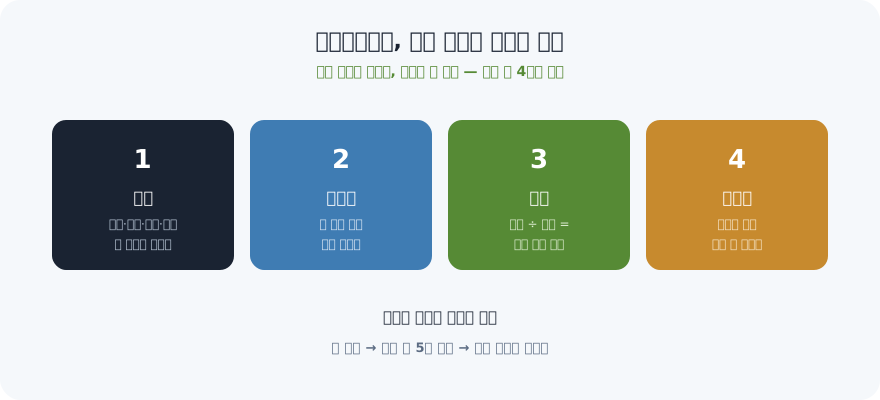
"I paid for it, so this time I'll actually read." You check out, and three weeks later the bookmark is still on page one.
That's not weak willpower. It's that money buys motivation, but it can't buy a habit. The resolve you feel at checkout lasts ten days at most. After that, the club's structure has to carry you — and most clubs either have none, or have one that doesn't fit you. So the real question isn't "how much should I pay?" It's "what structure am I buying?"
Key takeaways
- Money buys motivation, not habit — the payment effect lasts about ten days
- Judge a club on purpose, pressure, density, and output — not its reading list
- Run the 7-point checklist before you pay; any "I don't know" means wait
- Finishing a book isn't the win. One sentence → one action this week → attach it to a habit
Why paying doesn't make you read
The logic behind upgrading from a free club to a paid one is always the same: "I'll read just so the money isn't wasted." And honestly, it works — for a while. Loss aversion reliably lifts your attendance in the first few weeks.
The problem is the short shelf life. The money is already spent — a sunk cost — and within days your brain files it away as gone. What's left is the plain nightly fight: open the book, or open YouTube. In that fight, your receipt has no vote.
Which is why the good paid clubs aren't selling you money pressure at all. They're selling something else: a seat where not reading is visible, a deadline you can't quietly skip, an output you have to produce. (Same principle as beating procrastination with a system instead of willpower.)
Four criteria for picking the right club
The "curriculum" and the book list on the landing page are nearly useless for deciding. Look at these four instead.
1. Purpose — why are you going?
Two clubs with the same price can be selling completely different things. Roughly four types.
| Type | What it sells | Right for | Wrong for |
|---|---|---|---|
| Completion challenge | Deadlines, check-ins | People who never open the book | People who already read |
| Discussion / analysis | Perspective, depth | Readers who stay shallow alone | People who want to act |
| Application / practice | Behavior change | Readers whose life never changes | People wanting pure ideas |
| Networking | People, contacts | Industry connections | Quiet readers |
This is where most failures start: someone whose real pain is "I read but nothing changes" signs up for a discussion club. Discussion gives you perspective, not behavior. Name your pain first.
2. Pressure — what happens if you don't read?
A club where nothing happens when you show up unprepared fizzles out exactly like a free one, no matter the price. There's only one question: is it visible when I haven't read?
If there are presentation rotations, summaries to submit, a name attached to a section — there's pressure. If you can sit quietly and just listen, there isn't. Pressure isn't there to punish you; it's there to push you on the days you have no motivation of your own.
3. Density — headcount and airtime
Twenty people for two hours means six minutes of airtime each, on paper. In practice, three loud people take most of it. The bigger the group, the more it becomes a lecture; the smaller it is, the more it becomes a place where you have to speak. And when you have to speak, you can't not prepare.
4. Output — do you leave with something in hand?
If all you leave with is a good feeling, that was consumption. A summary, an assignment, one action for the week — something in a form that survives the meeting is what actually reaches next week's you.
The 7-point checklist before you pay
Run these seven before you hit checkout. Any "I don't know" means it's not time to pay yet.
✅ Before you register
- Can you state your purpose — which of the four types you need — in one sentence?
- Is this club actually that type (judge by how it runs, not how it markets)?
- What happens when you come unprepared? (If nothing, mark it down.)
- How many minutes will you have to speak per session? (Headcount ÷ time.)
- What output do you hold in your hand each week?
- Does it really fit your week (not on your late-night or childcare days)?
- What's the rule when you miss one? (Refund, make-up, grace — your anti-perfectionism safety net.)
Number seven is the one people skip. You miss a week, feel awkward about returning, skip the next — and the whole thing quietly disappears. Pick a club that has a designed path back. It's the exact same logic as the recovery rule that beats three-day quitting.
Three steps that turn a finished book into a changed life
Here's the part that matters. Even if you pick well and finish every book, most people still change nothing — because finishing is not the result, it's the raw material. Three steps turn material into a meal.
Step 1 — Take one sentence
Pick exactly one line from the book you never want to forget. Underline ten and you keep zero. Keep one, and it survives.
Step 2 — Translate it into an action this week
Turn that sentence into an action so small you can't fail, done within this week. "Attention is a form of love" → "phone in another room at dinner." Two conditions only: this week, and five minutes or less. (That's the core of reading for action.)
Step 3 — Attach it to a habit you already have
New habits can't stand alone. Anchor them: "after brushing my teeth → read that one sentence." "On the commute → ten pages." Then track it so it's visible. Once the checkmarks stack up, they become a streak you don't want to break.
| The usual way | The way that sticks |
|---|---|
| Finishing = the goal | Finishing = the material |
| 20 highlights | 1 sentence |
| "I'll apply it someday" | A 5-minute action this week |
| Ends when the club ends | Anchored to an existing habit |
So — should you sign up?
Here's the short version. If your problem is that you never open the book, a high-pressure completion club is worth every won. But if your problem is that you read and nothing changes, run the three steps above solo for two weeks before you pay for another club. If that fixes it, you just saved the fee. If it doesn't, then pick an application-focused club — with your eyes open.
Buy the structure, not the receipt. That's the only way a paid book club earns its price.
🌱 Put it into practice with VisionDream
The three steps live naturally in the app's Today tab. Put the one sentence from your book into Thinking (your one thing) and the five-minute action into Action (habit check), and tick it off daily. The calendar heatmap makes the momentum visible, and two streak protectors every month — used automatically when you miss a day — mean one skipped day doesn't collapse everything. In Sunday's weekly review, write three lines on whether the book actually changed your week, and reading starts to stick even without a club.
Do just one thing today: pick one sentence from the book you're reading, and write down the five-minute action it becomes this week. Plant your vision, and the fruit will come. 🌱
Frequently Asked Questions
Does paying for a book club actually make you read?
It works at first, but not for long. The money is a sunk cost, so within days your brain writes it off as gone. The payment effect lasts about ten days; after that, the club's structure has to carry you — deadlines, presentation rotations, outputs you must submit, anything that makes not reading visible. A club without that structure fizzles out exactly like a free one.
How do I pick the right paid book club for me?
Ignore the reading list and judge four things: purpose (is it a completion challenge, a discussion club, an application club, or a networking club — and which one matches your actual pain?), pressure (is it visible when you haven't read?), density (headcount divided by session length equals your airtime), and output (do you leave each week with a summary, task, or action in hand?). The most common failure is someone who reads but never changes signing up for a discussion club.
I finish the books but nothing changes. What now?
Finishing isn't the result — it's the raw material. Three steps: pick exactly one sentence you never want to forget (underline ten and you keep zero), translate it into an action small enough to do this week in five minutes or less, then attach it to a habit you already do daily and track it so it's visible. Paying for another club without these three steps produces the same outcome.
I miss one week and then quit entirely. How do I fix that?
The missed week isn't the problem — the guilt and awkwardness afterward is what ends the whole thing. So check the club's rule for missing a session (make-up, grace period, how you rejoin) before you pay, and set your own recovery rule in advance: miss one, simply resume the next week. Missing once is an accident; missing twice is a pattern.
Plant a vision, and fruit will surely grow 🌱
Start in the app →Related posts
- 📖Reading for Action — Why Nothing Changes After You Finish the Book (5 Steps to Make It Stick)
- 📲Goal-Tracking Apps — How to Pick One and Actually Finish Your Yearly Goals
- ⏰How to Stop Procrastinating — Break the Habit With Systems, Not Willpower
- 🖼️How to Make a Digital Vision Board on Your Phone (So You Actually See It Daily)