How to Find a Book Club in Your Neighborhood — And Start One If There Isn't
If you keep stalling halfway through books, it may not be weak willpower — it may be that you have no one to read with.
You've probably searched "book club near me." A few results come up, but you can't tell which ones are still active, what the vibe is, or whether the schedule works. Maybe you worked up the nerve to go once, felt out of place, and quietly stopped after the second meeting. So you go back to reading alone. But the real problem was never a shortage of clubs — it was that you had no search path and no filter.
Key takeaways
- Local book clubs aren't listed in one place — you have to check 5 separate channels
- Quitting after two visits isn't a discipline problem; you joined without a filter
- 4 questions asked before you show up screen out 90% of bad-fit clubs
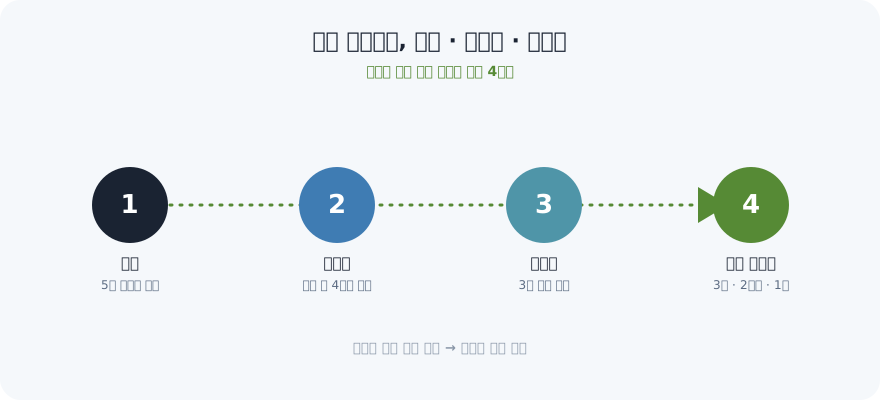
- If nothing fits, start your own: 3 people, 2 hours, 1 book — the most reliable path
Why finding a local book club is so hard
Three walls. First, you don't know where to look. Book clubs aren't the kind of thing one search surfaces; they're scattered across neighborhood forums, local apps, library boards, and dedicated platforms. Second, you can't sense the vibe until you're in the room. Is it social or discussion-driven? Do you have to finish the book? Not knowing makes the second meeting feel like a chore. Third, when nothing fits, most people stop there — even though that's exactly where the real option begins.
The four steps below knock down those walls in order.
Step 1 — Where to look: search 5 channels, not one
Don't check one place and conclude "there's nothing near me." Each channel hosts a completely different kind of club.
| Channel | What you'll find | What to check |
|---|---|---|
| Neighborhood forums / community groups | Long-running local groups | Any posts in the last 3 months (= still alive) |
| Local neighborhood apps ("meetups" tab) | New, small, low barrier to entry | Whether it's recurring or a one-off |
| Public library & community center programs | Facilitated, free or cheap, stable | Enrollment windows — check the calendar |
| Dedicated book club platforms & apps | Curriculum-style, clear format | Fee level, online vs in person |
| Indie bookstore / café boards, social hashtags | Taste-based, small | Usually requires DMing the organizer |
One tactic: narrow your search terms instead of widening them. "Book club" alone gets buried in ads. Combine your neighborhood with a genre (neighborhood + essays, neighborhood + self-improvement) or with a time slot (weeknight, weekend morning), and the real, active small groups surface.
Step 2 — Filter: 6 criteria that tell you if it fits
Finding one isn't the finish line. Most people who quit after two meetings didn't land in a bad club — they landed in the wrong club. Check these six before you go.
- Purpose — social, finishing books, or real discussion?
- Format — same book together / read anything and share / assigned facilitator and debate
- Size — 4-6 people means everyone talks; 10+ means you listen
- Cadence and timing — can it actually fit your week (weeknight vs weekend morning)?
- Cost and location — dues, drinks, and travel time combined, is it sustainable?
- Reading pressure — will you feel judged for not finishing, or can you share what you did read?
Ask these 4 questions in your first message. "Is there an assigned book?" "Can I come if I haven't finished it?" "How many people usually show up?" "When's the next meeting?" Those four answers screen out 90% of bad-fit clubs before you ever walk in.
Step 3 — Stick: the 3-visit rule
Don't mistake first-meeting awkwardness for a bad fit. Rooms full of strangers are awkward by default. So set a 3-visit rule in advance: you don't judge until after the third meeting. And if it still feels heavy after three, that's not a failure of grit — that's a fit problem. Move on without guilt. (Same principle as beating three-day quitting — designing for the point where people usually drop out.)
Step 4 — If nothing fits, start one: 3 people, 2 hours, 1 book
If you're tired of searching, the most reliable path is right here. Starting a book club doesn't require 30 members or a beautiful venue.
- Write a one-sentence concept. "Working 30-somethings reading one self-improvement book a month on weeknights" — who, when, what genre, all in one line. A club for everyone attracts no one.
- Start with 3 people. One friend plus one friend-of-a-friend is enough. Three keeps a conversation alive and survives one absence. Far more clubs die trying to recruit ten before starting than die from being too small.
- Lock the first date before you recruit. "Let's do it once enough people join" never happens. Set the date, place, and time first, then invite. A quiet café or a library study room is plenty.
- Fix a 2-hour format. 10 min catch-up → 20 min reading favorite passages aloud → 60 min discussion → 30 min where everyone names one action they'll take this week. That last block is the whole point. Without it, a book club is just pleasant conversation. (More on that in turning reading into action.)
| Joining a club | Starting a club |
|---|---|
| Takes weeks to find one | Starts with three texts today |
| Vibe and cadence are decided for you | You choose the concept, day, and book |
| Bad fit = back to square one | Bad fit = just fix the format |
| Nobody notices if you skip | You're the host — so you don't skip |
That last line is quietly the most powerful. Hosts don't skip. If you wanted a club because you needed consistency, nothing enforces consistency like being the one who opens the door. (Same mechanism behind building real consistency.)
🌱 Putting it into practice with VisionDream
Whether you join or start one, the real battle happens in the two weeks between meetings. Add "read 20 pages" as a habit in VisionDream's Today tab and check it off — the calendar heatmap makes your momentum visible, and two streak protectors every month, used automatically when you miss a day, keep one slip from collapsing the whole run. The one action you committed to at the meeting? Put it in your planner's weekly One Thing so it's still alive at the next session.
Give it ten minutes today 🌱 — open one of those five channels and search your neighborhood, and if nothing fits, text the one person who just came to mind: "want to read a book together?" Plant your vision, and the fruit will come.
Frequently Asked Questions
Where do I actually find a book club near me?
They aren't listed in one place, so check five channels separately: (1) neighborhood forums and community groups, (2) the meetups tab of local neighborhood apps, (3) public library and community center programs, (4) dedicated book club platforms and apps, and (5) indie bookstore or café boards plus social hashtags. When searching, don't just type 'book club' — combine your neighborhood with a genre (essays, self-improvement) or a time slot (weeknight, weekend morning) to surface the small, actually active groups.
I went to a book club and quit after two meetings. Why?
Most likely it wasn't a bad club, just the wrong one for you. Before joining, check six things: purpose (social vs finishing books vs discussion), format (assigned book or not), size, cadence and timing, cost, and reading pressure. Asking four questions up front — 'Is there an assigned book?', 'Can I come if I haven't finished?', 'How many people usually show up?', 'When's the next meeting?' — screens out most bad fits. Also set a 3-visit rule so you don't mistake first-meeting awkwardness for a bad fit.
What if there's no good book club in my area?
Start one — it's the most reliable path. Write a one-sentence concept naming who, when, and what genre; begin with just three people; lock the first date and place before recruiting instead of waiting for people to gather; and fix a 2-hour format (10 min catch-up, 20 min reading passages aloud, 60 min discussion, 30 min naming one action for the week). A quiet café or library study room is enough — and since hosts don't skip, it's also the strongest consistency system you can build.
How do I make sure a book club actually changes something?
End every meeting with 30 minutes where each person names one action they'll take that week. Without it, a book club stays pleasant conversation. Then manage the two weeks between meetings: add 'read 20 pages' as a habit in VisionDream's Today tab, let the calendar heatmap keep your momentum visible, and rely on the two automatic monthly streak protectors so one missed day doesn't end the run.
Plant a vision, and fruit will surely grow 🌱
Start in the app →Related posts
- 🗣️Adult Book Discussion Groups: Read Alone and You Last 3 Days — Read Together and You Last 3 Years
- 📲Goal-Tracking Apps — How to Pick One and Actually Finish Your Yearly Goals
- ⏰How to Stop Procrastinating — Break the Habit With Systems, Not Willpower
- 🖼️How to Make a Digital Vision Board on Your Phone (So You Actually See It Daily)