How to Build a Reading Habit — No Finish-the-Book Guilt, a 3-Step System That Survives a Missed Day
Whatever book you buy ends up shelved within three days. Every New Year you vow "12 books this year," you fill your cart with bestsellers, and you read the first 30 pages underlining every insight. Then a day or two gets busy, and suddenly opening the book feels like a chore — so you close it for good. And the conclusion is always "I guess I'm just not a reader."
But that's not weak willpower. The real culprit that broke you is finish-the-book guilt — the belief that you must read one book cover to cover, a set amount every day, underlining perfectly. Because of that guilt, missing a single day means "this book's a write-off too," and a written-off book never gets opened again.
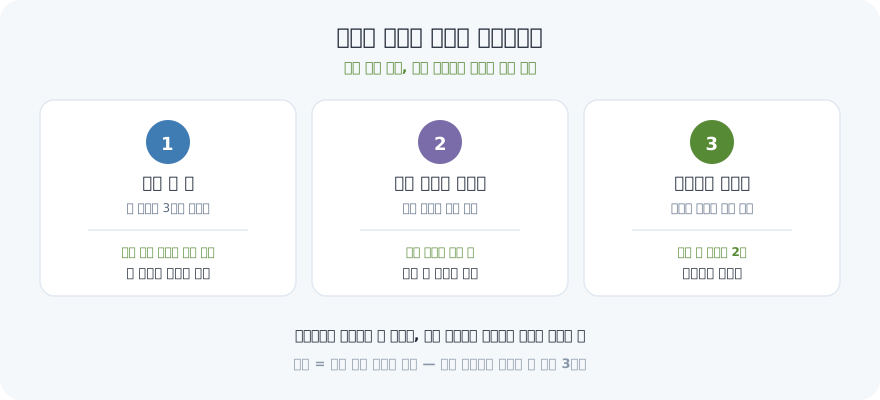
People who read consistently aren't people with strong willpower. They're people with a system that keeps them from shelving the book after a missed day. This isn't a nagging "read more" article. It's a 3-step reading system that defends against finish-the-book guilt and three-day quitting. You can set it up in 10 minutes today.
Key takeaways
- The real reason books get shelved in three days isn't willpower — it's finish-the-book guilt: "I have to read it all properly" blocks you from starting
- Shrink the goal from "one chapter" to "one page today." It has to feel trivially small to survive a busy day
- A missed day is an accident. The only rule is never miss two days in a row — treat the backlog as gone and start from one page today
- Above underlining, re-reading, and finishing: staying connected to the book. The goal is connection, not completion
- Perfectionism safety net: declare two buffer days this month in advance, and the self-blame of a missed day disappears
Why books, of all things, get shelved in three days
A book's finish line — "read the whole thing" — sits so far away that a single missed day triggers a "this book failed" verdict. That verdict makes you shelve it.
Unlike exercise or study, reading carries an unusually heavy pressure to "finish the book." The moment you buy a 300-page book, a debt forms in your head: "I have to read all of this." Reading 30 pages on day one feels great, but miss two days and the remaining 270 pile up like a loan. And the moment the loan feels burdensome, we close the book instead of opening it.
Here's the key: people who read consistently miss days too. The only difference is that they aim for "a few lines today," not "finishing." Their goal isn't reading a whole book — it's keeping daily contact with the book. So a missed day isn't "this book's dead," it's "one page today and I'm back on." (This is exactly the "connection, not completion" point from how to beat three-day quitting.)
| Reading trapped by finish-the-book guilt | A reading system that holds |
|---|---|
| "I have to read this cover to cover" | "One page today and today's a win" |
| A chapter, 30 pages, every day | One page you can turn even on your busiest day |
| Miss a day → "this book's a write-off" | A missed day is an accident — start from one page today |
| Burn out on underlining and perfect notes | You can just read and move on, no underlining |
| Cling to a boring book to the end | Close it and move to the next (finishing isn't mandatory) |
| Self-blame on a missed day → shelve the book | Two buffer days make a missed day okay by design |
Step 1 — Shrink the goal: "one page today," not "one chapter"
Most reading plans die because they're "a chapter a day." Start with "one page a day," not "30 pages a day," and it lasts.
We set reading goals when motivation is high: "30 minutes a day," "a chapter a day," "two books a month." The trouble is you have to keep those goals on the late-night day, the sick day, the day you're wrecked after putting the kids to bed. Miss 30 pages that day and it's a failure; failures pile up and you close the book.
The fix is to shrink the goal to the size you can keep on your busiest day. Not a chapter but a page. Even a single paragraph is fine. If that makes you think "how will I ever finish a book one page at a time," that's precisely why you've failed until now. It has to be trivially small to survive a drained day. And when you open the book just to read one page, momentum usually carries you to five or ten more — the problem was always "opening it," never "how much you read." (Use SMART goal setting to carve out a daily unit that small.)
Step 2 — The reset rule: the day after a miss is the real game
In three-day quitting, "three days" isn't the problem. The problem is that after missing on day three, the backlog feels heavy and you shelve the whole book.
This is the heart of the article. Most reading advice obsesses over how to start and how to finish. But 90% of reading failure is decided at the restart, not the start. Miss on Tuesday and Wednesday feels like "I'm two days behind"; by Thursday it's "the flow's broken, I'll start a new book." And that new book gets shelved in three days too.
There's one rule: never miss two days in a row. Missing a day is just an accident — everyone does. The danger is that not opening the book two days in a row hardens it into an "abandoned book." So the day after a miss, read one page no matter what. Don't try to repay the backlog — treat it as gone. From the same page you were on yesterday, start with one page today; just never miss two in a row. That's the entire restart. If you can't recall where you left off, just read from wherever it opens. (Letting go of perfectionism goes deeper on this "don't go back" rule.)
Step 3 — The perfectionism safety net: neither underlining nor finishing is mandatory
"Since I'm reading anyway, I'll underline and take notes and do it properly" is the number one killer of a reading habit.
Perfectionism seems like the opposite of laziness, but in reading the result is identical: both make you not read. Underlining and note-taking turns one page into ten minutes, and you burn out and stop opening the book. You cling to a boring book because "I bought it, so I'll finish," and reading itself stalls on that book.
So the final device is a safety net where reading loosely and not finishing are both okay. Give yourself three permissions. First, you don't have to underline, transcribe, or organize. Reading with your eyes and moving on still counts. Second, if it's boring, close it and move to the next book. Finishing isn't mandatory — clinging to a mismatched book is what stops your reading altogether. Third, declare two buffer days for this month in advance: "Missing up to twice this month isn't failure, it's a budget spend." When you plan the missed days in from the start, the self-blame on a missed day disappears, and without self-blame you open the book again the next day. You beat perfectionism not with stronger willpower but with slack designed in advance so that reading loosely is okay. (Read it alongside turning reading into action and the guilt of "perfect notes" loosens even more.)
The 10-minute setup you can do today
You have enough information. Spend exactly 10 minutes today, in this order.
- Rewrite today's goal as "one page." If it's "a chapter a day," make it "a page a day." Shrink it until it feels trivial.
- Keep the book always in sight. By your pillow, on the table, in your bag — within three seconds of your hand. Removing the friction to start beats willpower.
- Write the reset rule on your bookmark. "Never two days in a row. Skip the backlog. Start from one page today." Put those three lines on your bookmark or the first page.
- Declare two buffer days for this month in advance. "Missing twice this month still counts as a win."
Set up these four, and the next time you miss a day or two, you won't shelve the whole book. What matters isn't the finish count of "how many books this year" — it's not breaking your connection to the book. Stay tied to a book even one page at a time, and a year from now you'll unmistakably be "a reader." 🌱
🌱 Doing it with VisionDream
A reading habit is a system, not willpower. Managing those three steps by hand every day is its own burden — so that's the first thing you drop. VisionDream builds the structure into the app. Put "read one page today" into the action (habit check) of the Today tab (daily B·T·A) and it collapses your day into a single screen, doing the "shrink the goal" work for you, while the calendar heatmap shows you which weekday you close the book. Remember, the game is after a missed day — two streak protection passes used automatically each month are the perfectionism safety net that keeps your streak alive even when you miss a day. When finish-the-book guilt tries to reset 30 days to zero with "this book's a write-off too," the app spends a pass instead and keeps the thread. The 4-level planner rolls yesterday's unread "one page" forward automatically instead of stranding it on yesterday, running the reset rule for you, and the success tree grows your one-page-at-a-time reading days from a seed into a tree, making the "power of one page" visible.
Before you buy one more book, set up a structure that doesn't make you shelve the whole thing when you miss a day. The app is the tool; you're still the one opening the book. Plant your vision, and the fruit will come. 🌱
Frequently Asked Questions
Every book I buy gets shelved in three days. Do I just have weak willpower?
No. The real culprit isn't willpower, it's finish-the-book guilt. Because you believe you must read a book cover to cover perfectly, a single missed day becomes 'this book's a write-off too,' and you shelve it. People who read consistently aim for 'one page today,' not 'finishing,' keeping daily contact with the book. Shrink the goal to one page and add a reset rule that only avoids two misses in a row, and books stop getting shelved in three days.
If a missed day breaks my flow, isn't it better to just start a new book?
No — that way the new book gets shelved in three days too. A missed day is just an accident, and you can treat the backlog as gone. There's one rule: never miss two days in a row. The day after a miss, read one page from the same spot you were on yesterday and the flow continues. If you can't recall where you left off, read from wherever it opens. Don't try to repay the backlog; restart from one page today.
Don't I need to underline and take notes to actually retain anything?
Underlining and organizing are options for after the reading habit is established. While you're building the habit, the perfectionism of 'reading properly' makes one page take ten minutes and keeps you from opening the book at all. While building the habit, just read with your eyes and move on. Close a boring book and move to the next — finishing isn't mandatory, and clinging to a mismatched book is what stops your reading altogether.
How does the VisionDream app help me build a reading habit?
VisionDream builds the survive-a-miss structure into the app. Put 'read one page today' into the habit check of the Today tab (daily B·T·A) to collapse your day into one screen, and two streak protection passes used automatically each month keep your streak alive even when you miss a day, preventing collapse from finish-the-book guilt. The 4-level planner's automatic rollover brings yesterday's unread page into today to automate the reset, and the success tree grows your one-page-at-a-time reading days into a tree, making the power of one page visible.
Plant a vision, and fruit will surely grow 🌱
Start in the app →Related posts
- ⏰How to Stop Procrastinating — Break the Habit With Systems, Not Willpower
- 🌙The Evening Routine — Ten Minutes Tonight Decides Tomorrow Morning (4-Step, 10-Minute Checklist)
- 🌙How to Do a 5-Minute Daily Review — Stop Grading 'What You Didn't Do' (3-Line Format + Timebox)
- 📔Before You Buy a Planner — 3 Checks That Decide Whether You Finish the Year