Writing Your Goal 100 Times a Day: Why It Dies on Day Three — And the 21-Day Ramp That Fixes It
I bought the notebook the same night I read about the method. I filled two pages on day one, forced my way through day two, and on day three I closed the notebook and never opened it again.
The method itself is brutally simple: write your goal by hand, 100 times a day, for 100 days. It comes from Kim Seung-ho, the Korean entrepreneur who founded the lunchbox franchise SNOWFOX, and it has quietly spread through goal-setting circles because it needs no app, no subscription, and no system — just a pen.
What broke on day three wasn't my willpower. I worked it out later with a stopwatch. The sentence I had chosen was fourteen words long. One repetition took about 28 seconds. A hundred of them took 47 minutes. I had, without noticing, committed to a 47-minute daily assignment for 100 consecutive days.
Cut the sentence to six words and those same 100 repetitions take about 20 minutes. Nothing about the method changed. The daily cost dropped by more than half. This piece is about that arithmetic, and the 21-day ramp that comes out of it. 🌱
Key takeaways
- Quitting on day three is a sentence-length and time-budget failure, not a character failure
- At a realistic repetitive-copying speed, six words or fewer keeps you under 20 minutes; twelve words pushes you past 30 and that's where people stop
- It breaks in exactly four places — underestimated time, hand pain, a vague sentence, and no rule for the day you miss
- Build the sentence with four rules: present tense, six words or fewer, exactly one number, and "I" as the subject
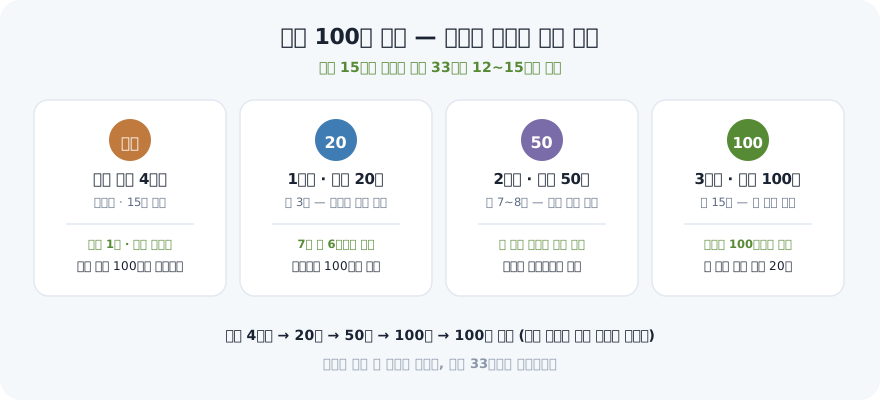
- Do not start at 100 — week 1: 20 reps, week 2: 50, week 3: 100
- Missing one day is a statistic. Missing two in a row is a new default. On bad days write the half version: 20 reps, about four minutes
- 100x writing, the 55x5 method, and affirmations give you different things — don't stack them, assign them roles
What the method actually is
In one line: you write the goal you want by hand, 100 times a day, for 100 days.
Kim Seung-ho is the founder and chairman of SNOWFOX, a Korean lunchbox and sushi franchise that grew into a US-listed group, and the author of several bestselling books on money and business. He introduced the practice in The Secret of Thought, and the reason it travels well is that it survives translation: nothing about it is culturally specific except the discipline.
That's as much biography as this needs. If you're reading this you don't need his résumé — you need to know why the method dies in your hands on day three.
Pull the method apart and there are three design choices, each doing a specific job:
| Element | Why it's built that way | How it collapses when you cheat |
|---|---|---|
| By hand | Handwriting is slow, and the slowness keeps the sentence in working memory instead of letting it slide past | Copy-pasting 100 lines into a notes app takes three seconds and leaves nothing behind |
| 100 times a day | Once a day gets buried under everything else. Density is what does the engraving | Drop to 10 and you may keep the habit, but you lose the engraving that made it worth doing |
| For 100 days | You meet the same sentence on good days and on the worst ones | Doing it only when you feel sharp isn't goal management, it's mood management |
The element people underrate is the first one. The moment you write by hand, this stops being a thought and becomes a physical task that consumes clock time. Start without doing the arithmetic and you will almost always hit the wall inside a week.
There is decent evidence that the writing part matters, by the way. Gail Matthews, a psychologist at Dominican University of California, ran a small study with 267 participants and found that people who wrote their goals down — and, even more so, those who also sent weekly progress notes to a friend — reported significantly more accomplishment than people who merely thought about their goals. It's one modest study, not a law of nature, but it points the same direction the notebook does: written and revisited beats thought about.
The real reason it dies on day three: nobody runs the numbers
Copying the same short phrase over and over is faster than normal handwriting, because after a dozen reps your hand stops reading and starts running muscle memory. A reasonable sustained rate for repetitive copying is around 150 characters per minute, including the small pauses for line breaks and numbering. Here is what that produces:
| Sentence length | Time per repetition | 100 reps a day | Total across 100 days |
|---|---|---|---|
| 4 words (~20 chars) | about 8 sec | about 13 min | about 22 hours |
| 6 words (~30 chars) | about 12 sec | about 20 min | about 33 hours |
| 8 words (~40 chars) | about 16 sec | about 27 min | about 45 hours |
| 10 words (~50 chars) | about 20 sec | about 33 min | about 55 hours |
| 14 words (~70 chars, my failed sentence) | about 28 sec | about 47 min | about 78 hours |
Same method, same 100 repetitions — and one decision about sentence length is the difference between 13 minutes and 47. Twenty minutes fits into a commute. Forty-seven minutes has to be scheduled, and anything that has to be scheduled gets skipped on the night you work late.
If you write in English you inherit a specific disadvantage here: the same goal takes roughly twice as many characters in English as it does in Korean or Japanese, so the ceiling is lower for you than it is in the original telling. Six words is your fifteen. Treat it as a hard cap, not a suggestion.
Time isn't the only place it snags. In practice the method only breaks in four spots:
| # | Failure point | What actually happens | Usually around | Fix |
|---|---|---|---|---|
| 1 | Underestimated time | You start assuming "five minutes," it's really 25–45, and it eats into sleep | Day 2–3 | Stopwatch one repetition before you start, multiply by 100, and look at the number |
| 2 | Your hand hurts | 100 reps of a long sentence makes the wrist and the first knuckle of the index finger ache. Pain doesn't yield to willpower | Day 3–4 | Cut to six words and split into two sets of 50 |
| 3 | The sentence is vague | "Get rich" can be written 100 times and still produce no action today, so it starts to feel pointless | Day 4–7 | Rewrite with the four rules below so it carries a number and a horizon |
| 4 | No rule for the day you miss | Miss one day, conclude "it's ruined," skip the next, done | The day after the first gap | The never-two-in-a-row rule plus a 20-rep half version |
Numbers 3 and 4 are the quiet killers. With 1 and 2 you can at least see the problem — your hand hurts, the clock says 40 minutes. With 3 and 4 the conclusion you reach is "I guess I'm just not disciplined," which is both wrong and expensive. The structure where one missed day turns into total abandonment is the same collapse pattern covered in how to stop quitting after three days.
Four rules for a sentence worth writing 100 times
Roughly 80% of the outcome is decided by the one sentence you choose on day one. There are only four rules.
| Rule | What it means | Why it's there |
|---|---|---|
| 1. Present tense | "I save," not "I will save" | Future tense still reads as not yet after the hundredth repetition |
| 2. Six words or fewer | Count them. Six is the ceiling, not the target | ~12 seconds a rep, ~20 minutes a day — the only band where 100 days is survivable |
| 3. Exactly one number | An amount, a count, or a deadline. Pick one | With no number, today produces no action. With two, the sentence gets long |
| 4. "I" as the subject | Start with "I" | If the subject is something you don't control — the market, your manager, a client — repetition just accumulates helplessness |
Easy to agree with, hard to obey. Most first drafts break two or three rules at once. Here are common ones, rewritten:
| First draft | What's wrong | Rewrite (words / characters) |
|---|---|---|
| Someday I'm going to be wealthy | Future tense, no number, "someday" | I save $1,000 a month. (5w / 22c) |
| I wish my manager appreciated my work | Subject isn't me, it's a wish | I report one win weekly. (5w / 24c) |
| I want to get healthy, lose weight and build stamina | Three goals in one sentence, 10 words | I walk 30 minutes daily. (4w / 23c) |
| By next year we'll hit $1M revenue and grow the team | Two numbers, no personal subject, 11 words | I close $80K monthly. (4w / 21c) |
| I want to become someone who's good at Spanish | Vague, wish form, no number | I study Spanish 20 minutes. (5w / 27c) |
Notice what the right-hand column has in common: every sentence is four to six words, carries exactly one number, and makes today's action obvious the moment you read it. If your sentence is still fuzzy, run it through the specificity and measurability tests in SMART goal setting first, then compress the survivor down to six words.
One more constraint: there can only be one sentence. Three goals at 100 reps each is 60 minutes a day, and that doesn't last a week, let alone 100 days. If you can't choose between your goals, you're not ready to start this method — you're ready to sit down and prioritize.
The 21-day ramp: don't write 100 on day one
This is the part that changes the outcome. Treat the first three weeks not as the practice itself, but as the period where you build the hand and the time slot that can carry the practice.
| Stage | Reps per day | Time (6-word sentence) | Purpose of this stage | Gate to advance |
|---|---|---|---|---|
| Week 1 (days 1–7) | 20 | about 4 min | Fix the act of sitting down | Wrote on 6 of 7 days |
| Week 2 (days 8–14) | 50 | about 10 min | Let hand and schedule absorb the load | 6 of 7 days, no hand pain |
| Week 3 (days 15–21) | 100 | about 20 min | Enter full dose | 6 of 7 days, no urge to rewrite the sentence |
| Week 4 onward (22–100) | 100 (hold) | about 20 min | Finish 100 days | — |
If you miss the gate, do not advance. Repeat the same week at the same rep count. Running week 1 twice costs you nothing. Someone doing four honest minutes a day for three weeks is far closer to day 100 than someone who wrote 100 reps on day one and vanished on day three.
Three supporting rules go with the ramp:
- Same time, same seat. If you don't fix the slot, it becomes "sometime today," which in practice means no. Attach it to something you already do daily — right after you wash your face, or right before you get into bed.
- Lock the sentence before week 3. Editing the sentence mid-stream resets the engraving. Weeks 1 and 2 are your grace period for revising; from week 3 it's frozen.
- Write the date and the last rep number every day. Something like "9/1 · 100." That column of numbers becomes the strongest fuel you have around week five. The principle — that a goal survives by staying visible — is the same one behind the loop in managing goals in five steps.
100x writing vs. the 55x5 method vs. affirmations vs. the mandala chart
If you've spent any time in goal-setting corners of the internet you've met the neighbors of this method, and the usual mistake is treating them as substitutes and rotating through all four. They don't deliver the same thing.
| Method | What it gives you | When it works | When it backfires | Daily cost |
|---|---|---|---|---|
| 100x for 100 days | Overwhelming engraving of a single goal, plus forced prioritization | Once your goal is already narrowed to one sentence | While you still have several goals — you can't choose what to write, so you stop by day three | 13–20 min |
| The 55x5 method | A short, intense burst — one sentence 55 times a day for five days | When you want a fast test of whether a sentence holds up before committing to 100 days | Used as a shortcut to the result itself; five days engraves very little | about 10 min, 5 days |
| Affirmations | Belief and identity repair | When self-doubt — "people like me don't do this" — is the actual blocker | When the sentence is far from what you currently believe; you get resistance, not belief | 1–3 min |
| The mandala chart | Decomposition of one goal into 8 areas and 64 actions | When the goal is set but you don't know what to do today | When filling the grid becomes the point — 81 boxes and nothing after | 1–2 hrs once, then ~10 min weekly |
The mandala chart is the one most English readers have already seen without knowing the name: it's the 81-box sheet Shohei Ohtani filled out in high school, and it does a completely different job from writing one line 100 times.
A workable order is mandala chart → 100x writing → affirmations. Decompose with the mandala chart until the center box is settled, compress that box into a six-word sentence and engrave it with 100x writing, and handle the "who am I kidding" voice that surfaces around week two with the approach in how to write affirmations that actually work.
Do not start all of them at once. If you can't yet hold a 20-minute daily commitment, stacking three practices on top of it guarantees all three collapse in week one.
The recovery rules, and three checkpoints
Nobody finishes a 100-day practice without missing days. The difference between people who finish and people who don't isn't whether they miss — it's what they do the day after. Five rules:
- Never two in a row. This is the only absolute rule here. One missed day is a statistic; two consecutive days is a new default called "not doing this anymore."
- On bad days, write the half version: 20 reps. About four minutes. Late night at work, sick, traveling — abandon the 100 and take the 20. The gap between 0 and 20 is far larger than the gap between 20 and 100.
- Never make up a missed day. Writing 200 the next day gives you a sore hand and costs you two more days. Leave the gap where it is and return to the normal dose.
- If you miss three or more days in a row, reset to week 1 (20 reps). Resuming at 100 from a cold stop almost always fails, because your hand and your schedule have already forgotten the habit.
- Never buy a new notebook. Continue in the same one, gap and all. A fresh notebook creates the psychological weight of "starting over," and that weight is what postpones the restart.
A hundred days is long enough that you need checkpoints. If any of these answers comes back wrong, adjust on the spot rather than grinding on.
| Checkpoint | Question | If the answer is bad |
|---|---|---|
| Day 30 | While writing it, does today's action come to mind? | If not, the sentence has no number or horizon — rewrite with the four rules |
| Day 30 | Is the daily session running past 25 minutes? | Then the sentence is too long — cut to six words |
| Day 60 | Has the goal itself changed? | If yes, start day 1 with the new sentence. Don't grind out a sentence you've outgrown |
| Day 60 | Besides writing, has any real action started? | If not, the writing has detached from your execution loop — attach a weekly review |
| Day 100 | What is different between the you of day 1 and now? | Write three lines, then choose the sentence for the next 100 days |
That fourth question is the important one. Writing a goal 100 times is not an incantation that delivers the goal. It is a device that runs the same sentence through your hand for 20 minutes a day until it is the first thing that surfaces when you face a decision. What you do after it surfaces is still on you.
🌱 Put this into practice with VisionDream
Keep the writing on paper — but what protects the 100 days is the record. Laying out your one-line vision and the five life areas (career, learning, health, finance, relationships) in the Dream Map makes it obvious which sentence deserves the notebook, and promoting that sentence to the weekly One Thing in the planner keeps it in one place all week. Log whether you wrote today under Belief (the affirmation check) in the Today tab (B·T·A), and the calendar heatmap shows your streak at a glance; on the day you miss, a streak shield (2 per month, applied automatically) protects the run for you. The tool is the app; the protagonist is you.
Your task today is exactly one thing. Take the goal you most want right now, compress it to six words or fewer, and write it 20 times. Four minutes. Not 100 — 20.
Closing the notebook on day three was never a verdict on your discipline. You had signed up for a 47-minute daily assignment. Change it to a 20-minute one and the whole story changes. Plant your vision, and the fruit will come 🌱
Frequently Asked Questions
What is the 'write your goal 100 times' method?
You write one goal by hand, 100 times a day, for 100 days. It was popularized by Kim Seung-ho, the Korean entrepreneur behind the SNOWFOX franchise, in his book The Secret of Thought. Three elements make it work: it must be handwritten rather than typed, it must reach 100 repetitions a day, and it must run for 100 days. Drop any one of them and the engraving effect largely disappears — copy-pasting 100 lines into a notes app takes three seconds and leaves nothing behind.
How long does writing a goal 100 times actually take?
It depends almost entirely on sentence length. Repetitive copying of a familiar phrase runs at roughly 150 characters per minute, so a six-word sentence takes about 12 seconds per repetition and about 20 minutes for 100. Eight words pushes you to about 27 minutes, and fourteen words to about 47. Once the daily cost crosses 30 minutes, it has to be scheduled, and scheduled things get skipped on busy nights — which is why capping the sentence at six words is a precondition for finishing, not a stylistic preference. English needs about twice the characters of Korean for the same goal, so your ceiling is lower than the original telling suggests.
I always quit on day three. What should I do differently?
Don't write 100 on day one. Use a 21-day ramp: 20 reps a day in week 1 (about 4 minutes), 50 in week 2 (about 10 minutes), and 100 in week 3 (about 20 minutes). That solves hand pain and time pressure at the same time. If you didn't write on at least 6 of 7 days in a given week, don't advance — repeat the same week at the same rep count. Running week 1 twice costs you nothing.
What kind of sentence should I write?
Follow four rules: present tense (not 'I will'), six words or fewer, exactly one number (an amount, a count, or a deadline), and 'I' as the subject. So 'Someday I'm going to be wealthy' becomes 'I save $1,000 a month,' and 'I want to get healthy, lose weight and build stamina' becomes 'I walk 30 minutes daily.' And there can only be one sentence — three goals at 100 reps each is an hour a day, which nobody sustains.
If I miss a day, do I have to start over?
No. One missed day is just a statistic; the thing that actually kills the practice is missing two in a row. On days you can't manage the full dose, write the half version — 20 reps, about four minutes. Don't try to make up the gap with 200 the next day either; you'll end up with a sore hand and lose two more days. If you have missed three or more consecutive days, reset to week 1 at 20 reps and ramp back up, and keep using the same notebook rather than buying a fresh one.
Should I do this, the 55x5 method, affirmations, or a mandala chart?
They aren't substitutes; they do different jobs. A mandala chart breaks a goal into 8 areas and 64 actions, 100x writing engraves a single narrowed goal, the 55x5 method is a short five-day burst useful for testing whether a sentence holds up, and affirmations repair the self-doubt underneath. A sensible order is mandala chart to settle the center box, then 100x writing to engrave it, then affirmations for the weeks when belief wobbles. Starting all of them at once is the reliable way to lose all of them in week one.
Plant a vision, and fruit will surely grow 🌱
Start in the app →Related posts
- 📲Goal-Tracking Apps — How to Pick One and Actually Finish Your Yearly Goals
- 🛰️What Is Dream Backcasting? Plan Backward from Your Future to Today in 5 Steps (30-Minute Worksheet)
- 🎯How to Set SMART Goals — One Sheet of Paper, 15 Minutes, 'Someday' Becomes 'Today'
- 🎯How to Set New Year's Goals — A 5-Step Annual Plan That Won't End as a Three-Day Resolution