Why Book Clubs Quietly Die in 3 Months — And the 6-Week Blueprint for One That Lasts
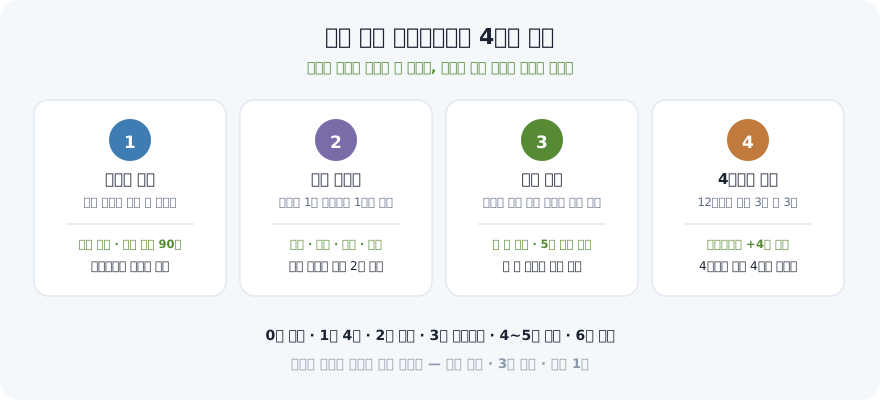
You've probably noticed the strange math. At home, three hours go by and you're still on page ten. The night before book club, you read eighty pages in one sitting without meaning to.
Your willpower didn't spike that evening. There was simply a seat waiting for you at 8 p.m. on Thursday. What beats us when we read alone isn't laziness — it's a day where nothing happens if we don't read.
But there's a second oddity. That club you loved? Three months later it's a group chat and nothing else. Nobody fought. Everyone said "see you next week." It just went quiet. This piece covers both halves — why reading works in a club, and why that club disappears. 🌱
Key takeaways
- A club works because the date and the seat are decided in advance, not because the people are special
- Clubs die from one person carrying all the operations and from how absences are handled — not from boredom
- When choosing, ignore the dues and the reading list; ask how many facilitators there are. One means it stops the month that one person gets busy
- Prep for your first meeting isn't finishing the book — 30 minutes, 3 highlights, 1 question is enough
- If you're starting one, begin with 4 people, not 12 — start with four and four remain
- No club nearby? The structure recreates alone (fixed day and time + one person to report to + one page a day)
Why you quit alone in three days but read for a club
What the club gave you wasn't motivation. It was a deadline.
| Reading alone | Reading for a club |
|---|---|
| You decide when to read, every single time | The day and hour are already set |
| Nothing happens if you skip | You'll have nothing to say on Thursday |
| A hard paragraph ends the session | Someone else pushes you through it |
| It only counts if you finish the book | Thirty pages is enough to join the conversation |
| A closed book stays closed | The next seat is still there, so you come back |
The line that matters most in that table is the last one. Solo reading doesn't collapse on the day you skip — it collapses because there's no seat to return to after you skip. That's how "this week is blown, I'll restart on the 1st" happens, and the 1st never arrives.
So why does the club die in three months — the 5 patterns
Clubs rarely die from people problems. They die from operational design. These five account for almost all of it.
| Failure pattern | What you see | The real cause | The fix |
|---|---|---|---|
| Facilitator overload | "Sorry, I'm swamped this week…" happens twice | One person handles discussion prep, announcements, the venue, and money | Split four roles across four people (discussion, announcements, venue, notes) |
| Absence stigma | Someone misses once and never returns | The group subtly expects an apology | State at meeting one: "miss a week, your seat stays" |
| Book-picking gridlock | Three days in the chat and no title chosen | Every pick requires full consensus | Lock in four books per quarter; suggestions go into the next quarter's list |
| Completion pressure | People who didn't finish quietly skip | Finishing becomes the de facto entry ticket | Entry ticket is "however much you read" |
| Drift into small talk | 15 minutes of book talk in a two-hour meeting | No running order, so the loudest voice steers | A fixed 90-minute agenda (check-in 10 · discussion 40 · open 30 · close 10) |
The first one dominates. Clubs stop not because they got boring but because the facilitator got tired — and facilitators usually don't say so. They just stop posting the announcement.
Which type of book club fits you
| Type | Typical size | Cost | What makes it last | Best for |
|---|---|---|---|---|
| Workplace club | 6–12 | Free to small dues | Two facilitators, so reorgs don't kill it | People for whom the commute itself is the barrier |
| Public library / community | 10–20 | Free | Whether there's a handover doc when staff change | Anyone who wants to start at zero cost |
| Online (Zoom, Discord) | 5–15 | Free to ~$10/month | Whether chat participation counts instead of forced camera | Irregular schedules — shift work, caregiving, remote towns |
| Paid / subscription club | 8–20 | $15–40 per session | Whether absence and refund rules exist in writing | People who only show up when money is on the line |
| Meetup / social apps | Fluid | Free | Whether four regulars emerge within the first three weeks | People who want to sample the vibe first |
The first thing to check isn't the dues or the reading list — it's how many facilitators there are. With one, the whole club halts the month that person moves or gets buried at work. The second is whether the absence policy exists in writing, not just in spirit.
Weighing a paid club? Run the seven checks in How to choose a paid book club first — the money isn't what makes it stick.
The 30 minutes before your first meeting — a 7-point checklist
Attendance at your second meeting matters far more than the first. And what decides the second is thirty minutes of prep before the first.
- Read 30 pages, not the whole book. Trying to finish, failing, and therefore not showing up is the single most common exit route.
- Mark three passages. One you loved, one you didn't understand, one you disagree with. The third is what keeps a discussion alive.
- Write one question as a full sentence. Questions held in your head evaporate in the room.
- Draft a 15-second introduction. Long ones make the next person anxious.
- Put the next meeting in your calendar as a recurring event. Highest-leverage thing you can do today; it takes 30 seconds.
- Calculate round-trip travel time. A 90-minute meeting plus 60 minutes of travel is a 2.5-hour commitment. People who skip this math burn out in week three.
- Announce one date you'll miss, in advance. A pre-announced absence is a planned gap, not a dropout.
Preparing to lead a discussion — 30 minutes, minute by minute
Plenty of people skip the week they're supposed to lead, purely from dread. It takes thirty minutes.
| Time | What you do | What you should have |
|---|---|---|
| 0–5 min | Skim the table of contents and your highlights | Two chapters chosen |
| 5–15 min | Copy out three quotes verbatim | 3 passages + page numbers |
| 15–25 min | Write three questions | One factual, one interpretive, one applied |
| 25–30 min | Decide only the first and last question | A one-line running order |
The three question types work like this. A factual question asks "what evidence did the author give?" An interpretive question asks "why did they see it that way?" An applied question asks "so what do I change this week?" Drop the third and the meeting ends as shared impressions, and nothing you read turns into anything you do. That bridge is the whole subject of reading that turns into action.
The 6-week blueprint for starting your own
If nothing nearby fits, starting one is faster than searching. But the order matters.
| Week | Goal | What to actually do | Success test |
|---|---|---|---|
| Week 0 | Fix the skeleton | Day, time, place, the 90-minute agenda, four books for the quarter | It fits on one page |
| Week 1 | Start with four | Don't chase twelve; get four certain people | All four have it in their calendar |
| Week 2 | Split the roles | Assign discussion, announcements, venue, notes | At least two people can run a session |
| Week 3 | Put the absence rule in writing | Post it: "seat stays, no apology required" | Your first absentee returns the next week |
| Weeks 4–5 | Expand | +4 people, referrals from current members only | Six regular attendees |
| Week 6 | Audit | Measure how much of the 90 minutes was book talk | 50+ minutes on the book |
Week 1 is where this goes wrong most often. Gather twelve at the start and you'll have three by week three — and those three leave carrying the impression that it doesn't work. Start with four and four remain. Clubs that clear six weeks usually run themselves after that.
Three rules that keep the seat open
These three lines effectively decide how long your club lives.
- Absence notices are one line, no reason required. "Can't make it this week" is complete. The moment you ask for a reason, missing becomes a sin — and people who feel guilty don't come back.
- The notes person posts a five-line summary of the session that was missed. It's a device for keeping the door open. Five lines is genuinely enough.
- Send a personal message only after two consecutive misses. Once is an accident; twice is the start of an exit.
That third rule is exactly how personal habits work — you don't break by missing once, you break on the second consecutive miss. The same 48-hour logic applied to individual consistency is in grit and staying power.
No club nearby? Rebuild the structure alone — 4 devices
If the club was never magic but rather structure, you can lift the structure out and use it by yourself.
| What the club provided | How to build it alone |
|---|---|
| A fixed day and time | Same weekday and hour as a recurring calendar event (30 seconds to set up) |
| Someone to talk to | Send a three-line summary to one person after reading — a friend, a group chat, a notes app |
| Permission not to finish | A one-page-a-day minimum — one page counts as "done" |
| A next seat | Don't count the days you missed; look only at the next scheduled date |
If you want the environment to do some of the work, why you read in a book café covers designing the space. To build the personal routine first, how to build a reading habit lays it out in three steps. Want to go as far as real discussion? Adult book discussion in four steps picks it up from there.
🌱 Run it with the VisionDream app
The structure a book club gives you exists inside the app too. Put "read one page" into the action check on the Today tab (B·T·A) and the calendar heatmap shows you how many days you've strung together. On weeks when you can't make the meeting, the two streak protectors you get every month (used automatically) keep the chain alive for you — which is the "your seat stays" rule running on its own. When you need other people, challenges, teams, and the leaderboard let you share progress with people chasing the same goal, and the Sunday weekly review closes the week in three lines so you can name next week's one thing. The app is the tool; you're the one doing it.
One thing to do today. Open your calendar and create a single recurring 90-minute event for next week, same day and same time. "Reading, 90 min" is a fine name. It's fine that you don't have a club to attend yet — build the seat first, and you can find the club to put in it later. Plant a vision, and the fruit will come 🌱
Frequently Asked Questions
Where do I actually find a book club?
Work through it in order and you won't wander. ①Your workplace's clubs or internal boards ②Your public library and community center programs ③Online communities, Discord servers, and Meetup ④Paid or subscription clubs. The earlier options cost less money and less travel, which is why they last longer. Once you have a candidate, check two things before you look at the price: how many facilitators there are, and whether the absence policy is written down.
I didn't finish the book. Should I still go?
Yes, go. The moment finishing becomes the entry ticket, the club quietly dies. Thirty pages, three marked passages, and one written question are enough to take part — and the questions from people who didn't finish often open better discussions than the leader's. Remember that not going because you didn't read is the most common way people drop out for good.
Speaking in front of a group makes me anxious.
It's stressful because you're trying to compose your thoughts live. Writing them down beforehand removes most of it. Start by reading one of your marked passages aloud and adding a single sentence about why it landed. A pre-planned 15-second introduction removes most first-meeting nerves too. For online clubs, choosing one that lets you participate by chat is a perfectly good move.
Do paid clubs last longer than free ones?
Operating structure decides it, not the money. Paid clubs last because they tend to have multiple facilitators and written absence and refund rules — not because of the fee. A free club with those same conditions lasts just as long. Conversely, a paid club run entirely by one person stops the same month that person burns out.
How many people should I start with if I'm creating a club?
Four. Recruit twelve at the outset and you'll have three by week three, and those three leave feeling like they were part of something that failed. Start with four certain people, split the four roles (discussion, announcements, venue, notes) in week two, and add four more in weeks four and five through member referrals only. Past six weeks, it generally runs itself.
Do online book clubs work as well?
They do, because what creates the effect is a set time and a reason to speak, not a shared room. The catch is that dropping out online is quieter, so the facilitation needs to get everyone to say something at least once — by chat if not on camera. The clubs that hold to the 90-minute agenda (check-in 10, discussion 40, open 30, close 10) are the ones that last.
Plant a vision, and fruit will surely grow 🌱
Start in the app →Related posts
- 📚Lee Dong-jin's Reading Method — He Doesn't Read to 'Get Things Done,' So Why Does It Still Change His Life? (4 Steps to Copy It)
- 📖Self-Help Book Recommendations: The Order Matters More Than the List — A Two-Line Quadrant for Picking the Right One Now
- 📲Goal-Tracking Apps — How to Pick One and Actually Finish Your Yearly Goals
- ⏰How to Stop Procrastinating — Break the Habit With Systems, Not Willpower