Why You Finish Books at a Reading Cafe but Never at Home — It's Environment, Not Willpower
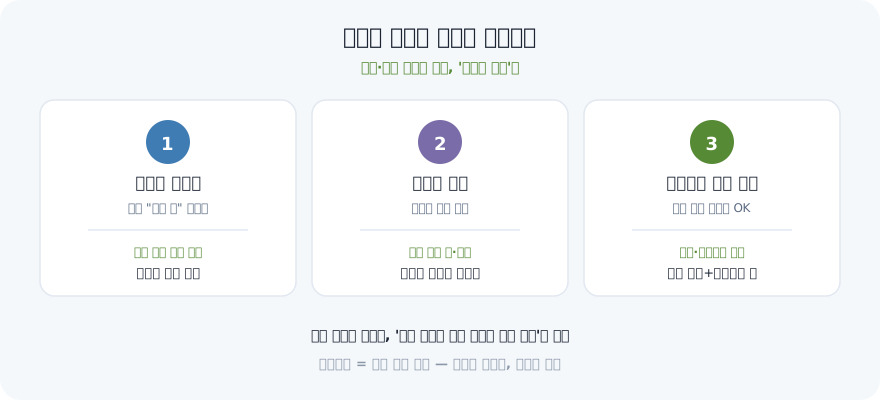
"This year I'll actually read." You buy the book, and within three days it's face-down beside your bed. Yet oddly, sit down at a cafe or library and that same book flows by in an hour — when at home three pages felt like a slog. That gap is exactly the thing you've been getting wrong.
Books don't get read not because your willpower is weak. It's because you tried to read alone, anywhere, anytime. Home is a place where the couch, the remote, the fridge, and every notification all signal "don't read." Trying to open a book on willpower alone in the middle of those signals is why you lose in three days.
A reading cafe — a book cafe, a study cafe, a library, or an online reading group — works for one reason: the environment reads for you instead of your willpower. The seat itself becomes a reading switch, and the people reading alongside you become a deadline. This isn't a nagging "read more" article. It's a 3-step method for holding your reading in place with environment when solo effort keeps failing.
Key takeaways
- Not reading at home isn't willpower, it's an environment problem — home is full of "don't read" signals
- Step 1, space is a switch: sitting in a reading-only seat (a cafe or library spot) flips your brain into reading mode
- Step 2, company is a deadline: alone it becomes "I'll read tomorrow," but a set time and person get you there
- Step 3, an online reading cafe works the same: even without a physical cafe, a check-in group recreates the structure
- The goal isn't a perfect page count but getting to the reading seat — sit down and the reading follows
Why books won't read at home but flow at a cafe
What decides your reading isn't willpower, it's the seat you're in right now. Change the seat and the same person reads the same book differently.
Sit on your couch and there's a remote in view, a phone in hand, a notification every five minutes. Opening a book in that environment is like putting the finish line 100 meters ahead while being yanked the other way each time. Sit down at a cafe seat, by contrast, and the space is laid with a signal: "here, you do something focused." The people around you are each on a laptop or a book; there's no TV, no fridge. Your brain pulls behavior from the place as a cue — bed means sleep, that cafe seat means reading. Psychology calls this a context cue.
Here's the key: people who read well also just stare at their phones on the home couch. The only difference is that they set aside a dedicated reading seat. So they don't have to squeeze out willpower — moving their body to that seat is enough to start reading. (If you have an internal "one page today" system that survives on its own, the reading cafe is the external environment that switches it on. The two are a pair.)
| Reading alone, at home | Reading cafe (space + company) |
|---|---|
| Bed, phone, TV signal "don't read" | The seat itself signals "read" |
| "I'll read later" postpones forever | A set time and person become a deadline |
| No one knows, so skipping goes unnoticed | Eyes reading beside you = gentle enforcement |
| Willpower drops and the day is over | Just getting to the seat restarts you |
| Shelved for good in three days | The seat and group hold your next day |
Step 1 — Space is a switch: pick one reading-only seat
Don't decide to read every single time. Instead of a decision, set one reading seat, and sitting in it is the start.
The first thing to do isn't to build a schedule but to pick one place. A book cafe near home, a corner of a library reading room, a study cafe by your office — choose exactly one as "my reading seat." There are only two conditions: (1) few "don't read" signals like a phone or TV, and (2) a book open within three seconds. Use this seat only for reading (or light study). Start watching YouTube there and the seat's signal gets contaminated.
Do this and the willpower battle of "I really should read today" disappears. What's left is one move: "go to that cafe seat." You've relocated the friction of starting onto a place. Rather than agonizing for 30 minutes at home over "should I read or not," it's far easier to spend those 30 minutes traveling to the seat. (The core of beating three-day quitting is ultimately "reduce friction instead of forcing willpower" — and in reading, that friction is the place.)
Step 2 — Company is a deadline: make a person and a time to read with
Reading alone has no deadline, so it gets postponed indefinitely. A reading cafe's real power isn't the quiet space — it's the eyes reading beside you at the same time.
If space is the switch, company is the deadline. Alone it becomes "I'm tired today, I'll read tomorrow," but "we agreed to read at the cafe Wednesday at 8 p.m." just gets you there. The moment a promised person and time exist, reading shifts from "optional" to "something I said I'd show up for." It doesn't have to be a grand book club. Even agreeing with one friend to "read our own books at that cafe every week" is enough to deliver you to the seat.
Clear up one misconception here: reading together isn't "the pressure of discussing well." Most reading cafes and reading groups are the loose kind where everyone reads their own book and shares a line or two at the end. Low pressure, full deadline effect. For how adult reading groups actually run, see the story of adult book discussion groups; for the difference between paid and free groups, see why paid book clubs actually hold.
Step 3 — Can't go to a physical cafe: build the same structure online
"There's no reading cafe near me," "the times don't work" — that's fine. The two effects, space and company, can be recreated online.
The key was never the physical cafe but the two conditions it created — a "reading-only signal" and "eyes reading with you." Both can be built online. In a Naver reading cafe, a Discord reading room, or an open-chat check-in group, simply posting "I read X pages today" every day creates the "eyes reading with you." An online read-together (study-with-me) where everyone keeps a camera on and quietly reads stands in for the space switch too.
You can mimic this at home. (1) Designate one "reading-only seat" inside your home (the end of the table, a chair by the window — phone in another room), and (2) check in to an online group with what you read there, and the space-plus-company structure is complete without a physical reading cafe. What matters isn't the name of the place but the structure: "a reading seat + eyes watching me." (Add reading that turns into action and the check-in becomes practice, not just a brag.)
The 10-minute setup you can do today
You have enough information. Spend exactly 10 minutes today, in this order.
- Pick one reading seat. Exactly one of a cafe, library, or study cafe near you. If none, designate a "reading-only seat" at home (phone in another room).
- Nail the first day and time into your calendar. "This Wednesday, 8 p.m., that seat." A date and time, not a vague "sometime this week."
- Get one set of eyes to read with. One friend, or one online reading cafe or check-in room. Choose someone to report "X pages today" to.
- Make getting to the seat the only goal. Don't set a page count. Sit down and the reading follows.
Set up these four and the next evening of "I should read today" while scrolling on the couch disappears. What matters isn't "how many books this year" but a structure that delivers you to the reading seat. With a seat and company, the book opens even on a day your willpower is empty. 🌱
🌱 Doing it with VisionDream
Reading, too, is environment and company, not willpower. VisionDream builds the "eyes reading with you" that a reading cafe provides right into the app. With teams, leaderboards, and challenges, checking each other's practice with people reading alongside you brings back the deadline that vanishes when you're alone — the "eyes reading with you" carry online even without a physical cafe. Put "go to the reading seat" into the action (habit check) of the Today tab (daily B·T·A) and it's not about how many pages but whether you got to the seat, logged in one daily check, while the calendar heatmap shows which weekday you skip the seat. And when you miss the seat for a day, two streak protection passes used automatically each month keep your streak alive and stop the "this week's a write-off too" self-blame.
Before you buy one more book, build the seat and the company to read in first. The app is the tool; you're still the one walking to the seat. Plant your vision, and the fruit will come. 🌱
Frequently Asked Questions
I can't read at home but read well at a cafe. Is something wrong with me?
Not at all — it's a natural effect. What decides your reading isn't willpower, it's the seat you're in. Home is full of 'don't read' signals like the bed, phone, and TV, while a cafe or library seat carries a context cue that 'here you do focused work,' flipping your brain into reading mode. That's why the same person reads the same book differently just by changing seats. Don't blame willpower — set aside one reading-only seat.
There's no reading cafe near me. Can I still use this method?
Yes. The key isn't the physical cafe but the two conditions it creates — a 'reading-only signal' and 'eyes reading with you.' Designate a phone-free 'reading-only seat' at home, and check in daily with 'I read X pages today' in an online group like a Naver reading cafe, a Discord reading room, or an open-chat check-in room, and the same structure is complete. An online read-together where everyone quietly reads on camera stands in for the space switch.
Reading groups feel intimidating — I'd have to be good at discussion.
Most reading cafes and reading groups aim not at discussion but at 'a seat to read together.' Many are the loose kind where everyone reads their own book and shares a line or two at the end — low pressure, full deadline effect. Don't hunt for a grand club; even agreeing with one friend to 'read our own books at that cafe every week' delivers you to the seat.
How does the VisionDream app help without a reading cafe?
VisionDream builds a reading cafe's two effects into the app. Teams, leaderboards, and challenges let you check practice with people reading alongside you, recreating the 'eyes reading with you' online, and the habit check in the Today tab (daily B·T·A) lets you log whether you got to the reading seat once a day. The calendar heatmap shows which weekday you skip the seat, and two streak protection passes used automatically each month keep your streak alive when you miss a day, stopping the self-blame.
Plant a vision, and fruit will surely grow 🌱
Start in the app →Related posts
- ⏰How to Stop Procrastinating — Break the Habit With Systems, Not Willpower
- 🌙The Evening Routine — Ten Minutes Tonight Decides Tomorrow Morning (4-Step, 10-Minute Checklist)
- 🌙How to Do a 5-Minute Daily Review — Stop Grading 'What You Didn't Do' (3-Line Format + Timebox)
- 📔Before You Buy a Planner — 3 Checks That Decide Whether You Finish the Year