I Put It Off Again Today — Diagnose Why You Procrastinate, Then Fix That
It's late again. The thing you meant to do all day is still sitting there, untouched, and now you're lying in bed running the same tape: What is wrong with me? You put it off again today — and then you spent the night punishing yourself for it, which is somehow more exhausting than the work would have been.
Here's the part nobody tells you: you're not lazy. Procrastination researchers keep landing on the same conclusion — it's a mood-repair problem, not a time-management problem. You're not avoiding the task. You're avoiding a feeling the task gives you. And that's good news, because it means the fix depends entirely on which feeling it is. Four people can all be "procrastinating" for four completely different reasons — which is exactly why one-size advice ("just start!") bounces off three of them.
Key takeaways
- Procrastination is emotional avoidance, not laziness — you're dodging a feeling, not a task
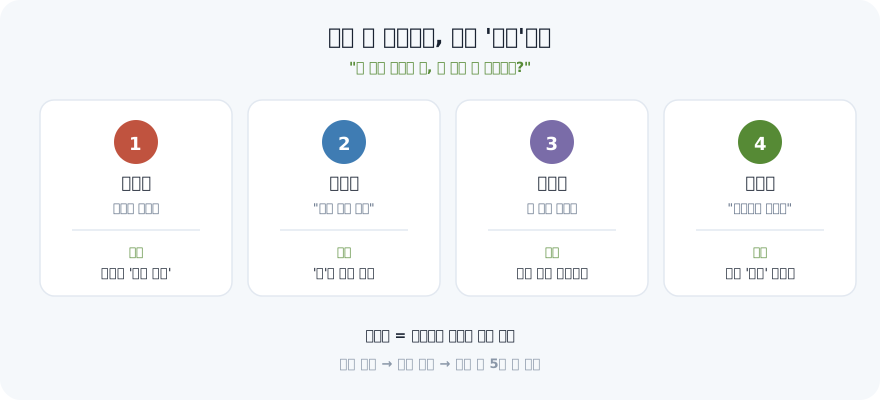
- There are 4 types: anxiety, boredom, burnout, and overwhelm — each needs a different fix
- One honest question diagnoses you: "What do I feel in my body when I picture the task?"
- The wrong prescription is why nothing has worked yet — matching it is why it finally will
- Whatever your type, the last step is the same: one 5-minute action, tonight
First: stop asking "why am I so lazy?"
That question has no useful answer. It's not a diagnosis, it's a verdict — and verdicts make you feel worse, which makes you avoid harder. That's the loop: avoid → guilt → more avoidance. The guilt isn't the cure for procrastination; it's the fuel.
So swap the question. Instead of "why am I like this?", ask: "What do I feel in my body the moment I picture doing this?" That single question is a diagnostic instrument, and the answer tells you which of the four you're dealing with.
The 4 types — find yours
| When you picture the task, you feel… | Your type | What you're really avoiding | The fix that works |
|---|---|---|---|
| Chest tightens, stomach drops | Anxiety | Doing it badly / being judged | Deliberately do a bad first version |
| Heavy, dull, "ugh" — you reach for your phone | Boredom | Meaninglessness | Reconnect it to a why |
| Empty, numb, no fuel at all | Burnout | Depletion (not the task) | Recover first — cut, don't push |
| Head spinning, "where do I even start" | Overwhelm | Ambiguity | Name the next physical action |
Read the middle column again. Every one of them is a feeling, not a workload. That's the whole thesis.
Type 1 — Anxiety: you're afraid of doing it badly
Signs: you clean your desk instead. You "research" for three hours. You've rewritten the first sentence nine times. The task is usually something that gets evaluated.
Why it happens: your brain has quietly merged the quality of this work with your worth as a person. Under that math, not starting is safer than starting badly — because an unwritten thing can still be brilliant.
Prescription: give yourself permission to produce something bad, on purpose. Set a timer for 15 minutes and write the deliberately terrible version — the one nobody will ever see. The goal isn't quality; it's breaking the spell that says the first attempt must be the final one. Perfectionism is procrastination wearing a nicer outfit, and letting go of perfectionism is the actual unlock here.
Type 2 — Boredom: it feels pointless
Signs: you don't feel dread, just a heavy "meh." You'd rather do literally anything else — including chores you also hate. You keep asking does this even matter?
Why it happens: the task got disconnected from anything you care about. Your brain refuses to spend energy on something with no visible payoff. That's not a defect; that's economics.
Prescription: don't push harder — re-link it. Write one sentence: "I'm doing this because ___." If you can't finish that sentence honestly, that's your real answer, and the task should be renegotiated, delegated, or dropped. If you can finish it, connect the boring task upward to the goal it serves, and make the goal concrete enough to feel real — that's exactly what SMART goal setting is for. A chore attached to a vision stops being a chore.
Type 3 — Burnout: the tank is empty
Signs: it's not just this task — it's everything. Rest doesn't restore you. You feel guilty and numb at the same time. This is the type most often misdiagnosed as laziness, and it's the one where "just push through" does real damage.
Why it happens: you're not out of discipline, you're out of fuel. Discipline runs on energy; you can't spend what you don't have.
Prescription: the counterintuitive one — subtract instead of add. Cut the list to the one thing that genuinely can't wait, and let the rest be late on purpose. Then stop the self-attack, because self-criticism burns the very energy you need to restart. This is where self-compassion isn't a soft nice-to-have — it's the fastest route back to being able to act at all. Treat yourself like someone you're responsible for helping, and the fuel comes back.
Type 4 — Overwhelm: you don't know where to start
Signs: the task is a giant vague noun. "Do taxes." "Job search." "Fix my health." You feel busy and paralyzed at once, and you keep re-reading the to-do without touching it.
Why it happens: it isn't one task, it's twelve tasks in a trench coat — and your brain can't run a project, only an action.
Prescription: stop planning and name the next physical action — the one you could do with your hands in the next five minutes. Not "do taxes," but "open the folder and find last year's return." Not "job search," but "open a doc and title it Résumé." Then do only that. Momentum is manufactured, not summoned — which is the quiet power of small wins. And once that first action is under way, protect it: a 25-minute block with your phone out of reach is how the started thing actually finishes, as laid out in deep work.
The 5-minute routine that works for all four
Once you know your type, the entry ramp is identical. Tonight, do this — it takes five minutes. (To make those five minutes a nightly fixture, see the 10-minute evening routine — writing tomorrow's first action the night before is the load-bearing line.)
- Write the task down as a sentence (60 sec). Vague things live in your head rent-free; written things get handled.
- Ask the diagnostic question (30 sec): what do I feel in my body when I picture it? Anxiety, boredom, emptiness, or confusion?
- Apply the matching prescription (60 sec): bad first draft / find the why / cut the list / name the next physical action.
- Shrink it to one 5-minute step and put it on tomorrow's list (60 sec).
- Decide the recovery rule (30 sec): if I miss tomorrow, I resume the next day. No guilt tax. No starting over.
That last step is the one people skip, and it's the one that decides whether this becomes a system or another abandoned resolution. If you want the deeper machinery behind it — shrinking the task, designing the environment, and beating avoidance with structure instead of willpower — read how to stop procrastinating with a system next. Diagnosis tells you what's wrong; that system keeps you moving after you know.
🌱 Put it into practice with VisionDream
The reason a diagnosis fades by morning is that it never lands anywhere. In VisionDream, the five-minute version of the thing you've been avoiding goes into the Today tab as a habit or task (B·T·A — Belief, Thinking, Action), and the calendar heatmap turns each check into momentum you can see. Because you get two streak protectors every month — used automatically when you miss a day — a single slip can't trigger the guilt spiral that made you procrastinate in the first place. And since every task links up to the goal and vision above it, the boredom type never has to wonder what it's for.
So don't end tonight with another verdict about yourself. Take five minutes, name the feeling, and write down the one small thing you've been putting off. Plant your vision, and the fruit will come. 🌱
Frequently Asked Questions
Why do I procrastinate even when I know exactly what to do and want to do it?
Because procrastination isn't a knowledge or time-management problem — it's emotional. You're not avoiding the task, you're avoiding a feeling the task triggers: anxiety about doing it badly, boredom because it feels pointless, emptiness from burnout, or confusion because it's too vague. Knowing what to do doesn't help when the block is a feeling, which is why you have to name the feeling first.
How do I know which type of procrastinator I am?
Ask one question: what do you feel in your body the moment you picture doing the task? A tight chest means anxiety (fear of doing it badly). A heavy 'ugh' means boredom (it feels meaningless). Numb emptiness means burnout (you're out of fuel, not discipline). A spinning head means overwhelm (the task is too vague). Each type needs a different fix, which is why generic advice usually fails.
Am I burned out or just lazy?
Check whether it's task-specific or global. Laziness or avoidance usually attaches to one dreaded task while you happily do other things. Burnout is everywhere — nothing feels rewarding, rest doesn't restore you, and you feel numb and guilty at the same time. If it's global, pushing harder makes it worse. Subtract from your list, protect your recovery, and stop the self-criticism that burns the energy you need to restart.
What should I do tonight if I procrastinated all day again?
Skip the self-blame — the guilt is what fuels tomorrow's avoidance. Instead take five minutes: write the task as a sentence, ask what you feel when you picture it, apply the matching fix (a deliberately bad first draft, reconnect it to a why, cut your list, or name the next physical action), shrink it to a 5-minute step on tomorrow's list, and decide in advance that missing a day doesn't reset anything.
Plant a vision, and fruit will surely grow 🌱
Start in the app →Related posts
- ⏰How to Stop Procrastinating — Break the Habit With Systems, Not Willpower
- 🌙The Evening Routine — Ten Minutes Tonight Decides Tomorrow Morning (4-Step, 10-Minute Checklist)
- 🌙How to Do a 5-Minute Daily Review — Stop Grading 'What You Didn't Do' (3-Line Format + Timebox)
- 📔Before You Buy a Planner — 3 Checks That Decide Whether You Finish the Year