Adult Book Discussion Groups: Read Alone and You Last 3 Days — Read Together and You Last 3 Years
Anyone can make a reading plan for the days that go well. What you actually need is a structure that opens the book on the days you don't feel like it.
How many books on your shelf stopped at page 20? You bought them on a day motivation was high — and they closed the moment it faded. So you finally join a book club, and hit a different wall: you sit silent for 90 minutes because you don't know what to say, and quietly stop showing up. Or you do finish a book, and a month later you can't recall what it said, and nothing in your life is different.
These three failures share one cause. You left reading up to willpower. An adult book discussion group isn't a hobby — it's a system that replaces willpower.
Key takeaways
- You're not lazy — you have no deadline and no audience. A discussion group supplies both, from outside you
- Reading alone collapses the week after the resolution; a fixed day with fixed people turns reading into a schedule
- You go silent in groups not because you're shy but because you have no prep structure — 3 questions fixes it
- A 30-second, 3-part comment (quote → your reaction → hand it back) is enough. Don't try to summarize
- Always land the discussion on one action. Without it, all you keep is the feeling of having read
Why alone lasts 3 days and together lasts 3 years
When you read alone, reading has no deadline and no witness. The cost of not reading is zero. But if six people meet Thursday at 8pm to discuss through chapter 3, not reading suddenly has a price — a small, certain one: awkwardness.
This isn't a discipline problem, it's a design problem. A discussion group does exactly three things:
- It creates a deadline (the next meeting = forced pace)
- It creates an audience (someone notices whether you showed up)
- It creates an output (you have to speak, so you read while thinking)
The third one is decisive. When you read knowing you'll have to talk, your brain flips from scanning mode to sorting mode. Same book, entirely different residue.
| Reading alone | Book discussion group | |
|---|---|---|
| Deadline | None (forever "this weekend") | Next meeting = hard deadline |
| Cost of not reading | Zero | Awkwardness (small but certain) |
| Reading mode | Skimming with your eyes | Choosing what you'll say |
| Blind spots | You never learn you misread it | Others' readings correct yours |
| After 3 months | Can't recall how many you read | 12 books × conversation = it sticks |
| Sustainability | Only while motivation lasts | As long as the day is on the calendar |
Willpower is a volatile resource. A system isn't. It's the same reason small wins beat grand resolutions — what wins is always the structure that runs on your worst days.
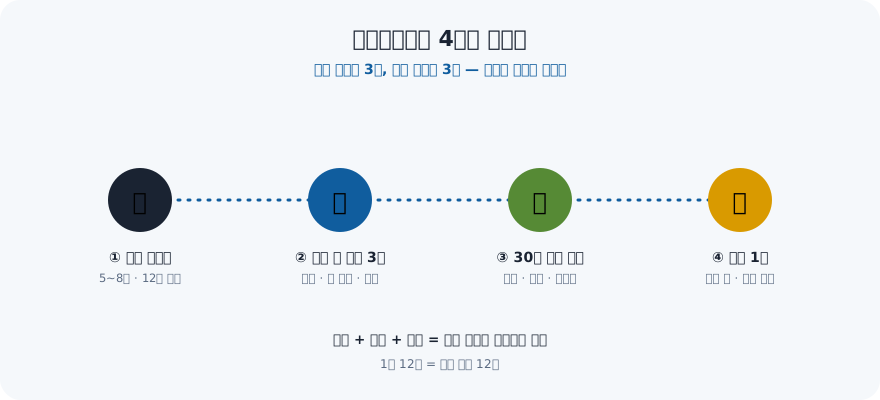
① Pick the group — 90% of the outcome is decided here
If you quit after a bad first meeting, you didn't fail at reading. You picked the wrong group. Check four things before you commit.
| What to check | What goes wrong | Your standard |
|---|---|---|
| How books are chosen | A book you don't care about = you don't read, then don't go | Voting or rotation > one leader deciding |
| Group size | 12 people = zero airtime; 3 = pressure to never miss | 5–8 people balances airtime and stability |
| Format | Open debate = only confident talkers speak | Round-robin turns favor beginners |
| Cadence & day | Biweekly loses the thread; late weeknights get skipped | A day you can attend 12 weeks straight |
Free and paid groups behave differently: free is easy to enter, but the cost of skipping is also zero, so it quietly dies. Paid groups buy you attendance (see what a paid book club is really worth). For finding a local group, see how to choose a neighborhood book club.
If you keep only one criterion: "Can I attend this 12 weeks in a row?" If the answer is no, it's not the right group for the life you have right now — no matter how good it looks.
② Before you read — write 3 questions (the real cure for silence)
You don't stay quiet because you're introverted. You stay quiet because you only read. With no prep, all you have is a hazy plot, so you attempt a summary, fail, and shut down.
The fix is almost embarrassingly simple. Before reading, write 3 questions in your notes app, and read hunting for sentences that answer them.
- "What do I want to get from this book?" — your purpose. One sentence.
- "Which passage touches my actual situation?" — the seed of a story only you can tell. It will never overlap with anyone else's.
- "Where do I want to argue with the author?" — agreement ends conversations; disagreement starts them. It's the most welcome kind of comment in any discussion.
When you hit a sentence that answers one of these, underline it with the page number. That's the whole preparation. Those three lines will carry you through all 90 minutes.
③ During the discussion — speak in a 30-second, 3-part structure
Beginners collapse under one false belief: I have to summarize the book well. Nobody wants a summary. Everyone read it. What people want to hear is what the book did to you.
The 30-second formula ① Quote — "On page 38 there's a line that says '…'" ② Your reaction — "It reminded me of something that happened at work last month. (2–3 sentences)" ③ Hand it back — "How did the rest of you read that part?"
The power is in step ③. Ending with a question passes the ball, and in that instant you stop being "the quiet one" and become the one who opens the conversation. Do it three times and you'll see: the silence was never your personality. It was a missing format.
Three safe cards when you have nothing to say: ① "Honestly, I don't get why this book is praised" (honest dissent is always welcome) ② "I'd like to hear more about the part you just mentioned" ③ "Has anyone actually tried the advice in this book?"
④ After the discussion — land it on one action
This is what almost every book club misses. Ninety minutes of great conversation, and everyone goes home with nothing changed. Insight is not action. You can understand a book perfectly and live next week exactly as you lived last week — the same trap described in why finishing books changes nothing.
So before you get home, write one sentence.
"One action I'll actually take this week, from this book: ______"
Two conditions only: this week, and small enough that you cannot fail. If the book said "attention is a form of love," the action is "→ leave my phone in another room during dinner this week." One book = one action. Read 12 books a year and 12 actions stay in your life. Twelve changed behaviors beat twelve finished books every time.
Anchor that action right after a habit you already have, or it evaporates — that's how identity-based habits work. Keep all the pleasure of deep reading and just add a landing strip, which is the same move described in the one step missing from deep reading.
5 common mistakes in adult book discussions
- Thinking you must finish the book to attend → Go having read half. The unread member's honest question often saves the discussion. Skipping is the worst option.
- Preparing a summary → Nobody listens to it. Prepare one piece of your own story instead.
- Only saying nice things → Unanimous agreement isn't a conversation, it's a greeting. One dissent saves 90 minutes.
- Choosing books that are too hard → For the first 3 months, pick readable books. The goal isn't knowledge, it's the attendance habit.
- Ending when the meeting ends → With no action, all you keep is the feeling of having read.
Do exactly one thing today
You have enough information. Now do one thing.
Open the book you're currently reading (or abandoned), and write those 3 questions in your notes app. Three lines, three minutes. It works even without a group — those lines flip reading from scanning mode to sorting mode. Then, this week, search for exactly one candidate group and put it on your calendar. Not three. One.
🌱 Put it into practice with VisionDream
Add the one action from your discussion to VisionDream's Today tab as a habit — you'll check it daily and watch it fill in on the calendar heatmap. Make attending the meeting your weekly planner's One Thing so it survives busy weeks, and if you miss a day, the 2 monthly streak shields (applied automatically) keep your streak from collapsing entirely. In Sunday's weekly review, write one line about what you actually did from this month's book — 12 weeks later, you'll see exactly what changed.
You were never failing from lack of willpower. You were missing the system that protects reading. Plant your vision, and the fruit will come. 🌱
Frequently Asked Questions
I'm not good at speaking up in a book discussion. Is that a problem?
No. Silence is a preparation problem, not a personality problem. Before reading, write 3 questions (what I want from this book; which passage touches my situation; where I want to argue with the author) and underline the matching sentences with page numbers. Then speak in a 30-second, 3-part structure: quote, your reaction, hand it back with a question. Nobody wants a summary — everyone read the book already.
Should I go if I haven't finished the book?
Yes. Skipping is far worse than not finishing. If you read half, talk about the half you read — and an unread member's honest question often revives a stalled discussion. Miss once and missing twice gets easier, which is how groups quietly die. Attendance, not pace, is what protects the system.
I keep joining groups that don't fit. What should I look for?
Four things: how books are chosen (voting or rotation beats one leader deciding), size (5–8 people balances airtime and stability), format (round-robin turns favor beginners over open debate), and cadence (a day you can attend 12 weeks straight). That last question alone eliminates most bad fits.
I discuss books but my life doesn't change. Why?
Because the discussion never lands on an action. Before you get home, write one sentence: 'One action I'll take this week from this book.' Two conditions — this week, and small enough that you cannot fail. Anchor it right after an existing habit so it doesn't evaporate. Twelve books a year becomes twelve changed behaviors, which is worth far more than a finished-book count.
Plant a vision, and fruit will surely grow 🌱
Start in the app →Related posts
- 📚How to Find a Book Club in Your Neighborhood — And Start One If There Isn't
- 📲Goal-Tracking Apps — How to Pick One and Actually Finish Your Yearly Goals
- ⏰How to Stop Procrastinating — Break the Habit With Systems, Not Willpower
- 🖼️How to Make a Digital Vision Board on Your Phone (So You Actually See It Daily)